49 works in this view — arrow keys or swipe to move between them.
Dance in Art
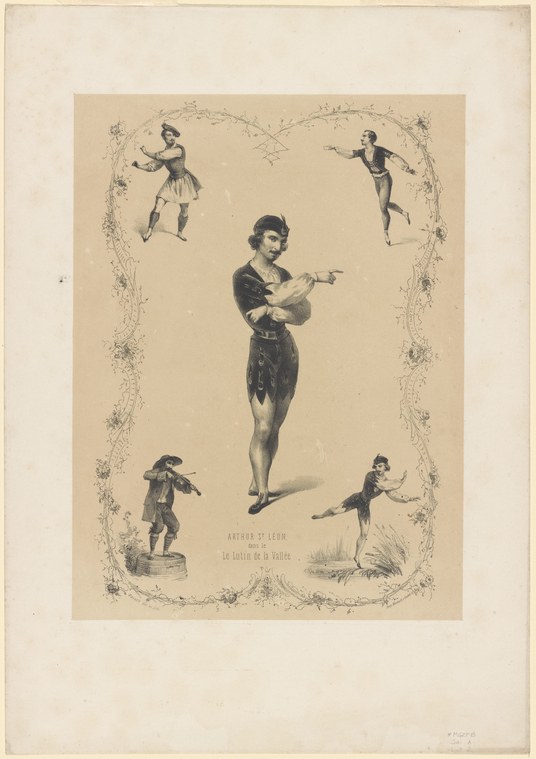
Arthur St. Léon, dans le Le lutin de la vallée
Unknown artist
- Collection:
- Prints depicting dance
- Source:
- New York Public Library
- Rights:
- Public domain — free to use, share and adapt.
- Recorded as:
- Public Domain
This image is a rare documentary record of a specific male dancer's technique and stage presence in the Romantic ballet period, capturing not a generalized idea of ballet but a named performer in a named role. For historians of 19th-century dance and practitioners of Romantic technique, it offers evidence of posture, arm carriage, and the visual ideal of the male dancer during a transformative moment in ballet history. The print also demonstrates how dance was circulated and consumed as visual culture in the 19th century—through theatrical portraiture distributed to an urban audience.
What you are looking at
A central male dancer in dark costume dominates the composition, posed frontally with arms raised in a graceful, lyrical position suggesting lightness and elevation. He wears what appears to be a short tunic or doublet with tights, characteristic of mid-19th-century theatrical male ballet dress. Around him, arranged in an ornamental frame of delicate vines and flowers, four smaller figures demonstrate variations of the same pose or related movements—two above and two below—suggesting either different moments in a sequence or the range of expression within a single choreographic theme. The entire composition is enclosed within an elegant printed border of intertwining botanical ornament. The background is plain and neutral, focusing all attention on the bodies and their geometry.
The dancing
The central figure stands in a nearly vertical line with weight centered, both arms raised and curved in a classical port de bras that suggests ethereal quality and control. The torso is upright and stable. The four surrounding figures repeat or vary this upper-body clarity—raised arms, curved carriage—indicating a single dancer studied from different moments or attitudes. All figures are depicted with the anatomical precision of academic training; the line from foot through torso to fingertips is continuous and deliberate. This is distinctly a soloist's study, not a group dance or partnered work.
The dance depicted
This is a Romantic-era ballet study, most likely depicting a character or solo from a specific work. The inscription references Arthur St. Léon and a piece titled *Le Lutin de la vallée* (The Valley Sprite), identifying this as documentation of a mid-19th-century theatrical ballet. St. Léon was a celebrated dancer and choreographer of the 1840s–1860s; *Le Lutin de la vallée* appears to be a ballet in which he danced a principal role. The pose and treatment suggest a lyrical male solo emphasizing line, elevation, and an almost ethereal or supernatural quality befitting a sprite or spirit character. The repeated studies around the border may represent either the dancer's preparation, key moments in the variation, or stylistic alternatives.
How it was made
This is a wood engraving or steel engraving, recognizable from the fine parallel hatching lines that model form and shadow, the precision of the printed line, and the delicate ornamental border. The technique allows for wide reproduction and circulation—this was a commercial print, likely issued as a souvenir or advertisement in relation to a theatrical production or the dancer's reputation. The clarity and finish suggest professional printmaking, probably French, consistent with the Parisian ballet world of the 1840s–1850s. Engraved prints of this kind were distributed to theater-goers and collectors interested in fashionable dancers.
About this work
This is a mid-19th-century engraved study of Arthur St. Léon, a celebrated male dancer of the Romantic ballet era, in a role from the ballet *Le Lutin de la vallée*. The work documents not only a specific costume and pose but also the refined, elevated aesthetic of Romantic male dancing—a period in which the male dancer's role was shifting toward supporting the ballerina while retaining moments of lyrical, otherworldly solo brilliance. The composition itself—a central figure surrounded by ornamental studies—follows the aesthetic conventions of the period's theatrical portraiture, treating the dancer as both artist and subject of refined aesthetic interest. The botanical frame and careful finish place the work within a broader 19th-century tradition of engraved celebrity portraiture and souvenir prints.
How to look at it
Attend to the pose itself: the raised arms and centered weight suggest a moment of suspension or weightlessness—not a traveling step, but an attitude of being. The ornamental surround, rather than contextualizing the dancer in a narrative scene, abstracts the pose into a study of form and line. Notice how the smaller figures are not miniatures but full studies; they indicate either the range of expression within a single role or the dancer's own range of technique. The print medium's precision allows you to read the musculature and line of the body clearly, as if the engraver were analyzing the dancer's construction. This is portraiture, but portraiture of the body as instrument.
The artist
The artist is not recorded in the catalogue. The style and finish are consistent with professional Parisian theatrical engraving of the 1840s–1850s. Such prints were often produced by multiple hands (designer, engraver, publisher) and issued without attribution to individual artists. The work was likely commissioned by the theater, the dancer, or a commercial print publisher capitalizing on St. Léon's celebrity.
The period
The mid-19th century saw Romantic ballet at its height, with emphasis on ethereal, otherworldly female characters (sylphs, spirits, peasant heroines) in pointe work. Male dancers occupied a more ambiguous position: they were essential as partners and pantomimists but often sidelined in solo display. St. Léon's career (1815–1870) spanned this period; he was known as a brilliant technician and for his work as both performer and choreographer, creating ballets that showcased varied styles and national dances. *Le Lutin de la vallée* fits the romantic fairy-tale tradition popular in 1840s Paris. Theatrical engraving was a major medium for celebrity portraiture and dance documentation before photography became dominant; prints were mass-produced, affordable, and essential to how performers built and maintained their public image.
Where it lives
This engraving is held in the New York Public Library's collection of prints depicting dance. It is a commercial theatrical print, likely issued in Paris or London in the 1840s–1850s, as a souvenir or publicity item related to performances in which St. Léon danced.
Dance in this work
Questions about this work
Who was Arthur St. Léon?
Arthur St. Léon (1815–1870) was a French dancer, choreographer, and ballet master of the Romantic era. He was celebrated for his technical skill, versatility in multiple dance styles, and his choreographic innovations. He danced across Europe and created numerous ballets, many of which toured internationally. He is remembered as a bridge figure between Romantic and later 19th-century ballet aesthetics.
What is a Romantic ballet sprite or fairy character?
In Romantic ballet (1830s–1850s), supernatural or otherworldly characters—sylphs, sprites, undines, naïads—were central to the genre's themes and visual appeal. These characters were typically portrayed by female dancers in pointe work, but male characters (often sorcerers, spirits, or enchanted princes) also occupied this aesthetic space. The elevated, ethereal posture seen here is characteristic of how such beings were visually rendered on stage.
Why were male ballet dancers important in the 19th century if the focus was on women?
Male dancers remained essential as partners, pantomimists, and occasional soloists, though the era's aesthetic increasingly prioritized the female dancer's lightness and otherworldliness. Celebrated male dancers like St. Léon built careers through superior technique, versatility (including non-ballet forms like Spanish dance or character work), and charisma. Male-centered roles—particularly exotic or comedic parts—allowed male dancers to remain visible and valued.
How were engraved prints like this used?
Theatrical engraved prints were sold as souvenirs outside theaters, through print shops, and by mail subscription. They served as advertisements for performances, souvenirs for fans, and collectibles for those interested in fashionable entertainment. They were affordable (compared to paintings), reproducible, and essential to how theaters and performers built their public image before photography became dominant in the 1860s onward.
More dance artwork





