49 works in this view — arrow keys or swipe to move between them.
Dance in Art
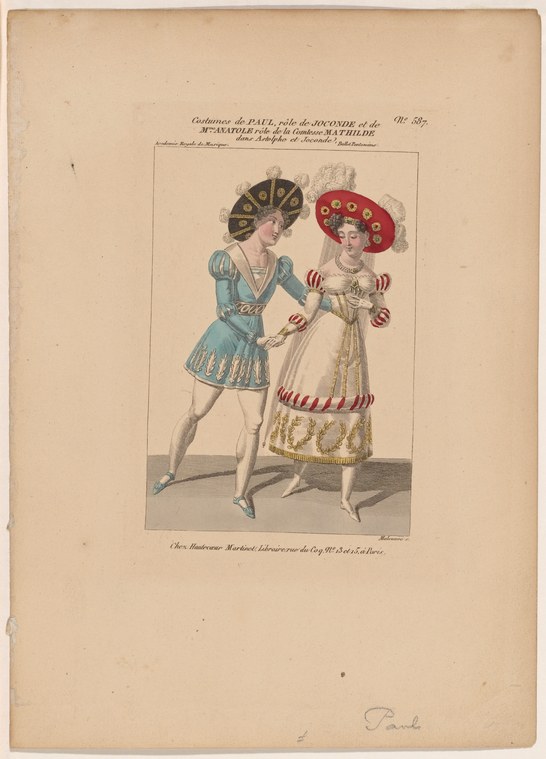
Costumes de Paul, rôle de Joconde et de Mme Anatole, rôle de la comtesse Mathilde, dans Astolphe et Joconde: ballet pantomime, Académie Royale de Musique
Unknown artist
- Collection:
- Prints depicting dance
- Source:
- New York Public Library
- Rights:
- Public domain — free to use, share and adapt.
- Recorded as:
- Public Domain
This work is a rare documented image of French court-derived theatrical ballet at the moment it was professionalizing as a distinct art form. The engraved costume study allowed knowledge of stage dance and fashion to circulate beyond the theatre, making the practice of professional dancers visible to a wider public. The quality of the rendering—the careful attention to the dancers' lifted carriage and extended leg positions—shows that engravers of the period understood and could represent ballet technique, preserving technical information that would otherwise be lost.
What you are looking at
Two figures occupy a shallow stage space rendered in hand-colored engraving. On the left, a male dancer in a short tunic of pale blue with gold trim and a black feathered headdress stands in profile, his right leg extended in a high battement or développé toward the female figure. She wears a high-waisted white gown with crimson hem decoration and gold ornaments, topped by an elaborate red feathered headdress that rises above her head. Both figures are poised in moment of courtship or dramatic encounter—his gesture is active and reaching; her posture is more restrained, though she holds her arms aloft in a balanced frame. The stage floor is rendered as a thin line; there is no architectural setting, allowing the figures and their rich costumes to command full attention. The color is restrained and flattering, with particular emphasis on the baroque extravagance of the headpieces.
The dancing
The male dancer is shown in a single active line: his left leg supports his weight while his right leg is lifted high in a balletic extension, his torso and arms reaching toward his partner. The female dancer faces him with both feet planted, her arms raised in a balanced pose at roughly shoulder height, with hands articulate and expressive. There is clear spatial relationship between them—a moment of approach and response. Both figures show the turned-out carriage and lifted posture conventional to stage dance of the baroque and rococo periods; the male figure especially demonstrates the kind of elevated, extended leg position that would become fundamental to ballet technique.
The dance depicted
This is a costume study for a character in *Astolphe et Joconde*, a ballet-pantomime performed at the Académie Royale de Musique (Paris Opéra). The image shows the roles of Paul as Joconde (left) and Mme Anatole as the Countess Mathilde (right). The work appears to document a moment of dramatic interaction or courtship between two characters—consistent with pantomime ballet, which told stories through expressive gesture and stylized movement. The elevated leg position, turned-out carriage, and balanced arm positions all reflect the conventions of French court dance and early theatrical ballet of the late 18th century. Without access to the choreography or libretto, the specific steps cannot be named, but the pose suggests a moment of romantic or dramatic climax.
How it was made
This is a hand-colored engraving, a common format for disseminating images of stage costume and performance in 18th-century France. The engraving was executed (likely from a drawing or painting) and then colored by hand, a practice that allowed multiple copies to be made and circulated among the aristocratic and theatrical public. The print medium meant that images of theatrical costume could reach audiences who might not attend the opera house, serving both as advertisement and as a record of the designer's invention. The restraint of the palette and the clear linear definition of the figures—typical of rococo engraving—would have made reproduction and hand-coloring efficient.
About this work
This hand-colored engraving documents a moment from *Astolphe et Joconde*, a ballet-pantomime at the Paris Opéra, showing the costumes and poses of two principal dancers. It is a costume study of the kind that circulated in prints, preserving both the designer's vision and a record of how these narrative ballet roles were physically presented on stage. The work sits at the intersection of fashion plate and performance documentation: the elaborate headdresses and jeweled trim of the costumes are rendered with the same attention to luxury and ornament as a couture illustration, while the dancers' poses and carriage record actual theatrical practice.
For dance history, this image is valuable precisely because it captures a historical moment in the evolution from court dance to theatrical ballet. The costumes—particularly the male dancer's short skirt and turned-out stance—mark a transitional aesthetic: neither entirely the baroque nor yet the Romantic tutus of the 19th century. The print format means this image was accessible not only to the Paris elite but to a broader public interested in fashion, theatre, and the spectacle of the Opéra.
How to look at it
Notice the specific moment the artist chose to freeze: not a static pose but a moment of interaction, with the male dancer's high extension and reaching gesture creating a diagonal line of energy. Observe how the headdresses—the male's black and feathered, the female's towering and ornate in red—dominate the composition and read as markers of theatrical luxury and status. The turned-out positions of both dancers and their lifted spines show the artist's knowledge of the aesthetics of the stage and the expectations for bodily carriage in theatrical dance. The lack of a floor or setting focuses the viewer entirely on the figures and their costumes, suggesting that this is a study meant to circulate among those interested in costume design and stage practice.
The period
This print dates to the late 18th century, when the Académie Royale de Musique was the center of European theatrical dance and the primary incubator of ballet technique. At this moment, ballet was transitioning from a form embedded in the court and carnival to a professional theatrical art with its own schools, hierarchy, and public. Narrative ballet-pantomime—where a story was told through dance and gesture rather than sung dialogue—was a dominant form. The period saw increasing standardization of technique and terminology (what would eventually become the codified steps of classical ballet), and the costume itself was beginning to evolve toward the lighter, more elevated aesthetic of the Romantic era. Engraved images of costume and performance were important media for disseminating knowledge of theatrical fashion and dance practice across Europe.
Where it lives
Held by the New York Public Library in the Prints Depicting Dance collection. This is a printed engraving with hand-coloring, a format typical of 18th-century theatrical publicity and fashion documentation.
Dance in this work
Questions about this work
What is a ballet-pantomime?
A ballet-pantomime was a theatrical form in which dancers told a story through a combination of stylized gesture and dance movement, without sung dialogue. Developed in France in the 18th century, it allowed for narrative and dramatic expression while showcasing the technical accomplishments of professional dancers. By the late 18th century, ballet-pantomime was the dominant form at major opera houses.
How do we know what the roles in this ballet were?
The title inscription at the top of the print identifies the characters and dancers: 'Costumes de Paul, rôle de Joconde et de Mme Anatole, rôle de la comtesse Mathilde.' This is a printed costume study, so the inscription is integral to the work and names the performers and their roles in the ballet *Astolphe et Joconde*.
Was this ballet actually performed?
The title page references the ballet as a work at the Académie Royale de Musique (the Paris Opéra), but the specific production history and dates are not confirmed in the current record. The existence of this printed costume study suggests the ballet reached a level of production and publicity that merited engraved documentation, which was an investment usually reserved for works of significance.
Why are the headdresses so elaborate?
Headdresses were a central element of 18th-century theatrical costume, signaling character, status, and nationality through their height, ornamentation, and styling. They were also essential for visibility in large theaters lit by candles, where the silhouette and outline of a dancer needed to read from a distance. The elaborate feathering and jeweled work visible here marks these as high-status characters and expensive productions.
More dance artwork





