49 works in this view — arrow keys or swipe to move between them.
Dance in Art
The three graces
Unknown artist
- Collection:
- Prints depicting dance
- Source:
- New York Public Library
- Rights:
- Public domain — free to use, share and adapt.
- Recorded as:
- Public Domain
The work is an invaluable record of how the ballet world of the 1840s–1860s imagined and costumed classical subjects. For dancers and choreographers, it shows what the "classical" vocabulary looked like in practice—not ancient Greek movement, but contemporary ballet technique applied to mythological figures. For historians, it demonstrates how reproductive prints shaped public understanding of ballet, since for most people this engraving would have been the only image of such scenes they ever saw.
What you are looking at
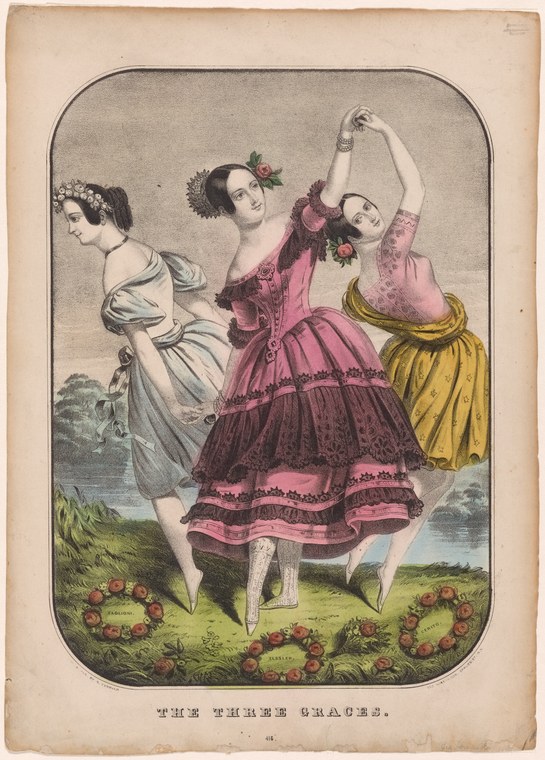
Three young women in classical dress occupy a sunlit pastoral landscape. The figure at left, in a pale draped chiton, turns to look over her shoulder. The central dancer wears a striking two-tone dress in deep burgundy and pink silk with multiple horizontal flounces, her arms raised in a graceful overhead position, her body arched in mid-movement. At right, a third dancer in yellow and pink faces forward with arms raised, her pose echoing the central figure's lift. All three wear wreaths in their hair and stand barefoot on grassy ground scattered with flower garlands arranged in decorative swags. A landscape of water and trees frames them in soft atmospheric perspective. The composition is tightly framed in a rounded rectangle with a black border, arranged as a symmetrical group against a neutral background that reads almost as a theatrical scrim.
The dancing
All three dancers stand primarily in profile or three-quarter view, their bodies elongated and weightless. The central figure's overhead arm position—both arms raised and curved—dominates the composition; her companion at right mirrors this gesture. Their torsos curve backward in what appears to be a sustained extension or arch, with the weight seemingly lifted through the spine. Feet are bare and appear to touch the ground lightly. The dancers do not touch one another; instead they occupy separate vertical spaces, each framed by the composition as an individual figure rather than as partners in dialogue or formation.
The dance depicted
This is almost certainly a representation of the Three Graces—Aglaea, Euphrosyne, and Thalia—drawn from classical mythology rather than from a specific social or theatrical dance practice. The image visualizes them as dancing figures in the manner of 19th-century neoclassical revival, when the Graces became a recurring motif in dance imagery and choreography. The barefoot bodies, classical drapery, and pastoral setting invoke both ancient sculpture and the contemporary ballet d'action tradition. While the title and composition reference classical sources, the actual dance vocabulary—if any—is ambiguous. The overhead arm position and arched backs suggest a vocabulary of grace and lightness derived from theatrical-ballet training, but the poses appear static rather than caught in an ongoing movement phrase.
How it was made
This is a hand-colored engraving or lithograph, identifiable by the fine parallel hatching visible in the darker passages and the precision of the printed line, with subsequent hand application of watercolor or gouache to the figures' costumes and the landscape. The printing process allowed this image to circulate widely, and the hand-coloring indicates it was a premium product—more expensive than a plain print, marketed to collectors and the middle-class home. The technique was common for theatrical and dance imagery in the mid-to-late 19th century, when colored lithographic prints and engravings became the primary means of distributing images of popular performers and ballet scenes.
About this work
This colored engraving depicts the Three Graces as ballet dancers in a style informed by both classical mythology and contemporary Romantic theatrical practice. The work belongs to a substantial 19th-century tradition of neo-classical ballet imagery in which mythological subjects—particularly the Graces, Hours, Muses, and Naiads—were translated into choreography and then into prints for public consumption. The image circulated as a popular print, reflecting the hunger for ballet imagery in an era when live performance was expensive and rare for most viewers, and when the Graces themselves were recurring characters in elaborate theatrical spectacles. This is documentary evidence of how classical mythology was absorbed into ballet vocabulary and how that merger was marketed to the public through affordable reproductive media.
How to look at it
Observe the suspended quality of all three figures: they are posed rather than captured mid-action, and their bodies are arranged for visual symmetry rather than as a spontaneous group. Notice how the central figure's overhead arm position creates a vertical axis that the eye follows; the artist has prioritized the sweep of the arm and the curve of the torso over the specificity of footwork or dynamic weight shift. The hand-coloring of the costumes—particularly the rich jewel tones of the central figure's skirt—would have been vivid and eye-catching to a 19th-century viewer, directing attention to the spectacle of theatrical dress. The landscape background, though delicately rendered, remains subordinate; the focus is entirely on the dancers' bodies and their positioning within the frame.
The period
The Three Graces were a recurrent motif in European Romantic ballet from the 1830s onward. They appear as characters or symbolic figures in many works of the period, including divertissements in longer ballets. The barefoot dancing, flowing classical drapery, and emphasis on graceful arm positions reflect the vocabulary of Romantic ballet as it was practiced in the 1840s–1860s. This was also the era when hand-colored lithographic and engraved prints became the primary mode of distributing dance imagery to a middle-class audience hungry for glimpses of the theatrical world. The soft palette, allegorical subject matter, and emphasis on feminine beauty and elongated grace are all characteristic of Romantic-era aesthetics applied to dance.
Where it lives
The print is held in the New York Public Library's Prints collection as part of a broader archive of dance-related reproductive imagery from the 19th century. The collection documents how dance was visualized, marketed, and consumed by the public through affordable media.
Dance in this work
Questions about this work
Who are the Three Graces?
In classical mythology, the three Graces (Aglaea, Euphrosyne, and Thalia) embodied beauty, joy, and charm. They became a favorite subject for 19th-century artists and choreographers, who depicted them as dancing figures. Prints like this one made these mythological characters familiar to the public.
Is this showing a real ballet performance?
Not directly. The image is an idealized representation inspired by the ballet tradition, rather than a record of an actual performance by named dancers. However, it reflects the real vocabulary and costume aesthetics of 1840s–1860s ballet, so it is historically accurate about how such characters were staged and danced.
What technique are the dancers using?
The overhead arm positions and arched backs suggest classical ballet training, but the barefoot stance and classical drapery create an ambiguous blend of ancient Greek and contemporary theatrical aesthetics. The poses are more important for their visual effect than for their technical specification.
More dance artwork





