49 works in this view — arrow keys or swipe to move between them.
Dance in Art
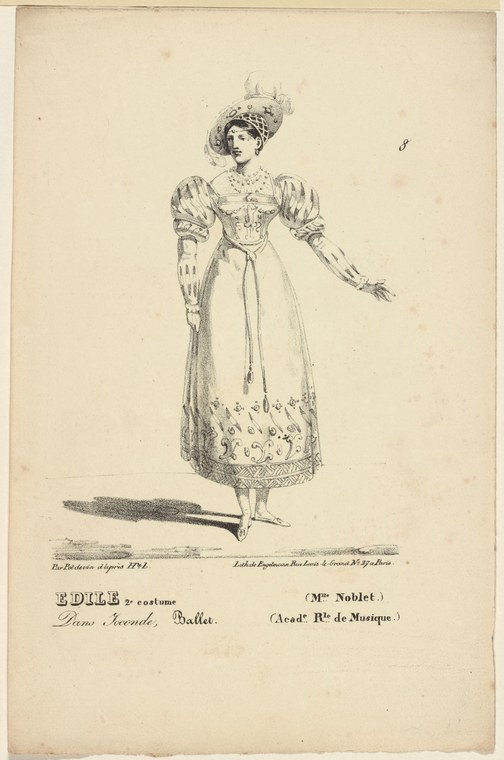
Edile 2e costume (Mlle Noblet.) Dans Joconde, ballet
Unknown artist
- Collection:
- Prints depicting dance
- Source:
- New York Public Library
- Rights:
- Public domain — free to use, share and adapt.
- Recorded as:
- Public Domain
This print is evidence of women's professional labor in early-19th-century opera and of how theatrical dance was commercialized and circulated through imagery. It records the identity and costume of a real named performer (Mlle Noblet) and thus counters the historical erasure of working dancers who were not prima ballerinas. The print also documents the specific silhouette and construction techniques of Romantic-era theatrical dress, which shaped how dancers moved and how dance was aestheticized.
What you are looking at
A single female dancer occupies the full height of the composition, posed against a plain background with minimal detail—only a shadow beneath her feet suggests spatial depth. She stands in an elegant contrapposto, weight shifted slightly to one side, her body upright and composed. She wears an elaborate early 19th-century costume: a high-waisted white gown with puffed sleeves ending in white gloves, the skirt reaching mid-calf and decorated with embroidered or appliqué ornament around the hem. Her head is crowned with an ornate feathered headdress suggesting theatrical convention. Her left arm extends gesturally to the side, palm forward in a graceful line; her right arm hangs more naturally. Her gaze is directed forward and slightly downward. The drawing technique is precise but economical—delicate pen or engraved line work with light shading to suggest fabric texture and volume, particularly in the sleeves and skirt.
The dancing
The single figure is presented in a frontal, formal pose typical of theatrical costume documentation. Her weight appears evenly distributed, with no suggestion of dynamic movement or balletic turnout—the pose reads as stationary and presentational rather than mid-step. The extended left arm and forward gaze convey graceful deportment and stage presence; the raised sleeves and fitted bodice emphasize an upright carriage and aristocratic bearing. This is a portrait of a dancer in costume rather than a capture of motion or technique.
The dance depicted
The figure is identified in the inscription as 'Mlle Noblet' in the 'Joconde' ballet. This is almost certainly Lise Noblet or one of her sisters of the Noblet family, celebrated Paris Opéra dancers of the 1820s–1830s. The ballet *La Joconde* (also *Mona Lisa*) was produced in the 1820s with choreography in the Romantic ballet idiom, though this print documents costume and character rather than choreographic content. The *Edile 2e costume* (Second Aedile costume) suggests a secondary theatrical role, likely a character part rather than a principal romantic role. The dress—high-waisted, demure, decorously trimmed—conforms to the silhouette and decorum of Romantic-era theatrical costume and suggests a supporting or comic character rather than a prima ballerina role.
How it was made
This is a line engraving or possibly a steel engraving, identifiable by the fine hatching, parallel line work, and crisp edges characteristic of the medium. The technique allowed for precise reproduction and wide circulation of costume documentation, making it a standard format for theatrical record-keeping and performer promotion in the early 19th century. The inscription at the foot in both French and Italian, together with the publisher credit, indicates this was a commercial print intended for sale to the public—likely marketed to opera enthusiasts and collectors interested in theatrical fashion and celebrity dancers. The print's condition and wear pattern suggest it was removed from a bound volume or portfolio.
About this work
This is a costume documentation print of a named Paris Opéra dancer of the 1820s–1830s, showing the dress and bearing of a secondary character role in the Romantic ballet *La Joconde*. The print is one of many produced in this period to record and circulate theatrical costume and to capitalize on public fascination with dancers and opera. It belongs to the history of both Romantic ballet and of theatrical celebrity in the early 19th century.
The work is important not as a depiction of dance technique or movement, but as documentary evidence: it preserves the exact construction and aesthetic of a historical costume, the identity of a working professional dancer now largely forgotten, and the theatrical conventions of character and rank in Romantic ballet. It also attests to the commercial apparatus of dance celebrity—the print commodified the dancer's image and made her visible to a broad public who would never attend a performance.
How to look at it
Observe the careful attention to costume detail—the embroidery at the hem, the precise drafting of the puffed sleeves, the feathered headdress—which indicates the print was made from an actual garment or a detailed drawing from life. The formal frontal pose and the dancer's downward gaze are conventions of costume documentation rather than performance photography; this is not meant to show motion or virtuosity, but deportment and dress. The small shadow beneath her feet and the spare background reflect the documentary purpose: the focus is entirely on the figure and her theatrical identity. The engraver's technique—the precise line and delicate shading—creates an image that reads as both elegant and factual, befitting its dual purpose as both souvenir and record.
The artist
The engraver and artist remain unrecorded in the catalogue, which is common for commercial theatrical prints of this period. The inscription indicates the print was published by an Italian or bilingual publisher (the text is in French and Italian), suggesting either Parisian or Italian publication or dual-market distribution. The style and technique are consistent with commercial dance and opera print production of the 1820s–1830s, when such prints were produced in large series and often bound into albums or portfolios for collectors and theatregoers.
The period
The 1820s–1830s were the flowering of Romantic ballet in Paris, the period of *La Sylphide*, *Giselle*, and the emergence of the ballerina as the central figure in ballet. The Noblet family were working professionals in this period, not stars but skilled and regularly employed dancers. Commercial theatrical prints flourished in this era as lithography and steel engraving made color and reproduction cheaper and faster; opera and ballet images were among the most popular subjects. These prints served multiple audiences: performers' families and friends, opera subscribers, the burgeoning middle-class public fascinated by theatrical life and celebrity, and collectors of theatrical ephemera. The print format also served as a tool for theaters to advertise productions and performers.
Where it lives
The print is held by the New York Public Library in its collection of prints depicting dance. It was removed from a bound volume or portfolio, as suggested by the binding marks at the foot. Such collections document the commercial circulation of dance imagery in the 19th century and reflect the appetite of public libraries and collectors to preserve theatrical ephemera.
Dance in this work
Questions about this work
Who was Mlle Noblet?
Mlle Noblet was a professional dancer at the Paris Opéra in the 1820s–1830s. The Noblet family—including Lise Noblet and her sisters—were working ensemble members and minor soloists during the early Romantic ballet period. They danced regularly but left few records; this print is part of the fragmentary evidence of their professional lives.
What was *La Joconde* ballet?
A Romantic-era ballet (also known as *Mona Lisa*) produced in the 1820s at the Paris Opéra. Very little is known about its specific plot or choreography today, as the majority of Romantic ballets are now lost or known only through such prints and written notices. This print documents a character costume rather than the choreography.
What does 'Edile 2e costume' mean?
An Aedile was a magistrate in ancient Rome, and the role appears in historical or classical comedies and ballets of the period. 'Edile 2e' (Second Aedile) designates a secondary character, not a principal role. This tells us the dancer played a supporting part in the narrative.
Why is this print important to dance history?
It preserves the image and professional identity of a real historical dancer who would otherwise be completely unknown, and it documents the actual construction and style of Romantic-era theatrical costume. It also shows how dance was commercialized and circulated through prints in the early 19th century.
More dance artwork





