49 works in this view — arrow keys or swipe to move between them.
Dance in Art
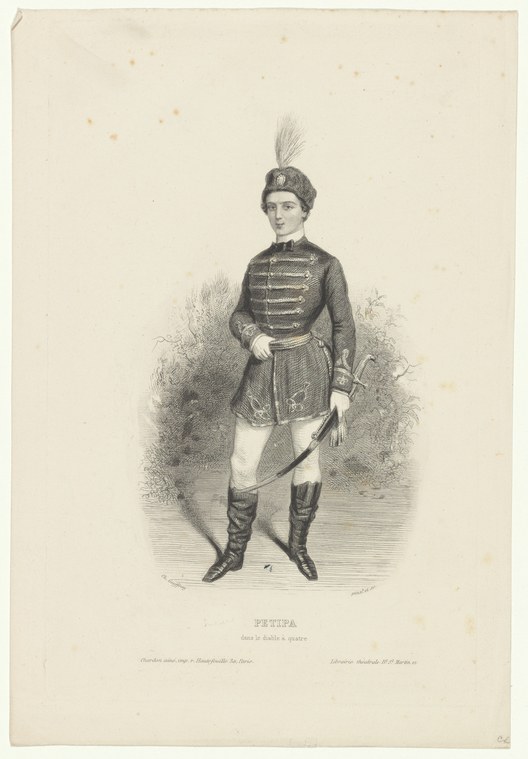
Petipa dans Le diable a quatre
Unknown artist
- Collection:
- Prints depicting dance
- Source:
- New York Public Library
- Rights:
- Public domain — free to use, share and adapt.
- Recorded as:
- Public Domain
This print is rare documentary evidence of how comic male ballet roles were costumed, posed, and presented to audiences in the mid-19th century. It shows that Romantic-era ballet, though celebrated for its female dancers and ethereal choreography, maintained a living tradition of male character dancing in military and comic roles—a lineage often overshadowed in dance history by focus on the prima ballerina.
What you are looking at
A single male dancer stands in an elegant contrapposto pose against a lightly stippled background. He wears a dark military-style tunic with ornamental frogging or braiding across the chest, a plumed headpiece or tall hat, and tall black boots that reach mid-calf. His right arm hangs naturally at his side while his left arm is raised and bent, the hand positioned near his body in a gesture of repose or preparation. He holds a curved sword or saber in his right hand, the blade angling downward. The dancer's posture is upright and dignified, his weight appears settled on one leg in a stable stance. The engraving is rendered in fine lines typical of 19th-century reproductive prints, with careful attention to the texture of fabric and the definition of the military costume. The composition isolates the figure frontally, presenting him as a subject for study rather than within a narrative scene.
The dancing
A single male dancer shown standing, with controlled posture and weight evenly balanced. His arms are positioned asymmetrically—one raised at the elbow, one lowered—in a pose that suggests either a moment of rest between movements or a formal stance. The costume and bearing indicate a trained performer of social or theatrical status. The stance and gesture convey formality and composure rather than dynamic action or turn.
The dance depicted
This is a portrait of a male dancer in character costume for a theatrical ballet or opéra-comique, most likely from a 19th-century French production. The inscription identifies this as Petipa in *Le diable à quatre* (The Devil Takes Four), a popular comic ballet that premiered in 1845 and was frequently performed through the late 19th century. The military tunic and sword suggest a character role rather than a classical male lead. The static, frontal presentation is typical of character or comic roles in Romantic and mid-19th-century ballet, where such roles were often danced with emphasis on character acting and pantomime rather than on technical virtuosity in the ballet vocabulary.
How it was made
This is an engraving, rendered in fine lines on paper. The technique allows for precise capture of costume detail and the modeling of form through parallel lines and stippling. The style and the signature plate mark suggest this is a commercial print intended for circulation among theaters, dance enthusiasts, and the general public—a common form of theatrical publicity and souvenir in the 19th century. The quality of execution indicates professional printing, likely from a Paris-based publisher.
About this work
This is a theatrical print documenting a dancer in costume for a 19th-century ballet-comique. It preserves the appearance of a character role from a celebrated comic ballet of the mid-1800s, capturing both the costume and the formal, dignified bearing expected of a trained performer in such a role. The work belongs to the tradition of theatrical portraiture—a now-vanished practice of circulating prints of celebrated dancers and roles to audiences who could not attend performances, and to dancers themselves as records of successful roles.
How to look at it
Notice the asymmetry of the pose: one arm raised, one lowered, suggesting a moment between actions rather than a held arabesque or attitude. The rigid, upright carriage and the sword-bearing stance emphasize character and social status over physical virtuosity. The fine engraving technique reveals the precision of the military costume—each frog and button is rendered—suggesting that theatrical authenticity of dress was important to how the role was understood. The frontal presentation, common in theatrical portraiture of the period, allows the costume and character to be read clearly, as if the dancer were being presented to an audience unfamiliar with the performance.
The artist
The artist is not recorded in the catalogue. The engraving bears a signature or imprint mark at the foot of the plate, but is not legible in the available image. The work is part of the NYPL's collection of theatrical dance prints, which document commercial and professional dance practice through reproductive graphics.
The period
This print dates to the era of Romantic ballet (approximately 1830–1870), when ballet was the dominant form of theatrical dance in Europe and particularly in Paris. *Le diable à quatre* was one of the most frequently performed comic ballets of the mid-century, rivaling serious ballets in popularity. Male dancers in this period, particularly those performing character roles, occupied an ambiguous position—celebrated within the theater but often viewed as subordinate to the female star. Comic male roles in military or grotesque costumes were a respected specialization, calling for strong acting ability and often substantial technical skill disguised as naturalistic movement.
Where it lives
This print is held in the NYPL's collection of prints depicting dance. It originates from a theatrical print tradition of the 19th century, in which engravings of celebrated dancers and roles were produced and distributed for public consumption, often sold in theater lobbies or through print dealers.
Dance in this work
Questions about this work
Who was Petipa and why is this portrait significant?
Marius Petipa (1818–1910) was the most influential male ballet dancer and choreographer of the 19th century, and later the principal choreographer of the Imperial Ballet in Russia. However, the name alone does not confirm which Petipa is depicted here or in what year. Early in his career Petipa performed character roles in French comic ballets like *Le diable à quatre*; later he became renowned for grand classical choreography. This print captures him or another dancer named Petipa in a character role, which illuminates the breadth of skills expected of a professional ballet dancer in this era.
What was 'Le diable à quatre' and why was it popular?
*Le diable à quatre* (*The Devil Takes Four*) was a comic ballet-pantomime first choreographed by Joseph Mazilier for the Opéra in Paris in 1845. It combined balletic technique with broad comedy and supernatural plot elements, appealing to audiences who wanted entertainment, spectacle, and humor alongside classical dance. The role shown here—in military dress and carrying a sword—suggests a comic or demonic male character, reflecting the ballet's use of male dancers in comedic roles.
Why are theatrical prints like this one valuable to dance history?
Before photography became common in dance documentation, theatrical prints were the primary way audiences and dancers recorded what performances looked like. They capture information about costume, bearing, character interpretation, and the visual conventions of the period that would otherwise be lost. This print shows how a male character role was staged, costumed, and presented—knowledge that informs our understanding of Romantic-era ballet beyond the famous female roles.
How was this print made and distributed?
This is an engraving, a relief or intaglio print technique that allowed multiple copies to be produced from a single plate and distributed commercially. Such prints were sold in theater lobbies, by print dealers, and in the homes of dance enthusiasts. They served as both souvenirs and promotional material, circulating the image of celebrated dancers and roles to a wide public.
More dance artwork





