49 works in this view — arrow keys or swipe to move between them.
Dance in Art
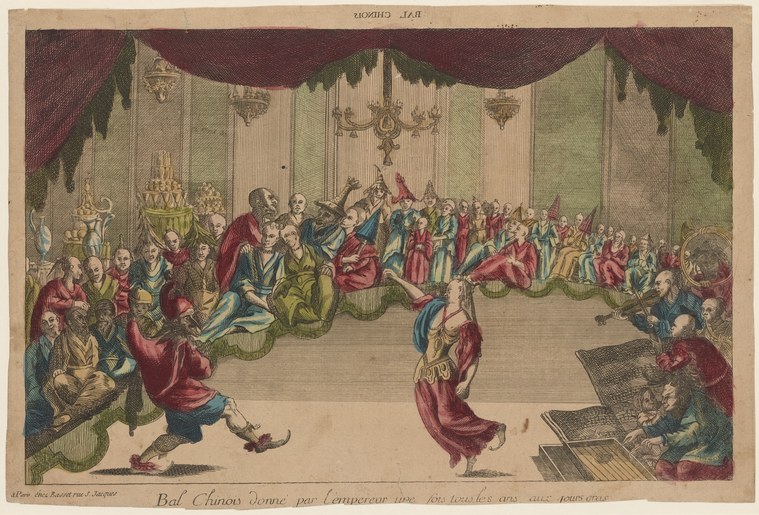
Bal chinois donné par l'empereur une fois tous les ans aux jours gras
Unknown artist
- Collection:
- Prints depicting dance
- Source:
- New York Public Library
- Rights:
- Public domain — free to use, share and adapt.
- Recorded as:
- Public Domain
This work shows how acrobatic and contortionist performance was understood as a prestigious form of court entertainment in imperial China—a spectacle of human capability and control that held court and audience interest. For dance historians, it documents the presence of extreme bodily practices in formal performance contexts centuries before modern circus or Olympic gymnastics, and reveals the European curiosity about non-Western performance traditions at a time when such images were rare and precious.
What you are looking at
A grand ceremonial ball unfolds in an ornate interior with tall paneled walls and a burgundy draped ceiling. Dozens of figures in jewel-toned silks and damasks crowd the space in a loose circle. At the center, two acrobatic dancers perform spectacular feats: one is inverted or contorted dramatically, while another executes an extreme backward bend or aerial maneuver. The surrounding courtiers—some seated, some standing—watch intently. The composition radiates outward from the acrobatic pair, with the crowd densest at the edges and the performance space deliberately cleared. Chandeliers hang above; the lighting is even and theatrical, emphasizing the spectacle. The engraver has captured a moment of astonishment and active performance rather than social dancing.
The dancing
The two central performers display extreme bodily articulation: one is dramatically inverted or contorted with limbs extended impossibly, the other in a deep backward extension or split. Their bodies show trained flexibility and strength. The surrounding figures are largely static—courtiers in formal standing and sitting poses, framing the action rather than participating. Arm gestures among the onlookers suggest conversation and pointing; there is no partner dancing, no formation, no social hold. The contrast between the explosive mobility of the central pair and the formal stillness of the audience is deliberate and striking.
The dance depicted
This is an acrobatic performance, most likely Chinese acrobatics or contortion, presented as imperial court entertainment. The title 'Bal chinois donné par l'empereur' (Chinese Ball given by the Emperor) and the inscription confirm this is a depiction of Qing imperial court entertainment—a genre that included extreme acrobatics, contortion, and gymnastic feats. The image shows professional performers executing tricks beyond normal human range, not social dance. This was circulated in Europe as a marvel of exotic imperial display, combining spectacle, difficulty, and non-European bodily practices.
How it was made
This is a hand-colored engraving or etching, most likely late 17th or 18th century. The fine parallel hatching for shading, the precise line work, and the applied watercolor indicate professional production for a print series or collection. The style and composition—the bird's-eye view, the detailed architectural setting, the densely populated scene—suggest this is part of a larger documentary or satirical series about Chinese court life, likely created for a European audience who had not witnessed such spectacles firsthand. The technique allowed wide distribution of the image and made the exotic performance available to readers across Europe.
About this work
This engraving documents a moment of imperial Chinese acrobatic performance as witnessed or imagined by a European artist and audience. It is not social dance but trained athletic spectacle—extreme contortion and gymnastics presented in a formal court setting. The work belongs in a dance gallery because acrobatics and contortion are dance-adjacent performance forms that require trained bodily control and are presented on a stage or performance floor to an assembled audience. The image is valuable as evidence of how non-European performance traditions were seen, interpreted, and circulated in early modern European print culture, and as a record (however mediated) of what imperial Chinese court entertainment looked like.
How to look at it
Focus on the two central performers and the precision with which the engraver has rendered their bodily distortion and weightlessness. The inversion or extreme spinal extension shown would have seemed almost impossible to a European audience; the artist has taken pains to make it visible and credible. Notice how the crowd frames the action—the onlookers' stillness and formal dress emphasize the performers' extraordinary mobility. The architectural setting (the tall paneled walls, the ornate ceiling, the chandeliers) signals imperial grandeur and makes clear this is an elite performance, not a street spectacle or market entertainment.
The artist
The artist is not recorded. The style, technique, and subject matter suggest a professional engraver working in the late 17th or early 18th century, likely in the Netherlands or France, producing prints for a educated European audience interested in accounts of distant lands. The work may derive from written accounts or earlier illustrations of Chinese court life, or from eyewitness testimony brought back by traders or diplomats.
The period
In the 17th and 18th centuries, European curiosity about China was intense but mediated entirely through trade reports, diplomatic accounts, and prints. Acrobatics and contortion had ancient roots in Chinese performance, appearing in imperial courts and public festivals. This engraving emerged in an era when printed visual evidence of 'exotic' performance was rare and valued—long before photography or direct travel. European artists and publishers created series of images meant to educate and astonish viewers about non-European courtly life, architecture, and entertainment. The formal court setting and the extremity of the bodily feats were equally important to the European viewer: proof both of imperial magnificence and of alien physical possibility.
Where it lives
The work is held in the NYPL Prints collection, classified as depicting dance. It is likely part of a larger series of engravings documenting non-European court life and performance traditions, created for European circulation in the late 17th or 18th century.
Dance in this work
Questions about this work
Is this actually dance?
It is acrobatic performance, not social or theatrical dance as Europeans understood it. But acrobatics and contortion are trained bodily practices performed on a stage for an audience—they belong in a dance gallery as performance relatives of dance, and they reveal how performance traditions move between cultures and reshape meaning.
What does 'Bal chinois' mean?
'Bal' means ball or celebration in French. 'Bal chinois' (Chinese ball) was a European term for imperial court entertainments and festivities that included music, dance, acrobatics, and spectacle. It was a category in the European imagination—a synonym for exotic, magnificent, and physically impossible.
How accurate is this image?
It is likely derived from written descriptions, earlier prints, or hearsay rather than from direct observation. The European engraver has rendered it in European compositional and architectural style, so the building and crowd are interpretations. But the central feat—the contorted bodies—may well be based on accounts of actual acrobatic practices in Chinese court performance.
Who performed these feats?
In imperial China, acrobats and contortionists were professional entertainers trained from childhood, performing in courts and at public festivals. They were valued members of court culture and were sometimes honored for their skill.
More dance artwork





