49 works in this view — arrow keys or swipe to move between them.
Dance in Art
Acte II de l'opéra de Silvie
Unknown artist
- Collection:
- Prints depicting dance
- Source:
- New York Public Library
- Rights:
- Public domain — free to use, share and adapt.
- Recorded as:
- Public Domain
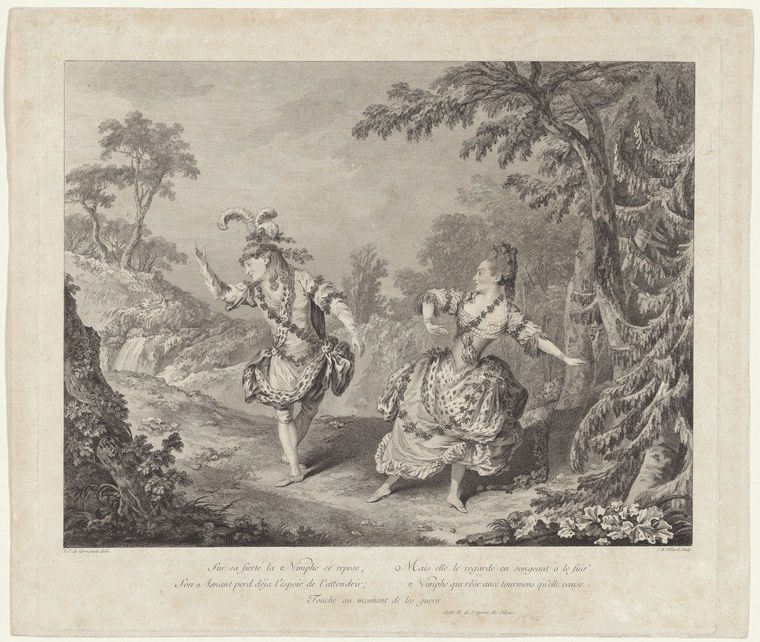
This work provides direct visual evidence of how theatrical dance was performed, dressed, and understood in the early 18th century. For dance historians, it offers a rare opportunity to examine the posture, spacing, and gestural language of Baroque opera-ballet outside the constraints of written notation. The choice to depict a moment of dramatic encounter—rather than a formal court figure—reveals how contemporary artists conceptualized dance as expressive gesture and narrative action rather than merely ornamental or structural movement.
What you are looking at
Two figures in elaborate court dress perform in a wooded landscape. The figure on the left wears a short tunic decorated with leaf garlands and a feathered headdress, striking a dynamic pose with one leg extended. The figure on the right, in a patterned dress with pearl necklaces and an ornate headdress, gestures toward the first dancer in an engaged, responsive posture. Both stand on a path flanked by large trees with dense foliage; flowering plants are scattered at the base of the composition. The setting evokes a pastoral or mythological grove rather than a court interior, though the figures' costume richness and the engraving's formal composition suggest theatrical origin. The landscape is rendered in fine parallel lines typical of 18th-century engraving, with careful attention to texture in the foliage and fabric.
The dancing
Both dancers carry their weight upright with arms gesturing expressively rather than in contact with each other. The left figure displays a pronounced turnout and extension, with one leg raised and the torso twisted in a stylized attitude suggesting trained movement. The right figure's pose is more contained, with arms raised in what appears to be an expressive or narrative gesture. The spatial relationship suggests a scene of encounter or dramatic exchange rather than partnered ballroom dancing. The compositions of the bodies—the lifted spines, the careful placement of limbs—indicate performers with formal training in theatrical or court dance conventions.
The dance depicted
This is most likely a scene from an 18th-century opera or ballet of the Baroque or early Rococo period, drawn from or inspired by Jean-Antoine Watteau's theatrical and fête galante subjects. The inscription identifies it as Act II of the opera 'Silvie,' suggesting a specific theatrical production, though the work cannot be confirmed as a direct representation of an actual performance. The costume, setting, and movement vocabulary are consistent with the pastorals and mythological operas that dominated French court and commercial theater in the early 18th century. The dance itself—if this represents a real choreographic moment—appears to be a pantomimic or narrative dance rather than a structured ballroom form, with emphasis on expressive gesture and theatrical presence.
How it was made
This is an engraving, executed in line-work typical of 18th-century reproductive prints. The technique allows for fine detail in the costumes, foliage, and musculature of the figures, and the even, controlled tone creates an impression of refinement suitable for a wealthy audience. The work is a reproduction of a painted or drawn design, likely by a known artist (the identity of the engraver is not recorded in the catalogue). Engravings of this quality were expensive to produce and circulated primarily among collectors, theater enthusiasts, and the educated aristocracy, making this a work of some prestige.
About this work
This engraving depicts two dancers in an ornate pastoral setting, identified as a scene from Act II of the opera 'Silvie.' The work is representative of 18th-century theatrical dance imagery, a genre that documented the performance practices of court ballet and opera-ballet during the Rococo period. The costume, gesture, and setting all point to a professional theatrical context, yet the work transcends mere documentation by employing the pictorial conventions of history painting and the fête galante—genres that invested such scenes with aesthetic and social significance. The engraving preserves a moment of theatrical dance at a moment when dance itself was becoming a major subject for fine art.
How to look at it
The engraver has frozen a moment of theatrical encounter, capturing not a formal pose but a gesture of engagement and response. Notice how the left figure's extended leg and twisted torso convey upward movement and energy, while the right figure's raised arms and turned body create a complementary spatial tension. The artist understood that theatrical dance was fundamentally about expression of emotion and narrative relationship, and has chosen a moment that reads clearly at a distance—the legibility of the pose suggests this scene was designed to be viewed from an audience perspective. The landscape setting, unusual for a court dance scene, indicates this is likely a staged pastoral rather than ballroom dance.
The period
This engraving dates to the height of French Rococo interest in theatrical and pastoral subjects. The early 18th century saw an explosion of printed dance imagery, driven by the success of Jean-Antoine Watteau's paintings of fêtes galantes and theatrical scenes. Opera-ballet—the hybrid form that combined sung narrative with choreographed dance—was the dominant theatrical form in Paris and other European courts. The costume and setting conventions visible in this print reflect the era's fascination with pastoral mythology and the artificial pleasures of aristocratic society. Engravings of specific theatrical scenes were marketed as luxury goods and souvenirs of celebrated performances or compositions.
Where it lives
The work is held in the New York Public Library's collection of prints depicting dance. It is identified by inscription as a scene from an opera or theatrical work, but no attribution to a specific engraver or painter is recorded, and the date of execution is not documented.
Dance in this work
Questions about this work
What opera is this from?
The inscription identifies this as Act II of an opera called 'Silvie,' but no record survives of the specific production, composer, or choreographer. It may represent a real performance or may be an imaginative recreation of a theatrical scene in the style of the period. The work may refer to or have been inspired by one of several 18th-century theatrical works with similar titles.
How do we know these are dancers and not mythological figures?
The inscription explicitly identifies the scene as part of a theatrical opera, and the costumes and poses are consistent with stage dress and trained movement vocabulary of the period. The formal composition and printing technique confirm this is a theatrical or balletic subject, not a mythological narrative illustration. The figures' posture and gesture display the controlled alignment and expressivity of trained performers.
What dance form is being performed here?
This most likely depicts a scene from an opera-ballet, the dominant theatrical form of early 18th-century French court and commercial theater. The movement is pantomimic and expressive rather than a structured ballroom dance. The costumes and setting suggest a pastoral scenario, typical of the mythological operas favored by Rococo audiences.
Who made this print?
The catalogue record does not attribute the engraving to a known artist. The quality of execution and the subject matter suggest it was created by a skilled reproductive engraver, possibly after a painting by a renowned history or theatrical painter such as Watteau or one of his followers, but this cannot be confirmed from the image alone.
More dance artwork





