49 works in this view — arrow keys or swipe to move between them.
Dance in Art
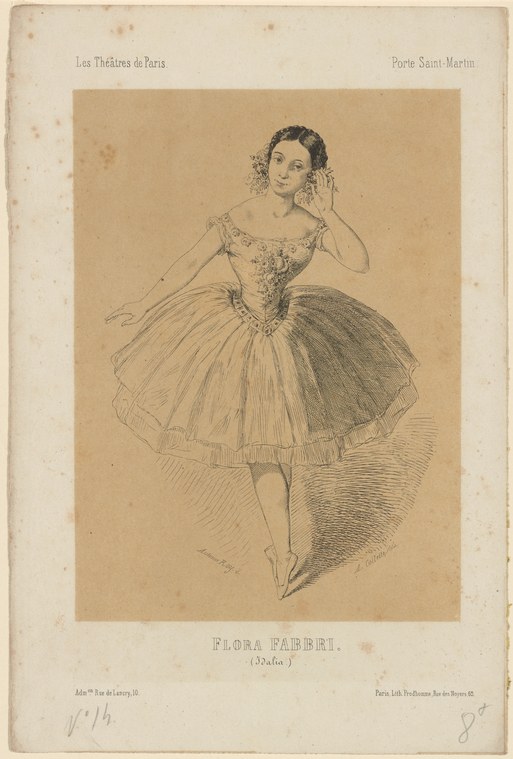
Flora Fabbri (Idalia)
Unknown artist
- Collection:
- Prints depicting dance
- Source:
- New York Public Library
- Rights:
- Public domain — free to use, share and adapt.
- Recorded as:
- Public Domain
This work documents the visual language and marketing of romantic ballet at its height, showing how dancers were posed, dressed, and presented to the public. The careful attention to costume detail, the refined romantic aesthetics of the pose, and the existence of such theatrical portraiture as a commercial practice all illustrate the central place of ballet in 19th-century urban entertainment and fashion.
What you are looking at
A single female dancer is shown in a three-quarter standing pose against a warm tan background. She wears a white tulle ballet skirt of moderate length, fitted at the waist with a decorated bodice featuring floral or ornamental embroidery across the chest. Her dark hair is arranged in ringlets framing her face, and she gazes downward with a contemplative expression. Her right arm is raised with the elbow bent, hand positioned near her face in a graceful, introspective gesture; her left arm hangs naturally at her side. She stands in a relaxed but poised manner, her weight appearing to rest on her right leg while her left leg is slightly extended. The pose suggests a moment of pause or reflection rather than active movement—a characteristic convention of romantic-era ballet portraiture, where dancers were depicted as if caught between steps.
The dancing
The single dancer's frame is upright and elegant, with the characteristic turnout and line of classical ballet training visible in the legs and posture. The raised right arm with bent elbow and hand near the face is a characteristic épaulement gesture of romantic ballet, suggesting the refined upper-body articulation of the period. The extended left leg and the angle of the torso create a gentle contrapposto. The downward gaze and introspective hand position convey the romantic sensibility of melancholic grace rather than virtuosic display.
The dance depicted
This is a portrait of a romantic-era ballet dancer, almost certainly from the mid-19th century. The tulle skirt length, the character of the bodice decoration, and the romantic aesthetic of the pose all point to classical ballet of the 1840s–1860s. The dancer's name, Flora Fabbri, is inscribed below in the title, and she is identified as performing in "Idalia"—likely a specific ballet or theatrical role. The image captures the convention of ballet portraiture from this period: the dancer is shown in a characteristic pose that displays the line and grace of the classical technique, with particular attention to the refined placement of the arms and the poised, ethereal quality that was central to romantic ballet aesthetics.
How it was made
This is a lithograph or engraving on paper, executed with fine linear detail and soft tonal work. The technique shows the characteristic approach of 19th-century theatrical portraiture: the figure is rendered with careful attention to the costume's texture and drape, particularly the layered tulle skirt, while the background is left deliberately plain to focus attention on the dancer. The medium allowed for relatively affordable reproduction and wide distribution among theater-going audiences, making this the kind of souvenir or publicity image that would have been sold at the theater or collected by dance enthusiasts. The artist's signature or mark is not clearly legible in the image.
About this work
This is a theatrical portrait of Flora Fabbri, a mid-19th-century ballet dancer, captured in the refined poses and aesthetics of romantic-era ballet. The work documents both a specific performer and the visual conventions through which ballet was marketed and consumed in this period: a single, graceful figure in classical dress, posed to display technique and elegance rather than narrative action. As a print produced for theatrical circulation, it belongs to the large body of dance ephemera—playbills, lithographs, cartes de visite—that constituted the public face of professional dance in the 19th century and that offers historians crucial evidence about who danced, how they were represented, and what audiences valued about their art.
How to look at it
Observe the careful placement of the arms and the downward gaze: these are conventions of romantic ballet portraiture designed to convey grace, refinement, and an introspective, almost dreamlike quality. Notice how the artist has rendered the tulle skirt—the layers and transparency suggest the lightness and movement of the fabric while the dancer herself is held in a still, posed moment. The pose itself is a kind of vocabulary: the extended leg, the bent arm near the face, the weight on one leg—these are not accidental but rather chosen to display the dancer's training and the aesthetic ideals of her era. The artist has frozen a moment that is neither actively dancing nor simply standing, but rather a carefully composed image of ballet elegance.
The period
This print dates from the height of romantic ballet in Europe, a period when ballet had become a primary form of theatrical entertainment and dancers were celebrities whose images were eagerly collected. The romantic era (roughly 1830–1870) saw the development of the pointe shoe, the codification of classical technique, and the rise of the ballerina as a focal point of spectacle. Prints, lithographs, and photographs of famous dancers were produced in large numbers and sold to the public, much as postcards and photographs of theater stars are marketed today. The aesthetic represented here—the ethereal quality, the melancholic poise, the emphasis on line and grace—reflects the romantic movement's idealization of the feminine, the supernatural, and the unattainable.
Where it lives
The work is held in the New York Public Library's Prints collection, catalogued as part of the "Prints depicting dance" series. It appears to be a mid-19th-century theatrical lithograph or engraving, the kind of promotional or commemorative image that was produced in quantity for theatrical distribution and public sale.
Dance in this work
Questions about this work
Was Flora Fabbri a famous dancer?
The catalogue record does not provide biographical details beyond her name and the role "Idalia." However, the fact that a theatrical portrait was produced and circulated suggests she was a professional performer of some standing. The care and quality of the lithograph indicate that she was significant enough to warrant professional portraiture intended for public sale.
What is the dance pose shown here?
This is not a depiction of an active step or combination, but rather a posed portrait in the romantic ballet aesthetic. The raised arm with bent elbow and hand near the face is characteristic romantic épaulement (arm carriage), and the extended leg and turned-out posture display the classical technique. It is the kind of pose a dancer would hold briefly during rehearsal or for a portrait sitting, chosen to showcase line and grace rather than virtuosity.
Why are there so many 19th-century prints of dancers?
Ballet was a major form of entertainment and dancers were celebrities. Lithographs and engravings of famous dancers were produced and sold much like modern promotional photographs or trading cards. They were affordable enough for middle-class audiences to collect, and theaters sold them as souvenirs. These prints are valuable historical documents: they show us what dancers wore, how they were marketed, and who was famous at any given moment.
What does the tulle skirt tell us?
The knee-length tulle skirt is characteristic of romantic-era ballet, falling between the longer skirts of earlier theatrical dance and the very short skirts of some other 19th-century spectacles. The layered tulle allowed for visibility of the dancer's legs and feet—crucial for displaying technique—while the romantic aesthetic demanded a certain ethereal quality. The decorated bodice suggests a specific theatrical character or role rather than practice costume.
More dance artwork





