49 works in this view — arrow keys or swipe to move between them.
Dance in Art
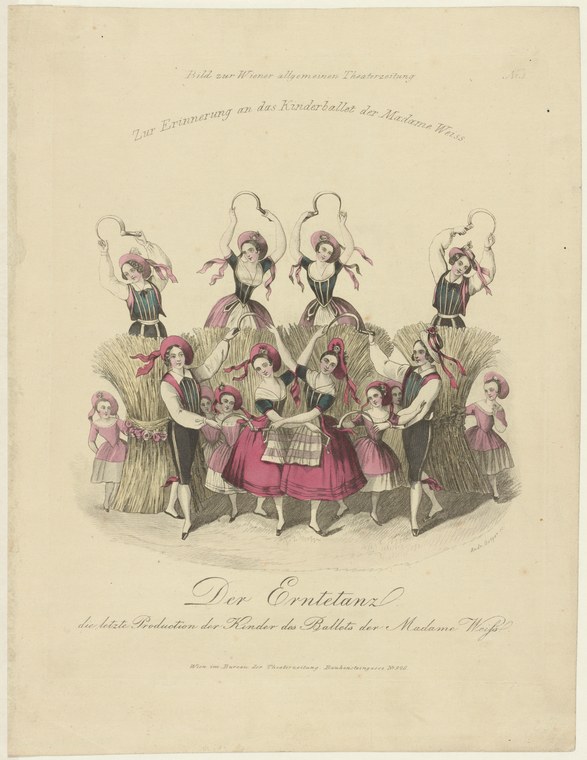
Der Erntetanz, die letzte Production der Kinder des Ballets der Madame Weiss
Unknown artist
- Collection:
- Prints depicting dance
- Source:
- New York Public Library
- Rights:
- Public domain — free to use, share and adapt.
- Recorded as:
- Public Domain
This print preserves evidence of how children were choreographed and presented as dancers in the 19th century, showing that juvenile performance was as much about tableaux vivant and costumed spectacle as about technical ballet training. It also documents the role of women teachers (Madame Weiss) in organizing and directing dance education outside established theatres.
What you are looking at
A colored engraving depicts a large group of young dancers—predominantly girls in pink and white costume—arranged in a theatrical formation around a central adult female figure in a darker dress with a red underskirt. The composition is circular, with dancers at multiple depths: some stand elevated at the back holding large curved props (possibly stylized wheat sheaves or decorative arcs), while others form a dense cluster around the seated or crouching central figure. The dancers wear matching costumes with white upper bodies, pink skirts, and pink bonnets or hats. The setting is undefined—no stage, floor, or interior is rendered—allowing the focus to remain entirely on the human geometry and the costume. The hand-coloring is restrained: pink for costumes and faces, tan for the props, black and gray for outlines and shading. The mood is one of coordinated ensemble celebration rather than individual virtuosity.
The dancing
The dancers stand in relaxed, upright postures with arms raised, held, or gestured toward the center. None are turned out; footwork and lower-body positions are not visible beneath the full skirts. The grouping emphasizes unison and geometric arrangement over technical precision. The central adult figure appears to be the focus of attention and possibly the teacher (Madame Weiss, named in the title), with younger dancers orbiting her in a ritual or ceremonial formation rather than executing a classical ballet phrase.
The dance depicted
The title identifies this as 'Der Erntetanz' (The Harvest Dance), described as the final production of the children of Madame Weiss's ballet. This suggests a student demonstration or school performance, likely from a private or semi-public ballet academy in a German-speaking region. The harvest theme and the symmetrical arrangement of children around a central maternal or pedagogical figure point to a didactic or celebratory work—possibly a seasonal or graduation performance. The choreography appears to prioritize visual spectacle and symbolic arrangement (the wheat-sheaf props, the circular grouping) over the virtuosic vocabulary of Romantic ballet, suggesting this was choreographed for young, developing dancers rather than trained professionals.
How it was made
This is a hand-colored engraving or lithograph (likely the latter, given the fluid line and the ease of color application). The technique allowed for multiple printed copies to be distributed—a common means of documenting and advertising private ballet academy productions in the 19th century. The soft, rounded line work and the careful gradation of tone in the skirts and faces suggest skilled execution. The hand-coloring, applied after printing, is competent but not elaborate, consistent with commercial theatre ephemera of the period rather than high-art reproduction.
About this work
This is a promotional or commemorative print of a student ballet performance from Madame Weiss's academy, likely dating to the mid-19th century. The work documents not the technique of professional ballet but the pedagogy and spectacle of juvenile dance training in the Romantic era—the use of costume, symbolic props, and ensemble arrangement to create visual tableaux. It is both an artwork and a historical document of how children were taught and displayed through dance in private academies during this period.
How to look at it
Notice the geometric precision of the composition—the way the dancers frame the central adult figure and the careful distribution of the elevated back row. The props (wheat sheaves or arcs) serve a heraldic or symbolic function rather than a functional one, emphasizing that this is a staged image rather than a naturalistic scene. The uniformity of costume and the symmetry of the arrangement are the point; individual dancers are not differentiated, and their identity as a unified ensemble is paramount. The artist has chosen a moment of stillness and arrangement rather than movement.
The period
The Romantic ballet era (roughly 1830–1870) saw the rise of private dance academies across Europe, many run by retired dancers or foreign ballet masters seeking to disseminate technique and create performance opportunities for students. These academies often mounted public or semi-public performances to demonstrate their work and raise funds. The harvest theme and the emphasis on ensemble tableaux reflect the Romantic period's interest in folk themes and the picturesque, adapted here for a children's performance. The use of hand-colored prints to document and advertise these productions was standard practice.
Where it lives
The print is held in the New York Public Library's collection of prints depicting dance, part of their broader holdings on dance history and theatre documentation. Such prints are typically part of a larger archive of ballet academy ephemera and are valuable for reconstructing the practice and pedagogy of 19th-century dance training.
Dance in this work
Questions about this work
Who was Madame Weiss?
The catalogue record does not identify her beyond the print's inscription. She was the director of a ballet academy, likely in a German-speaking city, and trained young dancers for public performance. Without further research, her dates, reputation, and career trajectory cannot be established from this image alone.
Was this a real performance or an idealized representation?
It was almost certainly a real performance that actually took place. The specificity of the title, the naming of the director, and the commemorative nature of the print all suggest this was made to document and promote an actual academy production. However, like all theatrical prints of the period, it may have been cleaned up or idealized in composition—the geometry may be tidier in the print than it was on stage.
What does 'Erntetanz' mean and why was it chosen?
Erntetanz means 'harvest dance.' The harvest was a popular theme in Romantic-era dance and art, symbolizing fertility, abundance, and the cycle of nature. It was an appropriately picturesque subject for a children's performance and allowed for colorful costuming and symbolic props (the wheat sheaves visible in the print).
More dance artwork





