49 works in this view — arrow keys or swipe to move between them.
Dance in Art
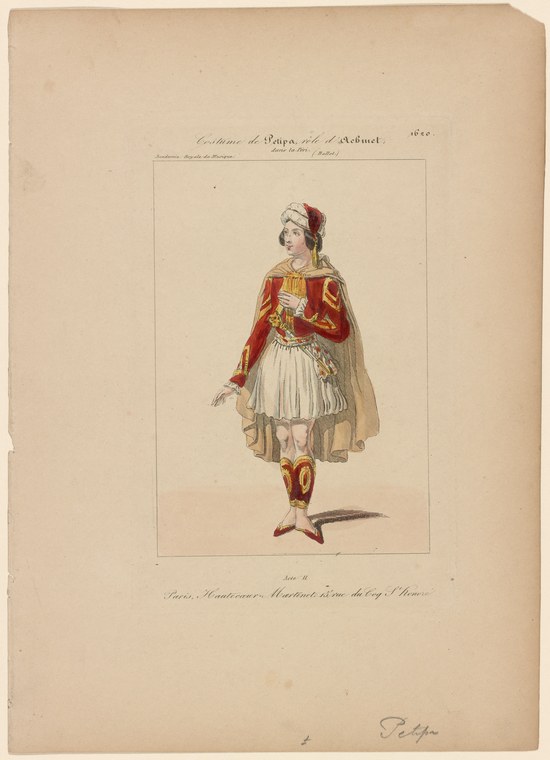
Costume de Petipa, rôle d'Achmet, dans La péri, ballet, acte II, Académie royale de musique
Unknown artist
- Collection:
- Prints depicting dance
- Source:
- New York Public Library
- Rights:
- Public domain — free to use, share and adapt.
- Recorded as:
- Public Domain
Marius Petipa became the dominant choreographer of the Imperial Ballet in Russia and shaped classical ballet as we know it; this image preserves an early moment in his European career, when he was a dancer learning the repertory of Paris. The costume itself embodies the Romantic era's orientalism and the aesthetic of the male dancer as aristocratic fantasy figure rather than athletic performer—a mode that shaped male dance imagery for decades.
What you are looking at
A single male dancer in exotic costume stands in a three-quarter pose against a plain background, his body weight shifted slightly onto one leg in a pose of elegant repose. He wears a richly decorated jacket in deep red with gold embroidery and trim, paired with a white pleated skirt that falls to mid-thigh. A draped cape in gold and red flows from his shoulders. His head is crowned with a tall red cap or headdress, and his face is rendered in profile, gazing upward and to the side with a contemplative expression. Red stockings and red shoes with pointed toes complete the costume. The figure's bearing is aristocratic and controlled—the arms hang naturally, one slightly forward, the other at the side—suggesting a moment of dramatic stillness rather than active movement. The drawing employs fine line work with hand-applied watercolor or gouache for the rich reds and golds, leaving the paper exposed for highlights and the folds of the skirt.
The dancing
A single standing figure with weight on the right leg and the left leg free, allowing the body to curve gently through the hip. The upper body is upright and composed, the arms relaxed and asymmetrical—a pose that reads as nobility or authority held in reserve. The head is turned away from the body's centerline, creating a spiraling line through the figure. There is no active footwork or dynamic momentum; this is an arrival or a pause, the kind of stillness that frames spectacle.
The dance depicted
This is a costume design for a male dancer in *La Péri*, a three-act ballet first performed at the Paris Opéra in 1843, with music by Friedrich Burgmüller and choreography by Jean Coralli. The inscription identifies this as the costume of Petipa in the role of Achmet in Act II. Marius Petipa, one of the nineteenth century's greatest ballet masters, danced in this production early in his Paris career. The exotic dress—the tall headdress, the jeweled jacket, the draped cape—marks this as an Oriental or Eastern fantasy role, consistent with the romantic-era fascination with the harem and the East. The ballet tells of a young man's quest for a magical fairy (*la péri*), and Achmet appears to be a supporting character in this narrative of desire and transformation. The dancer's composed stance suggests the dignified, somewhat melancholic bearing expected of such roles.
How it was made
This is a hand-colored engraving or etching, recognizable from the fine, regular line work that structures the figure and the selective application of color—the reds and golds are laid in with precision while the background remains paper-white. The technique allowed for reproduction and distribution, making costume designs like this available to theatrical audiences, set designers, and dance enthusiasts in the mid-nineteenth century. Such prints served both documentary and promotional purposes, capturing the visual splendor of the Opéra's productions for readers who might never attend a performance. The hand-coloring marks this as a more expensive edition, aimed at collectors and the wealthy.
About this work
This is a costume design engraving for a dancer in one of the great ballets of the Romantic era, *La Péri* (1843), showing Marius Petipa as the character Achmet in Act II. The work captures not a moment of choreography but a formal presentation of costume and bearing—the kind of image used by the Paris Opéra to advertise its star dancers and the exotic fantasy worlds their roles inhabited. It is a record of how a major historical figure in ballet appeared to the public eye, rendered in the refined graphic language of mid-nineteenth-century theater documentation.
How to look at it
Observe the pose: the figure is not mid-leap or in active extension, but gathered and composed, with the weight settled and the body held in a dignified S-curve. This is the moment a dancer holds for the audience to admire the costume and the bearing it creates. Notice how the artist has rendered the face in profile, gazing away from the viewer—a convention that emphasizes the figure as object of display rather than as a personality making eye contact. The richness of the embroidered jacket and the delicate rendering of the pleated skirt show where the designer wanted the eye to rest; the lower legs and feet, though carefully drawn, are secondary. The upright posture and the restraint of gesture tell you this is classical theater, not the earthy or passionate styles that came later.
The artist
The artist is not recorded, which is typical of theatrical costume design prints of this period. Such works were often produced collaboratively by the Opéra's design workshops and distributed by Parisian print publishers without attribution to individual draftsmen. The style is consistent with the formal, naturalistic approach to costume documentation common in Parisian theater graphics of the 1840s.
The period
This print dates to the height of Romantic ballet, when the Paris Opéra under Louis-Philippe was the leading house in Europe and the exotic fantasy—the harem, the Orient, the supernatural realm—dominated the stage. *La Péri* itself was a significant work, blending the Romantic obsession with the magical and distant with the technical virtuosity of the ballet d'action. Male dancers in this era, especially foreign visitors like Petipa, were often cast in such roles as princes, warriors, or sorcerers from distant lands, roles that allowed them spectacular costumes and moments of nobility without requiring the display of strength that characterized later athletic styles. The print economy of Paris made such images widely available, feeding the public appetite for theater imagery.
Where it lives
This is a hand-colored engraving from the New York Public Library's prints collection on dance. Such costume designs were produced by the hundreds in Paris and circulated as inexpensive popular prints, though hand-colored examples like this were more costly and aimed at theater enthusiasts and collectors.
Dance in this work
Questions about this work
Who was Marius Petipa?
Petipa (1818–1910) was a French dancer and choreographer who became the principal choreographer of the Imperial Ballet in St. Petersburg, where he created or revised most of the classical ballet masterworks still performed today, including *Swan Lake*, *The Nutcracker*, and *The Sleeping Beauty*. He began his career as a dancer in Paris in the 1840s and was one of the most celebrated male dancers of the Romantic era before moving to Russia.
What is *La Péri* about?
*La Péri* is a three-act ballet (1843) with music by Burgmüller and choreography by Coralli. It tells of a young man's quest for a magical fairy—*la péri*—and his encounters in an exotic, dreamlike world. It is a classic example of Romantic-era ballet, which favored otherworldly settings, beautiful women in ethereal costumes, and male dancers cast as princes or warriors from distant lands.
Why is he wearing Eastern dress?
The Romantic ballet of the 1830s–1840s was fascinated by the exotic and distant—the Orient, the harem, magical realms—partly as an escape from industrializing Europe and partly because such settings allowed for spectacular, imaginative costumes and sets. An Oriental character like Achmet could be a prince, a sorcerer, or a guardian of the fairy realm, and the costume signaled both wealth and otherness to the audience.
More dance artwork





