49 works in this view — arrow keys or swipe to move between them.
Dance in Art
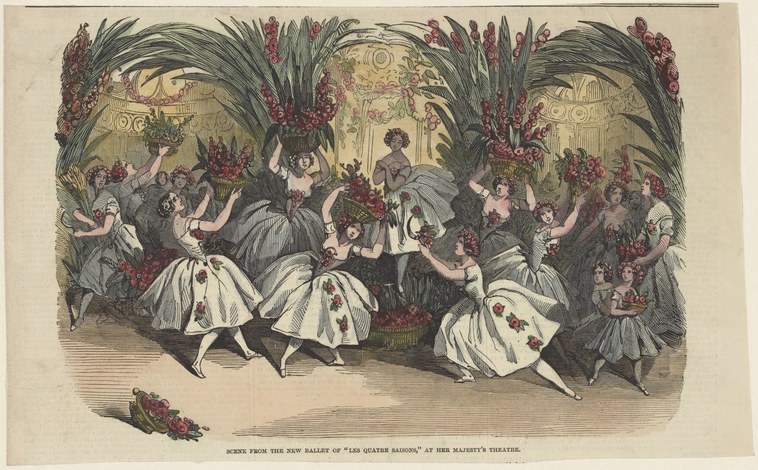
Scene from the new ballet of Les quatre saisons, at Her Majesty's Theatre
Unknown artist
- Collection:
- Prints depicting dance
- Source:
- New York Public Library
- Rights:
- Public domain — free to use, share and adapt.
- Recorded as:
- Public Domain
Theatre prints like this are primary documents of how specific ballets looked on stage and how they were understood by the public. They are often the only visual record of choreography that has not survived in notation. For dance historians and dancers studying romantic ballet, such prints are invaluable evidence of costume, ensemble arrangement, and the theatrical aesthetic of the period.
What you are looking at
A theatrical ballet scene set within an elaborate interior framed by towering plumes of feathered greenery—likely palms or similar exotic plants—and bunches of roses suspended from above. The stage is populated with dancers in romantic tutus of white silk, their skirts caught in motion, arranged in a loose ensemble across the depth of the space. In the center stands a solo figure in darker dress, possibly male, amid the female dancers who gesture and pose around him. The lighting is even and clear, characteristic of mid-19th-century theatre. At the bottom of the print runs a caption identifying this as a scene from the ballet *Les quatre saisons* (The Four Seasons) at Her Majesty's Theatre, London. The entire composition has the compressed, frontal perspective of a theatre scene print, with dancers arranged across the stage face toward the viewer.
The dancing
The female dancers wear the pointe shoes and bell-shaped tutus of mid-19th-century romantic ballet, their arms lifted in soft, rounded positions and their bodies angled to display the line of the silhouette. Several dancers strike classical poses—an arabesque or attitude visible among them—while others turn or gesture toward the central male figure. The grouping is loose and picturesque rather than symmetrical, suggesting a moment of romantic or narrative action rather than geometric ensemble work. The central figure's darker costume distinguishes him as possibly a prince or male lead. All figures are caught in balletic port de bras and carriage.
The dance depicted
This is a scene from a mid-19th-century romantic ballet, almost certainly in the Romantic Ballet style that dominated European stages between the 1830s and 1860s. *Les quatre saisons* is a known ballet of this era; this print documents a moment of theatrical spectacle and narrative encounter, likely a vision or dream sequence given the lush garden setting. The costume, the pointe work, the pose vocabulary, and the theatrical frame all place this squarely in the romantic ballet tradition. The emphasis on naturalistic gesture, the softness of the arm positions, and the picturesque rather than formal arrangement of the ensemble are all hallmarks of the style. The work shows ballet as a form of narrative theatre dependent on visual spectacle and romantic themes.
How it was made
This is a hand-colored engraving or lithograph, evidently from a theatrical print series documenting London performances of the 1840s–1860s. The technique allowed for wide circulation of images of celebrated dancers and ballets to an urban public; such prints were sold individually and collected. The color has been applied by hand, which meant each print was unique and labor-intensive. The medium suggests this image was valuable as documentation of a specific production and as a souvenir for theatre-goers, rather than as fine art, and implies an audience of middle-class ballet enthusiasts in London.
About this work
This is a hand-colored theatrical print documenting a scene from *Les quatre saisons*, a romantic ballet performed at Her Majesty's Theatre, London, in the mid-19th century. It records the visual spectacle and narrative content of a celebrated production in an era when ballet was central to London's theatrical culture. The print preserves not only the choreography and costume of the piece but also the stage design and the commercial machinery of ballet as popular entertainment. It belongs in a dance gallery because it shows how ballet was framed, marketed, and imagined by its contemporary audience, and because it documents the romantic ballet as a coherent visual and kinetic form.
How to look at it
Notice the frozen moment in which the dancers are caught: none of the poses is static, but rather each suggests motion arrested mid-phrase. The viewer should attend to the silhouette of the tutus and the line of the arms—these were the primary vehicles of beauty in romantic ballet. The elaborate scenic frame, with its artificial plants and flowers, tells us that the ballet was understood as a visual and decorative art, and that theatrical spectacle was as important as dance technique. The hand-coloring gives the print a luxurious quality that speaks to the value ballet held in the eyes of its audience.
The period
The romantic ballet reached its height in London during the 1840s and 1850s, driven by the success of dancers like Marie Taglioni and Fanny Elssler and by works like *La Sylphide*, *Giselle*, and *La Fillete Mal Gardée*. Ballets with pastoral, magical, or narrative themes dominated the stage. Theatre prints were a major medium for circulating images of famous dancers and scenes, and they were produced in large quantities for a growing middle-class audience. By the mid-19th century, London was a major center of ballet performance, rivaling Paris and Milan. The hand-colored print was the standard medium for theatrical documentation, before photography became dominant.
Where it lives
This print is held in the New York Public Library's collection of prints depicting dance. It is part of a larger body of 19th-century theatrical prints documenting London's ballet culture.
Dance in this work
Questions about this work
What is *Les quatre saisons*?
The Four Seasons is a romantic ballet of the mid-19th century. Details of its original choreography, composer, and premiere are not recorded in this image, but the title and the scene depicted here suggest a narrative ballet with allegorical or pastoral themes, likely featuring a central male character surrounded by female dancers representing the seasons or seasonal nymphs.
Why are the dancers on pointe?
Pointe work became the standard technique for female ballet dancers in the romantic period (1830s onward). It created the illusion of weightlessness and ethereality, central to the romantic aesthetic. The technique was enabled by the development of the blocked pointe shoe and was used to suggest otherworldly or supernatural characters.
What was Her Majesty's Theatre?
Her Majesty's Theatre (later the Haymarket Theatre) was one of London's principal venues for opera and ballet in the 19th century. It was a center of European theatrical culture and hosted many celebrated dancers and productions.
Who danced in this ballet?
The print does not identify the dancers by name. Theatre prints of this era sometimes did, but this one records only the scene and the ballet title. The quality of the production suggests it featured celebrated London dancers of the mid-19th century.
More dance artwork





