49 works in this view — arrow keys or swipe to move between them.
Dance in Art
La Naiade
Unknown artist
- Collection:
- Prints depicting dance
- Source:
- New York Public Library
- Rights:
- Public domain — free to use, share and adapt.
- Recorded as:
- Public Domain
For dance historians, this print is a rare visual record of how a Romantic ballet role was actually embodied and presented to the public. For artists and dancers today, it captures the precise moment when European ballet shifted from the geometric formality of the eighteenth century to the weightless, nature-inflected aesthetic that still influences contemporary dance. The image shows us not just what Romantic ballet looked like, but what its makers and audiences believed ballet *meant*—a encounter with the ethereal and the natural.
What you are looking at
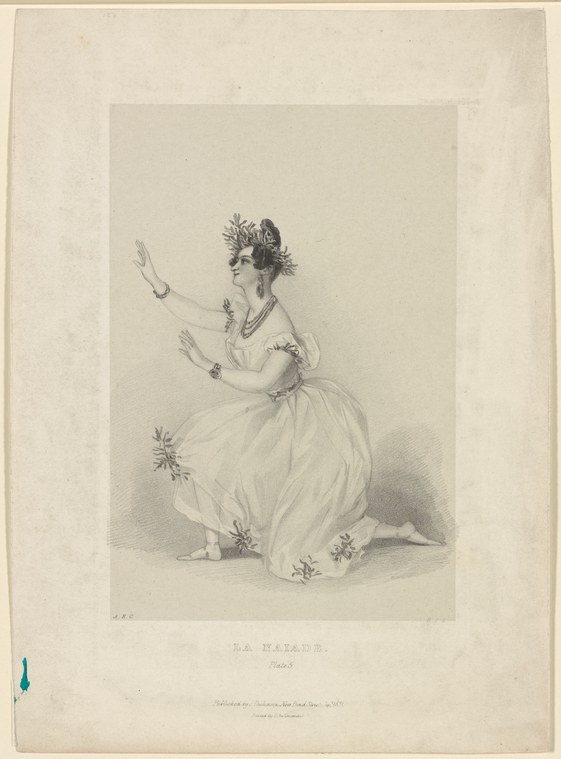
A young woman in Romantic-era dress stands in a graceful, balletic pose against a plain background. She wears a white muslin gown with a fitted bodice and full skirt that falls to mid-calf, the fabric rendered with careful attention to its voluminous folds and soft drape. Her dark hair is styled up and adorned with what appears to be a decorative comb or ornament. Her posture is characteristically balletic: one arm is raised to shoulder height with a gentle curve, the other extended to the side, and her weight appears to be on one leg in a stance suggesting elevation or the preparation for it. Most distinctively, she holds bouquets of small flowers—visible in her raised hand and scattered at her feet on the ground—which transforms this from a simple dance study into a narrative moment. The setting is indeterminate, a plain wash without landscape or interior detail, which keeps focus entirely on the figure and her gesture.
The dancing
The dancer is solitary, her body arranged in a balletic frame characteristic of early nineteenth-century practice. Her arms are held in a soft, rounded position rather than the rigid geometry of earlier eras; her raised arm curves gently from the shoulder. Her torso is upright and elongated, and her stance suggests she is either on relevé (rising onto the balls of the feet) or captured in the moment of a leap. The flowers she holds and the scattered blooms at her feet suggest she is in motion—perhaps scattering petals as part of the choreography—or pausing in a gesture of offering or commemoration. There is no partner; this is a solo female dancer.
The dance depicted
This is almost certainly a Romantic ballet, most likely depicting a naiad or water nymph—the title *La Naiade* confirms this. The naiad was a stock character in early nineteenth-century ballet, often portrayed as a sylph-like creature associated with nature, water, and the supernatural. The flowers and the ethereal, weightless quality of the pose align perfectly with the Romantic aesthetic that dominated ballet from the 1830s onward. The costume—a simple white muslin gown without pointe shoes visible and with the skirt ending above the ankle—is consistent with the era before the full development of the pointe technique and the longer tutus of mid-century ballet. The soft, graceful arm positions and the suggestion of elevation place this firmly within the theatrical vocabulary of Romantic ballet rather than any folk or social dance.
How it was made
This is a lithograph or engraving—most likely a lithograph given the soft gradations of tone and the way the figure emerges from the pale background. The technique allows for careful modeling of the fabrics, particularly the delicate rendering of the muslin gown's folds and the shading that gives the figure three-dimensionality. The simplicity of the background and the focus on the single figure suggest this was a study or promotional print, possibly from a published collection of lithographs documenting roles and dancers of the period. Such prints were common in the 1830s–1840s and circulated widely to document celebrated performers and celebrated roles, making them important records of how these dances were actually performed and understood.
About this work
This lithograph documents a moment from Romantic ballet, capturing a dancer in the role of a naiad—a water nymph or nature spirit, one of the archetypal Romantic characters. The work is undated and unattributed, but the style of dress, the balletic vocabulary, and the iconography all point to the 1830s–1850s, the height of the Romantic ballet era. The image preserves not just a pose but a whole aesthetic: the emphasis on grace, weightlessness, and connection to the natural world that defined early nineteenth-century ballet in France and across Europe. The flowers scattered at the dancer's feet are not incidental detail but part of the choreography and meaning—linking the dancer to nature and to the themes of loss, ephemerality, and beauty that haunted Romantic art.
How to look at it
Look first at the pose itself: the raised arm, the elongated torso, the suggestion of elevation. This is not a pose of social dancing or folk movement, but a carefully composed balletic moment that required trained technique. Notice the flowers—not merely decoration, but part of the choreography and meaning. The artist has chosen to freeze the moment at a point of apparent suspension or weightlessness, capturing the Romantic ideal of the ethereal dancer. The plain background focuses all attention on the figure and her gesture, a compositional choice that emphasizes the character as a timeless ideal rather than a figure in a specific place.
The period
The 1830s and 1840s were the golden age of Romantic ballet. Ballets featuring supernatural or sylph-like female characters—among them *La Sylphide* (1832), *Giselle* (1841), and many smaller works—dominated European stages. These works reflected broader Romantic cultural interests in nature, melancholy, the supernatural, and the ideal of transcendent female beauty. Naiads and water nymphs appeared frequently in both painting and dance during this period, often as symbols of fleeting beauty and connection to the natural world. In visual art, lithography had become the dominant medium for documenting theatrical performance, making prints like this one crucial records of how performers moved and how audiences understood the roles they performed.
Where it lives
The print is held in the New York Public Library's collection of prints depicting dance. It is an example of the lithographs and engravings that documented theatrical performance in the nineteenth century, circulated to the public as souvenirs and records of celebrated roles.
Dance in this work
Questions about this work
What is a naiad and why does it appear in ballet?
A naiad is a water nymph from classical mythology. In Romantic ballet, naiads and similar supernatural female characters embodied the era's fascination with nature, the otherworldly, and the ideal of ethereal female beauty. The naiad allowed choreographers and dancers to explore weightlessness, grace, and the connection between movement and nature.
What do the flowers mean?
The flowers are both literal and symbolic. In performance, the dancer likely scattered them as part of the choreography, creating a visual link between the dancer and nature. Symbolically, flowers in Romantic art often evoke beauty, youth, ephemerality, and melancholy—themes central to Romantic ballet.
When was this made and who is the dancer?
The print is undated and unattributed. Based on the costume, style, and aesthetic, it almost certainly dates to the 1830s–1850s, the height of Romantic ballet. Without a signature or inscription, we cannot identify the specific dancer or even the specific ballet, though the role of naiad appears in many works of the period.
Why is this a lithograph and not a painting?
Lithography was the dominant medium for documenting theatrical performance in the nineteenth century. It allowed for relatively inexpensive, reproducible prints that could be widely distributed as souvenirs, promotional materials, and historical records. A lithograph could be in the hands of theatre-goers and collectors within weeks of a famous performance.
More dance artwork





