49 works in this view — arrow keys or swipe to move between them.
Dance in Art
Pulcinella
Unknown artist
- Collection:
- Prints depicting dance
- Source:
- New York Public Library
- Rights:
- Public domain — free to use, share and adapt.
- Recorded as:
- Public Domain
Pulcinella represents the living link between folk physical comedy and theatrical dance. His character demonstrates that early modern performance was not divided between 'dance' and 'theatre' but integrated physical wit, acrobatics, and rhythmic movement into a single vocabulary. For dance historians, Pulcinella is essential evidence that the street performer's body—comic, athletic, improvisatory—was as foundational to European performance culture as the court dancer's, and that popular physical culture persistently influenced elite theatrical forms.
What you are looking at
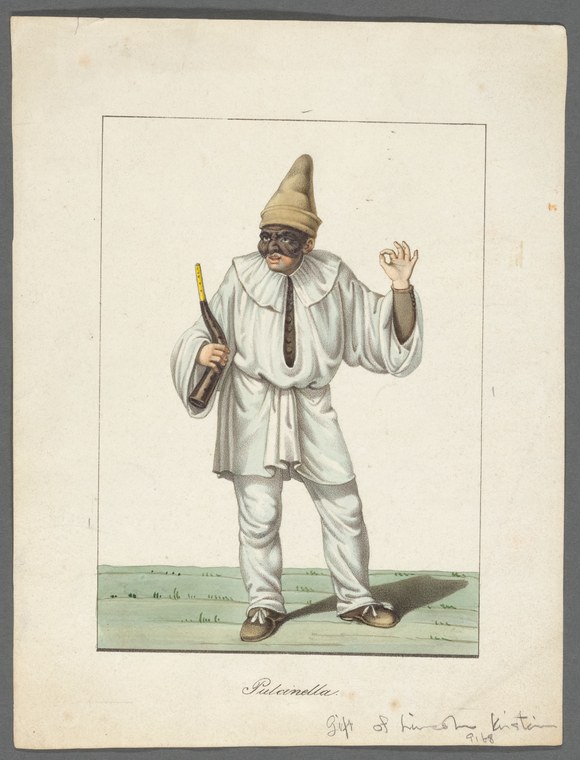
A single male figure dominates the composition, standing against a plain background with a green ground line. He wears an all-white costume consisting of a loose tunic or shirt with a large white collar, white hose or leggings, and brown shoes. His most distinctive feature is a tall, conical yellow hat with a pointed crown. He has a dark complexion and wears a prominent mustache. His right arm is raised with the hand open in a gestural pose, while his left arm holds what appears to be a small club or stick. His body is turned slightly, with weight settled on both feet, in a stance that suggests readiness for movement or performance. The figure's expression and bearing convey a theatrical character rather than naturalistic portraiture.
The dancing
A single standing figure in theatrical dress, weight evenly distributed across both feet with a grounded, frontal stance. The right arm is raised to approximately shoulder height with palm open in an expressive, communicative gesture. The left arm is bent, holding a small implement. The torso is relaxed but alert, the shoulders squared to the viewer. This posture is consistent with a performer at rest or presenting himself to an audience, rather than captured mid-movement.
The dance depicted
This is Pulcinella, a stock character from commedia dell'arte, a form of Italian improvised comedy-theatre that included stylized dance and physical comedy. Pulcinella was known for his acrobatic antics, comic gestures, and distinctive physical vocabulary that blended dance, mime, and slapstick. The figure's pose here—frontal, gestural, with raised arm and held prop—represents the character in performance mode, ready to engage an audience. The stance and gesture are comedic and theatrical rather than balletic, reflecting commedia's emphasis on character and physical wit over formal dance technique.
How it was made
This is a hand-colored engraving or print, evidenced by the fine linear work visible in the hat, face, and fabric rendering, combined with watercolor or gouache wash in the flesh tones, costume, and ground. The technique allowed for wide circulation of the image and reproducibility—multiple impressions could be distributed across Europe. Hand coloring was added afterward by artisans, making each print slightly individual. This production method and distribution model suggest the work was part of a commercial series documenting commedia dell'arte characters, likely created for theatrical audiences, collectors, or performers.
About this work
Pulcinella, a foundational character of Italian commedia dell'arte, was a comic-acrobatic performer known throughout Renaissance and early modern Europe. This print captures him in characteristic pose: costumed, gestural, and ready to perform. Commedia dell'arte performance was built on physical comedy, rapid-fire movement, and improvisation, and while not dance in the formal sense, it was fundamentally choreographic—performers trained in specific physical vocabularies, stock routines, and ensemble coordination. Pulcinella's physical comedy, acrobatic tricks, and balletic comic moments made commedia a crucial precursor to pantomime and to the later integration of comedic dance into ballet and theatrical forms. The character's endurance—appearing in Stravinsky's 1920 ballet and countless adaptations—speaks to the physical and theatrical power his type embodied.
How to look at it
Notice the character's frontal address to the viewer—this is a performer presenting himself, not a candid moment. The raised arm and open palm are the language of commedia gesture: communicative, inviting, comedic. The small club or stick (likely a slapstick or bauble prop) is a physical gag device. The tall hat, mustache, and white costume are instantly recognizable markers of identity. This is not a dancer's pose in the academic sense; it is a performer's ready stance, capturing the character in the moment of theatrical address—the frozen instant before or between comic business.
The period
Commedia dell'arte emerged in mid-16th-century Italy and remained the dominant popular theatrical form across Europe through the 18th century. The form relied on a stock of recurring characters (Pulcinella, Arlecchino, Pantalone, and others), each with a defined physical vocabulary and comic persona. Performers trained from childhood in acrobatics, tumbling, sword-play, and stylized gesture. By the 16th and 17th centuries, commedia troupes were celebrated across Europe and influenced court entertainments, court ballet, and eventually high theatrical forms. Prints of commedia characters circulated widely, functioning as both advertisements for touring troupes and as collectible records of famous performers and celebrated roles. Pulcinella in particular was ubiquitous in prints and paintings, reflecting his status as one of the most recognizable and beloved characters.
Where it lives
This work is held in the Prints collection at the New York Public Library. It is part of a broader archival series documenting European theatrical practice and popular performance, particularly commedia dell'arte imagery that circulated in print form across the 16th–18th centuries.
Dance in this work
Questions about this work
Is this a dancer or an actor?
Pulcinella is both. Commedia dell'arte performers were trained in acrobatics, tumbling, and stylized physical action that blended comedy, dance, and mime. The distinction between 'dance' and 'theatre' did not exist in the way we use it today. Pulcinella's physical vocabulary was choreographed, learned, and repeatable—he was as much a dancer as a comic actor.
Why does this character matter to dance history?
Pulcinella represents a continuous thread of popular, athletic, comic physical performance that influenced European dance at every level. His character type appears in court ballet, in 18th-century pantomime, and most famously in Stravinsky's 1920 ballet Pulcinella. He demonstrates that 'folk' or popular performance was not separate from theatrical dance but foundational to it.
What is that stick he is holding?
It is a slapstick or bauble—a prop used in commedia for physical comedy and sound effects. Striking it produced a loud crack that punctuated comic action. It is both a practical tool and a symbol of the character's comedic role.
How do we know this is from the commedia dell'arte period?
The costume is the canonical Pulcinella outfit: white tunic, white hose, conical hat, and mustache. This costume is documented in countless prints from the 16th–18th centuries. The print style and technique are consistent with early modern engraving and hand-coloring practices used to circulate theatrical imagery.
More dance artwork





