49 works in this view — arrow keys or swipe to move between them.
Dance in Art
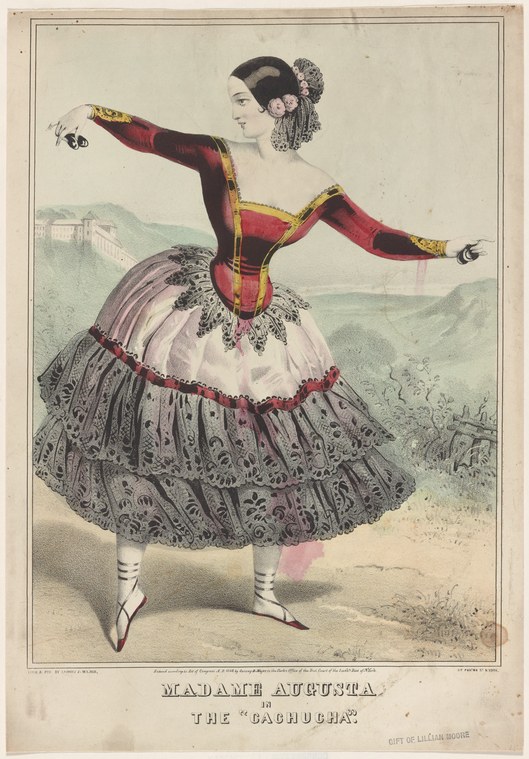
Madame Augusta in the "Cachucha"
Unknown artist
- Collection:
- Prints depicting dance
- Source:
- New York Public Library
- Rights:
- Public domain — free to use, share and adapt.
- Recorded as:
- Public Domain
The Cachucha is historically significant as one of the first widely successful examples of a non-European dance vocabulary being incorporated into Western theatrical dance without being marginalized or exoticized into a grotesque caricature. It demonstrates how the Romantic era's fascination with national character and exotic locales manifested in actual choreographic practice. The print itself is evidence of how 19th-century dancers built celebrity and income through the merchandising of their own images—a practice that continues in contemporary dance.
What you are looking at
A single female dancer in theatrical costume stands in a dynamic pose against a landscape background. She wears a deep red velvet bodice with gold trim, fitted tightly at the waist, paired with a voluminous skirt of pale silk or tulle decorated with intricate black lace or embroidered patterns, gathered with a red band at the hem. Her dark hair is pulled back into an elaborate braided knot adorned with what appears to be a jeweled or beaded ornament. White stockings and pointe-like shoes complete the ensemble. Her arms are extended in an arabesque-like position, with the right arm stretched forward and the left extended behind, her body caught mid-movement in an attitude of theatrical grace. The background shows a misty, hilly landscape rendered in soft greens and grays, establishing an outdoor or pastoral setting. The composition emphasizes the dancer's elegant line and the spectacular breadth of the skirt.
The dancing
The dancer stands on or near her supporting leg with apparent weight distribution suggesting classical theatrical training. Her extended arms create an open fifth-position frame characteristic of trained ballet dancers, with elongated fingers and a lifted, composed carriage through the torso. The extended back leg and forward arm position suggest either arabesque or a pose derived from classical vocabulary. The body demonstrates control and turnout, with the dancer's alignment suggesting the technical vocabulary of 19th-century academic dance training.
The dance depicted
This depicts the Cachucha, a lively Spanish dance that became a sensation in European theatrical dance during the 1830s–1840s. The Cachucha blended Spanish folk movement vocabulary with the technical precision of Romantic ballet, typically performed as a solo showpiece by celebrated dancers. The figure of Madame Augusta—likely the Spanish dancer Augusta Maywood or another prominent performer of the era who specialized in this role—suggests this is a theatrical interpretation rather than authentic Spanish folk practice. The voluminous skirt, the classical arm vocabulary, and the theatrical framing all indicate that this is the Cachucha as it was performed on the European stage: a hybrid form that took Spanish rhythmic and movement character and translated it into the balletic language of the period.
How it was made
This is a hand-colored engraving or lithograph, as indicated by the fine line work, the applied color wash, and the printing techniques visible in the rendering. The artist has used aquatint or hand coloring to achieve the soft, atmospheric landscape background and the detailed rendering of the textile patterns on the skirt. The technique allowed for mass circulation; such prints were affordable and popular souvenirs of celebrated dancers and performances, distributed through print shops to theater audiences and dance enthusiasts. The inscription at the bottom—"MADAME AUGUSTA IN THE 'CACHUCHA'"—confirms this was a commercial theatrical print, likely published to capitalize on the dancer's fame.
About this work
This hand-colored engraving celebrates the Cachucha as it existed in Romantic-era European theater—a Spanish dance adapted for the classical ballet stage. The image captures a pivotal moment in dance history when folk vocabularies from the Iberian Peninsula entered elite theatrical practice, mediated through the bodies and technique of international ballet stars. The Cachucha represented both exoticism and national identity; it was *other* enough to be thrilling, yet refined enough to be acceptable in opera houses and theaters frequented by aristocratic audiences. The print itself is a document of 19th-century dance celebrity culture: Madame Augusta's name in the title reflects how individual dancers, not choreographers or companies, were the commercial draw. The image shows how the Romantic ballet world consumed and promoted dance through prints, photographs, and sheet music covers.
How to look at it
The artist has frozen the dancer at the apex of a phrase, in a pose of complete control and theatrical stillness—not a moment of stepping or traveling, but a display pose designed to showcase the dancer's line and the spectacle of her costume. This reflects the compositional strategy of 19th-century dance portraiture, which prioritized readable elegance and the monumental presentation of the individual dancer over the capture of motion or the representation of a specific choreographic phrase. The landscape background, though sketchy, establishes this as a theatrical rather than documentary image; it is a romanticized vision of the dancer in character rather than a record of an actual stage set. Pay attention to how the artist has rendered the skirt fabric—the intricate patterning and volume are as much a subject of the image as the dancer herself, reflecting how costume was integral to the Romantic ballet star's appeal.
The artist
The artist is not recorded. However, the style, technique, and printing practices are consistent with commercial theater prints produced in Paris and London during the 1830s–1840s, a period when lithography and hand-colored engraving were the standard media for theatrical portraiture and dance documentation. The work would have been produced by a commercial print publisher catering to theater audiences rather than a fine artist working on commission.
The period
The Cachucha rose to fame during the height of the Romantic ballet era (1830s–1840s), when dancers like Carlotta Grisi, Marie Taglioni, and Fanny Elssler performed as soloists in ballets and as independent artists in theater productions. The Cachucha itself became famous through Fanny Elssler's performances and was subsequently taken up by other celebrated dancers including Augusta Maywood. This period saw intense international competition among European and American dancers, and the Cachucha—associated with Spanish passion and folk authenticity—became a signature vehicle for demonstrating virtuosity and star quality. Theater prints like this one were essential to building and maintaining a dancer's reputation across cities and countries, serving as portable advertisements in an age before photography or cinema.
Where it lives
This print is held in the New York Public Library's collection of prints depicting dance, part of a broader archive of 19th-century theatrical and dance documentation. The inscription and catalog information indicate it was a commercial publication, likely sold in theater lobbies or through print shops in European capitals.
Dance in this work
Questions about this work
Who was Madame Augusta?
The most likely candidate is Augusta Maywood (1825–1876), an American-born dancer who became a European star and was celebrated for her interpretations of Spanish dances including the Cachucha. However, the print inscription alone does not definitively identify which Augusta danced this role; it was a signature piece for multiple dancers of the era. The title tells us she was celebrated enough to carry a print on her name alone.
What is the Cachucha, and is this authentic Spanish dance?
The Cachucha is a Spanish dance in triple meter with characteristic rhythmic and movement qualities. What is shown here is the Cachucha as adapted for the European theater stage—refined, set to classical ballet vocabulary, and performed by a trained ballet dancer in theatrical costume. It is not an ethnographic documentation of Spanish folk dance, but rather a 19th-century hybrid form that drew on Spanish character while operating within the technical and aesthetic conventions of Romantic ballet.
Why was this print made and how was it used?
Commercial theater prints served multiple purposes: they were souvenirs sold to audiences after performances, advertisements for touring dancers, and documents of celebrity that circulated among dance enthusiasts. They helped build and maintain a dancer's reputation across different cities and countries. Owning a print of a celebrated dancer was equivalent to owning a photograph or poster of a modern star—a way of participating in fan culture.
What does the costume tell us?
The voluminous skirt, jeweled bodice, and careful grooming reflect the expense and status of a successful theater dancer; only celebrated soloists could command the resources for such elaborate costumes. The hybrid style—red velvet bodice suggesting Spanish character, but the silhouette and proportions clearly derived from Romantic ballet fashion—visually encodes the dance's position as a European appropriation of Spanish material.
More dance artwork





