49 works in this view — arrow keys or swipe to move between them.
Dance in Art
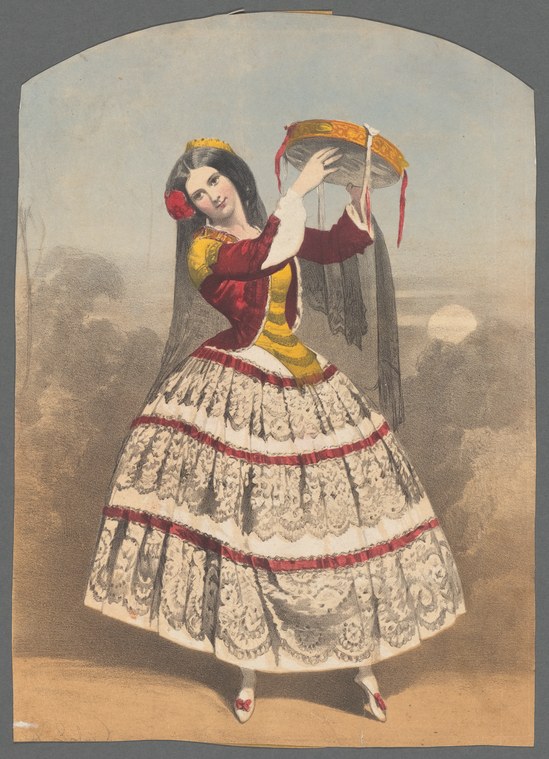
Female dancer with tambourine
Unknown artist
- Collection:
- Prints depicting dance
- Source:
- New York Public Library
- Rights:
- Public domain — free to use, share and adapt.
- Recorded as:
- Public Domain
This print is essential evidence for how professional dancers were marketed, costured, and remembered in the 19th century. It shows the boundary between live performance and its mechanical reproduction—a crucial moment in theater history—and documents the iconography of a specific dance role or character type. For historians of costume, gender, and theatrical celebrity, the work offers a direct window into how dancers' bodies and labor were packaged for public sale.
What you are looking at
A young woman in theatrical dress stands alone against a diffuse, clouded background, holding aloft a tambourine with both hands. She wears a white lace skirt with deep red or maroon ribbons dividing it into three flounced tiers, and a fitted bodice in deep red or burgundy silk with yellow brocade or trim at the front. A black lace shawl or fichu drapes from her shoulders. Her dark hair is crowned with a small tiara or ornamental headpiece, and red roses or pom-poms sit at her ears. She gazes upward with a gentle, almost reverent expression. The pose is stationary but energetic—her arms raised and extended, the tambourine held at an angle as though about to be struck or already caught in motion. The figure occupies the center of the composition, and the soft, atmospheric background suggests a stage lit by gaslight or early electric stage lighting, with no other figures or props visible. The work is a hand-colored theatrical print, likely from a portrait series of popular dancers or roles.
The dancing
The dancer stands in an upright, elongated frame with her weight evenly distributed on both feet. Both arms are raised and extended slightly outward from the body, holding the tambourine aloft at shoulder height and slightly forward of the body's center line. The pose is frontal and stable—not a mid-leap or mid-turn, but a held moment of presentation. Her upper body is straight, her gaze directed upward, creating a sense of aspiration or performance toward an audience. The raised arms and the object suggest instrumental rather than pure body-based dance movement; this is a dancer who plays as she dances.
The dance depicted
This appears to be a European theatrical dance figure from the 19th century, most likely a Romantic ballet or a light operatic or pantomimic dance role. The tambourine, the Spanish-influenced costume with lace and bright ribbons, and the statuesque pose suggest either a character role (possibly Spanish or Gypsy-coded) or a soubrettish comic or demi-caractère role in grand opera or ballet. The image does not show active footwork or complex partnering, and the costume is too ornate and stage-specific for folk dance documentation. The upward gaze and the formal, nearly devotional quality of the pose suggest theatrical spectacle and audience address rather than social or participatory dance. Without an inscription or signature, the specific character and role cannot be determined, but the style and execution point to a professional dancer of some prominence, captured by a print-maker serving the mid-19th-century appetite for theatrical souvenirs.
How it was made
This is a hand-colored lithograph or chromolithograph, identified by the soft color transitions, the absence of fine engraved line-work, and the even application of color in flat areas. The printing technique allowed for relatively rapid, affordable mass production of theatrical portraits, making these prints affordable souvenirs and advertising for performers and roles. The hand-coloring—visible in the slightly uneven application of red pigment and the delicate tinting of skin—suggests that colored impressions were added after the stone or plate was printed, a common practice for popular theatrical prints. The soft, atmospheric background is characteristic of lithographic stone work, which could render subtle gradations of tone. The quality and finish suggest this was a commercial product of moderate cost, created for distribution in theater lobbies or by subscription, not a fine art print or private commission.
About this work
This is a hand-colored theatrical print documenting a professional stage performer in the Romantic or early Victorian era, captured in costume and character as a tambourine-playing dancer or actress. The figure's formal pose, ornate costume, and theatrical presentation make clear that this is a commercial theatrical souvenir—a print made to be sold to admirers and circulated among theater-goers. The work sits within the long tradition of theatrical portraiture in print, a genre that flourished in the 19th century as a bridge between live performance and the print market. Such images tell us what dancers wore, what roles were popular, and how the dancing body was framed for public consumption and memory.
The image is significant because it documents a moment when dance was increasingly professionalized, commodified, and mediated through mechanical reproduction. The tambourine, the upward gaze, and the statuesque bearing all speak to a particular aesthetic of theatrical dance in the mid-19th century—one that blended classical training with exotic or picturesque costuming, and which valued visual spectacle and character portrayal alongside technical virtuosity.
How to look at it
Look first at the pose: the dancer is not caught in action but is held in a formal, presentational moment—arms aloft, gaze upward—which suggests a moment of triumph or aspiration rather than a movement phrase. This is a portrait pose adapted to a dancing figure, not a naturalistic capture of motion. Observe the costume closely: the elaborate lace, the bright ribbon trim, and the ornamental headpiece and ear ornaments are all stage elements designed to be read from a distance and to signal a character type. The tambourine is the key prop—it tells you this dancer played an instrument as part of her role. The soft, almost luminous background is characteristic of 19th-century stage lighting effects, and the overall effect is one of visual spectacle rather than kinetic energy.
The period
This work dates from the mid-to-late 19th century, an era in which lithographic and chromolithographic printing transformed the circulation of theatrical images. The Romantic ballet had dominated European stages from the 1830s through the 1850s, and character roles—especially those coded as Spanish, Gypsy, or exotic—remained popular through the Victorian era. Operetta and light opera also grew in commercial importance from mid-century onward, and their costumes were more ornate and colorful than classical ballet, as this image reflects. The tambourine-playing dancer is likely either a character in ballet d'action or a role in grand opera or operetta. The hand-coloring of prints was standard practice before chromolithography became fully dominant, so this work sits in a transitional period technologically.
Where it lives
The work is part of the New York Public Library's collection of theatrical prints and dance imagery. It is catalogued as a print depicting a female dancer with a tambourine, likely produced and distributed in the mid-19th century as a theatrical souvenir or portrait.
Dance in this work
Questions about this work
What is the dancer holding?
A tambourine, a percussion instrument with a wooden or metal frame and metal jingles. Its presence suggests the dancer played an instrument as part of her role or performance, which was common in pantomimic, operatic, and character dance roles of the 19th century.
What kind of dance is this?
The costume, pose, and tambourine suggest a European theatrical dance from the Romantic ballet era or from grand opera or operetta—likely a character role coded as Spanish, Gypsy, or exotic. The formal, upright pose and the absence of active footwork indicate this is a portrait of a role or character rather than documentation of a movement technique.
Why is this print hand-colored?
This is a lithograph that was printed and then colored by hand—a standard practice in the mid-19th century before chromolithography became economical. Hand-coloring made theatrical prints more appealing and affordable to buy, and ensured that the bright costumes were accurately represented in color.
Who was the dancer?
The print is not inscribed with a name, so the specific dancer and role are not recorded in the catalogue. However, the professional quality and theatrical distribution suggest this was a well-known performer of the era.
More dance artwork





