49 works in this view — arrow keys or swipe to move between them.
Dance in Art
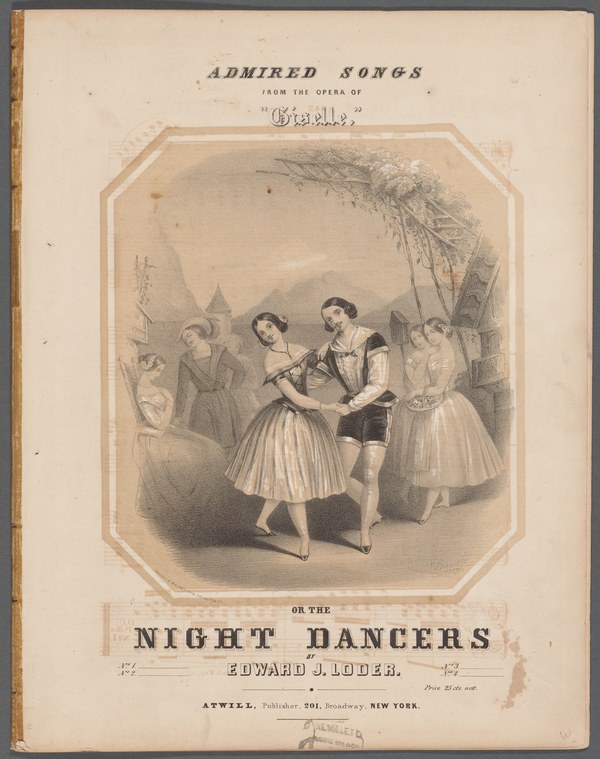
Admired songs from the opera of "Giselle" or the Night dancers
Unknown artist
- Collection:
- Prints depicting dance
- Source:
- New York Public Library
- Rights:
- Public domain — free to use, share and adapt.
- Recorded as:
- Public Domain
This print preserves the visual aesthetic and technical ideals of romantic ballet at a moment when the style was at the height of its cultural influence. For dancers and historians, it offers evidence of how the defining technical and narrative elements of *Giselle*—particularly the illusion of female weightlessness and the male dancer's supporting role—were understood and represented in the nineteenth century. The existence of such prints in America suggests that romantic ballet had already crossed the Atlantic and become part of transatlantic theatrical culture.
What you are looking at
A theatrical scene depicts a group of dancers in a moonlit forest or garden setting, with a large willow tree dominating the right side of the composition. In the center, a male dancer in dark clothing supports a female dancer in a pale tulle skirt who appears weightless, her body arched backward in an attitude of ethereal suspension. Around them, four other female dancers in similar gauzy white costumes stand in graceful poses, some with arms raised, creating a dreamlike tableau. The lighting is rendered in pale tones with dramatic shading that suggests nocturnal enchantment. The setting and the dancers' costumes—high-waisted, translucent skirts and the supernatural weightlessness of the central female figure—evoke the world of the supernatural beings known as sylphs or willis. The composition is framed by a decorative octagonal border printed in the period style.
The dancing
The central male dancer stands in a supporting role, his body angled to bear the weight of the woman he elevates. The principal female dancer is captured in a moment of apparent weightlessness, her torso arched back, her legs extended, her arms positioned asymmetrically—one raised, creating a line of elegant extension. The surrounding female figures are posed in varied attitudes of classical refinement: some with arms raised in ports de bras, others standing with the upright posture and turned-out legs characteristic of ballet training. The dancers occupy multiple planes in depth, creating a sense of a supernatural gathering rather than a coordinated ensemble in unison.
The dance depicted
This is imagery from Adolphe Adam's *Giselle*, the romantic ballet that premiered in Paris in 1841 and became one of the most performed works in the classical ballet canon. The scene depicted is almost certainly Act II, in which Giselle has been transformed into a wili—a spirit of a maiden who died before her wedding—and dances with her supernatural sisters in the moonlit graveyard. The central lift, with the male dancer supporting the female in an attitude of impossible lightness, became one of the signature technical achievements of romantic ballet and a visual metaphor for the otherworldly nature of the female dancer. The surrounding maidens represent the corps de ballet of willis that populated the romantic stage.
How it was made
This is a hand-colored engraving or lithograph, a reproductive print designed for mass circulation. The soft gradations of tone, particularly in the atmospheric rendering of moonlight and foliage, suggest lithography, a technique that allowed for more nuanced tonal control than wood or steel engraving. The decorative border and the publication information at the base—'ATWILL, Publisher, 501 Broadway, New York'—indicate this was a commercial print issued in the United States during the mid-nineteenth century. Such prints were affordable visual merchandise aimed at the theater-going public and served as souvenirs of celebrated performances or as promotional material for touring companies.
About this work
This is a mid-nineteenth-century theatrical print celebrating a scene from *Giselle*, Adolphe Adam's romantic ballet. It captures the visual and technical ideals of romantic ballet at its height: the ethereal weightlessness of the female dancer, the supporting role of the male performer, the supernatural subject matter, and the aesthetic of pale tulle and moonlit enchantment that defined the era. The print was issued in New York by Atwill, one of the major theatrical publishers of the period, indicating that *Giselle* was already in circulation in America and formed part of the cultural vocabulary of the mid-century theater public. It belongs in a gallery of dance imagery because it documents not only a canonical work but also the visual conventions through which romantic ballet was understood and marketed.
How to look at it
Attend to the central lift: it is the visual and technical heart of the composition and of the romantic ballet aesthetic it represents. The artist chose to freeze the moment of maximum elevation and lightness, the instant in which the male dancer's support is most invisible and the female dancer appears most supernatural. Notice how the surrounding willis are posed in attitudes that emphasize verticality and elongation—the raised arms, the turned-out legs, the upright carriage—all of which reinforce the otherworldly refinement of the scene. The moonlit, atmospheric setting is rendered through soft tonal gradations that emphasize the ethereal quality of the scene.
The artist
The artist is not recorded in the catalogue, but the work is identified as a song publication for the opera or ballet *Giselle* by composer Edward J. Loder, published by Atwill in New York. Atwill was a major theatrical and musical publisher active in New York from the 1830s through the 1870s, specializing in prints, sheet music, and theatrical imagery that served both as commercial products and promotional material for performances. The engraver or lithographer is unknown, but the quality of the print and its professional hand-coloring suggest a skilled theatrical publishing house.
The period
The romantic ballet reached its artistic peak in the 1840s and 1850s, with *Giselle* (1841) representing one of its supreme achievements. This print dates to the mid-nineteenth century, a period when romantic ideals—the elevation of the ethereal, the supernatural, the unattainable female—dominated not only ballet but also literature, music, and the visual arts. In America, the dissemination of such prints alongside the touring of European ballet companies helped establish ballet as a fashionable cultural pursuit among the urban middle class. The print's publication in New York reflects the city's emergence as a major theatrical center and the appetite among American audiences for images of celebrated European performances and performers.
Where it lives
This is a hand-colored theatrical print held in the New York Public Library's Prints collection. It was issued by Atwill, a New York publisher, as part of a series of affordable prints based on celebrated theatrical productions. Such prints were intended for the theater-going public and served as both souvenirs and visual documentation of performances.
Dance in this work
Questions about this work
What is Act II of Giselle about?
In Act II, Giselle has died and been transformed into a wili, a spirit of a maiden who died before her wedding. She dances in a moonlit graveyard with her supernatural sisters. The act is famous for its technical demands on the female dancer—particularly pointe work, ethereal quality, and weightlessness—and for the iconic moment in which the male dancer (Albrecht) supports her in a soaring lift.
Who created Giselle?
The ballet *Giselle* premiered at the Paris Opéra in 1841 with choreography by Jean Coralli and Jules Perrot, music by Adolphe Adam, and a libretto by Théophile Gautier and Henri Saint-Léon. The role of Giselle was created by the dancer Carlotta Grisi.
What is a lithograph and why use it for theatrical prints?
Lithography is a printing technique based on the principle that oil and water do not mix. An artist draws on a smooth stone with a greasy crayon, which is then treated with chemicals to fix the image. The stone is dampened and rolled with greasy ink, which adheres only to the drawn areas. Lithography allowed for soft tonal gradations and atmospheric effects impossible in wood or steel engraving, making it ideal for the moody, moonlit effects of romantic theatrical imagery.
When did Giselle arrive in America?
The ballet was performed in America in the 1840s and 1850s by touring European companies. This print, published by Atwill in New York, indicates that *Giselle* was already in circulation and had achieved sufficient popularity to justify commercial theatrical prints based on scenes from the ballet.
More dance artwork





