49 works in this view — arrow keys or swipe to move between them.
Dance in Art
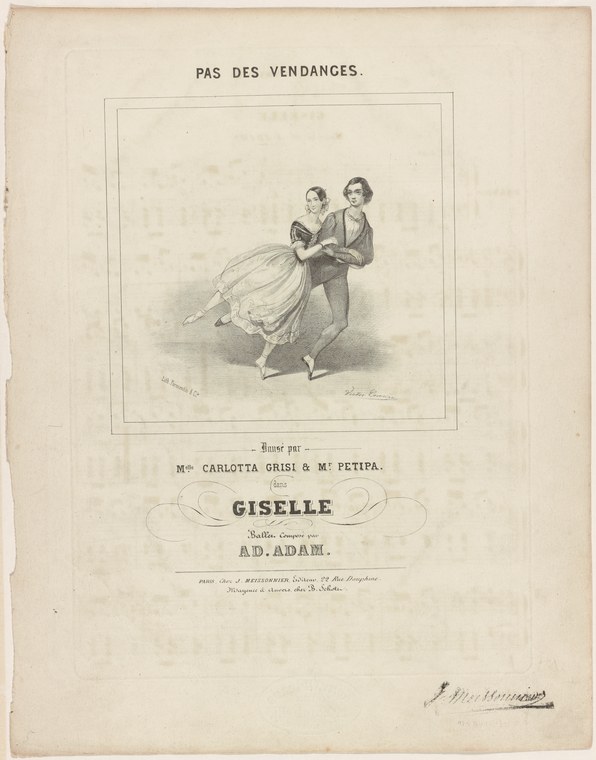
Pas des vendanges. Dansé par Melle. Carlotta Grisi & Mr. Petipa dans Giselle. Ballet composé par Ad. Adam
Unknown artist
- Collection:
- Prints depicting dance
- Source:
- New York Public Library
- Rights:
- Public domain — free to use, share and adapt.
- Recorded as:
- Public Domain
Giselle survives in the modern repertory, but the technique and style of its earliest performances is known largely through prints like this. This image shows the actual bodies, the actual holds, the actual weight-distribution of 1840s Romantic ballet—not a later reconstruction or photograph made decades after. It is evidence of how Petipa, one of the most influential male dancers and later choreographers of the 19th century, partnered; and of Grisi's technical and expressive vocabulary at the height of her career.
What you are looking at
A man in dark tailcoat and pale trousers supports a woman in a full white Romantic-era tutu as she leans backward in an attitude of surrender or distress. The woman's body arches away from him, her right leg extended, her left arm reaching upward in an expressive gesture. The composition is intimate and theatrical: the man's face is turned toward hers with an expression of concern or intensity, while her gaze is directed away. The background is plain, throwing all focus onto the pair and their physical relationship. The print is finely rendered in lithographic tone, with careful attention to the fall of fabric, the modeling of limbs, and the emotional charge of the pose.
The dancing
The man stands firmly planted, providing a stable base while supporting the woman's considerable weight as she extends backward in an unbalanced position—a classic Romantic-era supported adagio. His right arm supports her waist; his left appears to steady her extended leg. The woman's posture is one of complete dependence on her partner's strength: her torso is nearly horizontal, her free leg extended, her upper body arched. This is not a symmetrical or mutual embrace but a display of male strength and female lightness, central to Romantic ballet vocabulary. The relative scale and positioning show mastery of the supporting relationship fundamental to ballet partnering.
The dance depicted
This depicts a moment from Giselle, specifically the 'Pas des vendanges' (Vintage Dance) performed by Carlotta Grisi and Marius Petipa. The image captures a supported adagio—a hallmark of Romantic ballet in which the male dancer displays his partner's extension and fluidity while she appears weightless and ethereal. The vineyard setting of the pas des vendanges (the ballet is set in a wine-growing region) would have been conveyed through costume and staging rather than background detail here. The print documents the actual movement vocabulary and partnering technique of 1840s ballet, showing how Petipa supported Grisi's famously light and expressive dancing.
How it was made
This is a lithograph, a technique that allowed fine tonal gradation and detail—evident in the careful modeling of the figures' bodies, the luminosity of the tutu, and the subtle shading that creates depth. The inscription identifies the artists and work with precision, suggesting this was a commercial print made for distribution to ballet enthusiasts and the public. Lithography's relatively affordable production meant such prints could reach a wider audience than engraving alone, making this a document intended for sale and viewing in homes and studios of the ballet-going public.
About this work
This lithographed image documents a specific moment in Giselle, one of the foundational works of Romantic ballet, as danced by two of its greatest early interpreters. It is not a theatrical scene-painting but a movement study—a close-up of choreographic vocabulary frozen in time. The print preserves the physical grammar of 1840s supported adagio, showing in concrete form what Romantic partnering looked like: the man as strong, attentive support; the woman as an extension of his strength, apparently weightless and expressive. For historians and dancers, this image is primary source material for how this repertory was actually performed in its moment.
How to look at it
Attend to the man's posture and the angle of his supporting arm: he is not holding the woman decoratively, but absorbing her full weight while she extends away from him in an attitude of complete dependence. This is the core partnering vocabulary of Romantic ballet. The woman's arched back and extended leg would require enormous control and trust; the print captures the aesthetic of effortlessness that Romantic technique aimed for, while the man's visible tension and focus show the labor that made such lightness possible. Note also the dress: her full tutu and his dark formal coat are not costumes for a vineyard scene, but the street clothes of Romantic ballet as it was danced in the theater of the 1840s.
The artist
The artist of the lithograph is not recorded on the print, but the inscription credits the composition to Adolphe Adam, the ballet's composer. The work would have been made shortly after Giselle's premiere in 1841 in Paris, produced by a commercial theatrical print house. Such prints were common accompaniment to successful new ballets, serving as both publicity and memorabilia for audiences.
The period
Giselle premiered in Paris in 1841, at the height of Romanticism in ballet. This was an era in which female dancers dominated the stage, pointe work was becoming standard, tutus were lightening and shortening, and the male dancer's role was increasingly that of supporter rather than principal performer—a reversal from earlier periods. Lithography was the dominant print medium for theatrical documentation and publicity in this period. This print belongs to a rich visual archive of Romantic ballet, created while the style was still in its living moment.
Where it lives
The print is held by the New York Public Library in its Prints collection. It is a commercial theatrical print, made for public sale and distribution shortly after the ballet's premiere. The inscription and attribution are printed on the work itself, suggesting it was produced with the sanction or at least the knowledge of the ballet house and performers.
Dance in this work
Questions about this work
Is this an actual scene from Giselle?
No—it is a lithograph of a specific moment in the 'Pas des vendanges,' a short dance sequence within Act I of Giselle. The print was made for sale to the public and does not attempt to show the full theatrical setting. Rather, it isolates and celebrates the technical moment, the performers, and the partnering vocabulary at the heart of the scene.
Who were Carlotta Grisi and Marius Petipa?
Carlotta Grisi (1819–1899) was an Italian ballerina and the original Giselle in 1841. Marius Petipa (1818–1910) was a French dancer and her partner in the premiere. Petipa went on to become the most influential choreographer of the 19th century, particularly during his long career in Russia. This print captures them at a defining moment in both their careers.
What is the 'Pas des vendanges'?
A 'pas de deux' or short dance duet in Act I of Giselle. The term 'vendanges' refers to the grape harvest; the ballet is set in a wine-growing region, and this dance occurs early in the story, before the tragic turning point. The pas des vendanges showcases the budding romance between Giselle and Albrecht through dance.
What was a lithograph?
A print made by drawing on a specially treated stone and using the principle of oil and water repulsion to create multiple impressions. Lithography was faster and cheaper than engraving and allowed for fine detail and tonal variation. It became the standard medium for theatrical prints, fashion plates, and popular art in the 19th century.
More dance artwork





