49 works in this view — arrow keys or swipe to move between them.
Dance in Art
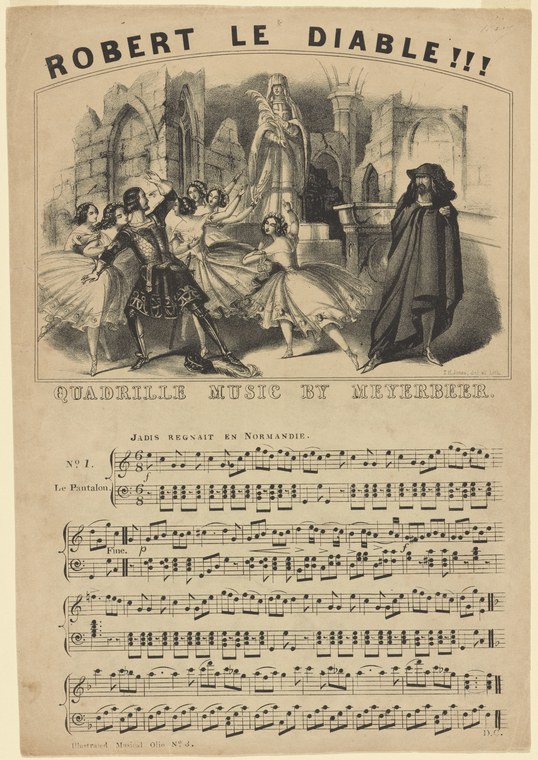
Robert le diable!!! Quadrille music by Meyerbeer
Unknown artist
- Collection:
- Prints depicting dance
- Source:
- New York Public Library
- Rights:
- Public domain — free to use, share and adapt.
- Recorded as:
- Public Domain
This image captures the exact mechanism by which theatrical choreography influenced social dance in the 19th century. It shows dancers not at the opera house but in the moment when that aesthetic was being domesticated, printed, purchased, and performed in ballrooms. The visual link between stage ballet and parlor quadrille is explicit here: the same bodies, the same architectural drama, the same narrative context, now reduced to music and printed instruction for amateur performers.
What you are looking at
An engraved illustration for a quadrille composed by Giacomo Meyerbeer, based on themes from his opera *Robert le diable* (Robert the Devil). The scene depicts a supernatural encounter in a Gothic cathedral interior, with pointed arches and stone walls creating dramatic depth. A tall, caped figure in dark robes—Robert himself—stands at right, observing a group of ethereal female dancers in the center-left. These women, dressed in flowing white gowns with diaphanous skirts, are arranged in a loose formation; their poses suggest swaying, suspended movement rather than grounded steps. The lighting is chiaroscuro, with strong shadows emphasizing the Gothic architecture and the otherworldly quality of the vision. The composition reads as a moment of spectral encounter: the women appear to float or drift rather than walk, their arms raised and bodies arched in attitudes of grace or supplication. This is the famous scene from Act IV of the opera, in which Robert encounters the ghosts of fallen nuns in the cloister.
The dancing
The female dancers occupy a middle ground, their bodies arranged in a loose diagonal line or cluster. Their posture is consistently upright and elongated, with arms raised or extended, suggesting the classical ballet vocabulary of the period. The nearest dancers display a gentle curve of the spine and an ease of carriage consistent with Romantic-era ballet: weightless, ethereal, with skirts rendered as billowing rather than structured. The dark-clad male figure at right is static and commanding, his stance creating an observer's relation to the dance rather than participation in it. The contrast between his earthbound heaviness and the women's apparent lightness is compositional.
The dance depicted
This illustrates the *Quadrille Robert le diable*, a social dance arrangement derived from Meyerbeer's opera, likely dating to the 1830s when the opera premiered. The quadrille was the dominant social dance form in European ballrooms of the era—a square-set dance for four couples—and operatic quadrilles were standard products of the publishing industry. This particular composition references the opera's most famous scene, the supernatural ballet of the nuns. The printed musical score below the illustration shows it is indeed a quadrille, in four-part form typical of the genre. While the image captures the theatrical context and aesthetic of Romantic ballet, it represents not the stage ballet itself but rather how that choreographic vocabulary had been adapted for ballroom performance by the 1830s.
How it was made
This is a wood or steel engraving with hand-applied or chromolithographic color wash, printed as a decorative cover or frontispiece for a sheet-music publication. The technique allowed for fine detail in the figures and architecture, and the inclusion of the printed score below confirms its function as a commercial music publication. Engraving was the standard medium for such works, permitting multiple impressions and wide distribution. The quality of the line work and the composition's sophistication suggest this was a prestigious publication, designed for the middle-class drawing room market where quadrilles were regularly danced and performed.
About this work
This is a hybrid object: part theatrical imagery, part social dance instruction, and entirely a product of early-19th-century popular culture. The illustration documents the moment when the Romantic ballet aesthetic of the stage—weightless, ethereal, supernatural bodies—entered the ballroom through the quadrille, a four-couple social dance that dominated European and American parlors from the 1830s through the end of the century. By publishing operatic quadrilles with elaborate narrative illustrations, music publishers created a commerce in choreographic fantasy: the purchaser could buy not just the music but a visual and narrative link to the opera house. This particular example shows how Meyerbeer's *Robert le diable*, one of the most celebrated operas of the era, was immediately mined for ballroom appeal. The supernatural quality of the scene—Robert's vision of the nuns—made it ideal material for the Romantic imagination and for the marketing of sheet music to aspiring dancers and musicians at home.
How to look at it
Look at the contrast between the static, grounded male figure (Robert) and the weightless, swaying group of female dancers. The artist has conveyed motion through the flow of drapery, the curve of the spine, and the raised arms of the women, while keeping their feet ambiguous or off the ground. The architectural setting—the soaring Gothic arches—frames the dancers and creates a vertical emphasis that reinforces their ethereal quality. The scene is a freeze-frame of theatrical choreography: the artist chose not a climactic moment but a suspended one, capturing the Romantic aesthetic of bodies in a state between motion and stillness. The printed musical score below grounds the image in the practical reality of ballroom dancing: what you are looking at is not a stage scene but a guide to performance in the home.
The period
Meyerbeer's *Robert le diable* premiered at the Académie Royale de Musique in Paris in November 1831 and became an immediate international sensation. The opera's Act IV ballet—the supernatural scene in the cloister—was famous as one of the most spectacularly choreographed moments of the Romantic opera. By the mid-1830s, when this quadrille was likely published, operatic quadrilles had become a standard commercial genre. Music publishers in Paris, London, and other major cities competed to release ballroom arrangements of hit operas within months of their premiere. The quadrille itself, which had evolved from French court dances, was at the height of its social prestige: it was the most fashionable dance in ballrooms across Europe and America, danced at balls by the aristocracy and gentry, and increasingly by the rising middle class. The format of this publication—engraved cover with narrative scene, printed musical score—was entirely typical of the sheet-music trade of the 1830s.
Where it lives
This engraving is held in the New York Public Library's collection of prints depicting dance. It appears to be a commercially printed sheet-music cover or title page, likely from a Paris or London music publisher of the 1830s. The collection documents dance as it appeared in visual culture of the 19th century.
Dance in this work
Questions about this work
What is a quadrille and how did it relate to opera?
A quadrille was a social dance for four couples arranged in a square, performed in ballrooms. In the 1830s, music publishers created 'operatic quadrilles'—ballroom arrangements of melodies from hit operas like *Robert le diable*. These gave amateur dancers at home a way to perform a version of the most celebrated theatrical scenes. The quadrille was the most fashionable social dance of the era, making operatic quadrilles a lucrative commercial product.
Why do the dancers look so ethereal and ghostlike?
This illustration depicts Act IV of Meyerbeer's opera, in which Robert encounters the supernatural vision of fallen nuns in a cloister. The artist has captured them in the style of Romantic-era stage ballet: weightless, elongated bodies with raised arms, flowing drapery, and a vertical composition that suggests they are barely touching the ground. This aesthetic of the 'ethereal' was central to Romantic ballet and had become the visual vocabulary for depicting ideal femininity.
Is this a stage performance or a ballroom dance?
Both and neither. The image depicts the theatrical scene from the opera, but it was published as a guide to ballroom dancing. The score below confirms its function as sheet music for amateur performance. The quadrille as a social dance adapted the narrative and aesthetic of the opera stage for the parlor: the same music, the same story, but performed by and for non-professional dancers in a domestic setting.
Who would have danced this quadrille?
Educated members of the middle and upper classes in the 1830s. Quadrilles were the dominant social dance across Europe and America, performed at balls and in drawing rooms. Someone who had seen *Robert le diable* at the opera house, or heard of its fame, could purchase this sheet music and dance a version of its most famous scene with family or friends.
More dance artwork





