49 works in this view — arrow keys or swipe to move between them.
Dance in Art
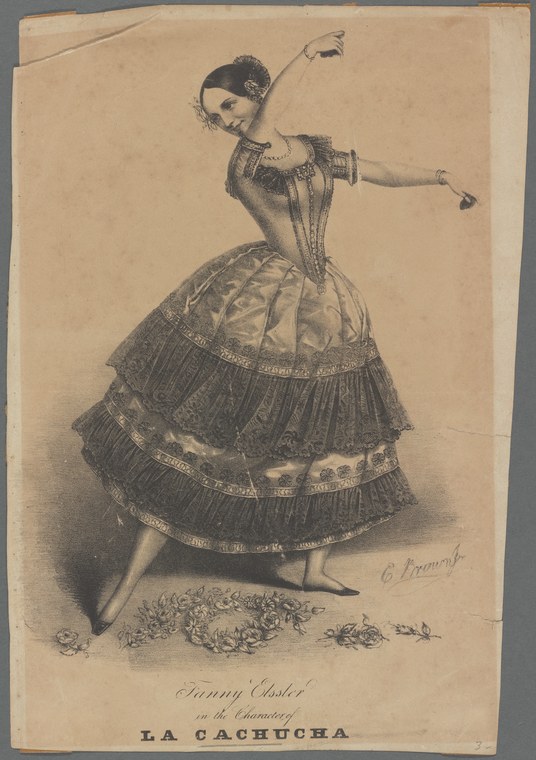
Fanny Elssler in the character of La cachucha
Unknown artist
- Collection:
- Prints depicting dance
- Source:
- New York Public Library
- Rights:
- Public domain — free to use, share and adapt.
- Recorded as:
- Public Domain
Fanny Elssler was one of the most celebrated dancers of the Romantic era, and the Cachucha was her most famous role—a dance that was revived repeatedly throughout her career and that of other dancers for decades. This print is documentary evidence of how the role appeared in performance, what the costume looked like, and how the theatrical and dance press recorded and circulated the memory of landmark performances. For historians of Romantic ballet, this image is invaluable: it shows the character-dance aesthetic that existed alongside the ethereal, story-based ballets that dominate our memory of the period.
What you are looking at
A young woman in early 19th-century theatrical dress is captured mid-movement in a dynamic pose against a plain background. She wears a dark bodice with short puffed sleeves and a voluminous skirt composed of multiple tiers of gathered fabric, edged with decorative bands—the full skirt of the Romantic era, circa 1830s-1840s. Her right arm is raised overhead with the hand turned inward in an elegant line; her left arm extends to the side at shoulder height, both gestures suggesting grace and control. Her body leans slightly backward, weight apparently on her left leg, while her right leg is extended or lifted, creating an impression of lightness and suspension. Her hair is styled up in the fashion of the period. Scattered on the ground beneath her are small floral sprigs or garland elements. The inscription at the bottom identifies her as "Fanny Elssler in the character of La cachucha," and bears what appears to be an artist's signature on the right side.
The dancing
A single female dancer is shown in a traveling or turning phrase—the raised arm and extended leg suggest elevation and rotational momentum. Her frame is open and display-oriented rather than partnered; the arms are shaped with balletic line, wrists soft and hands articulate. The extended leg and backward inclination of the torso suggest she is captured mid-movement in an elevation or turn, with weight lifted and the body held in vertical alignment typical of trained theatrical dancing. The small scale and isolation of the figure on the page emphasize her as a solo performer.
The dance depicted
This is a portrait of the Austrian-Italian dancer Fanny Elssler performing the Cachucha, a Spanish-influenced character dance that became one of her most celebrated roles in the 1830s and 1840s. The Cachucha was traditionally a rhythmic, footwork-heavy Spanish dance, but Elssler's theatrical version integrated it into Romantic ballet vocabulary—combining castanet-accompanied footwork with the elevated, ethereal line expected of Romantic dancers. The image captures her in the theatrical costume of the role: the tiered skirt and fitted bodice are typical of character dances as they appeared on the European stage, and her pose suggests the blend of technical virtuosity and dramatic presence that made her performances legendary. The scattered flowers at her feet may reference the role's Spanish theatrical context or suggest the applause and admiration that attended performances.
How it was made
This is a lithographic print, recognizable from its tonal qualities, the soft modeling of the figure, and the characteristic line work of the medium. Lithography allowed rapid and relatively inexpensive reproduction of theatrical portraits, making images of celebrated dancers widely available to audiences and collectors. The technique's capability for fine detail and atmospheric shading is evident in the rendering of the skirt's folds and the delicate articulation of the dancer's limbs. As a lithographic print from the collection of printed dance imagery at NYPL, this object would have circulated among theater-goers, collectors, and dance enthusiasts throughout the 19th century.
About this work
This lithograph documents one of the most iconic roles in early Romantic ballet: Fanny Elssler's signature performance of the Cachucha, a Spanish character dance that became the vehicle for her international fame in the 1830s and 1840s. The image preserves both the visual spectacle of the role—the elaborate layered skirt, the fitted bodice, the elevated carriage—and a moment of dynamic movement that suggests the technical brilliance and dramatic command that audiences admired. As a popular print, it reflects how theatrical dance imagery circulated in the 19th century, democratizing access to the visual memory of celebrated performances.
The work belongs in a gallery of dance in art because it captures a specific historical collaboration between a dancer, a choreographic tradition, and a visual medium. It shows us not only what the Cachucha looked like on stage, but how that image was preserved, distributed, and consumed by a public far removed from the theater itself.
How to look at it
Observe the pose as a moment of suspension rather than stillness: the raised arm, the extended leg, and the backward tilt of the body suggest Elssler is caught mid-turn or mid-elevation, not resting. The convention of theatrical portraiture in this period was to capture the dancer's most arresting or characteristic attitude rather than a static pose—a moment that revealed her skill and the visual poetry of the role. Look at the careful articulation of the hands and feet: even though the feet are not clearly shown, the drawing suggests weight and balance distributed through a trained body. The scattered flowers are a convention of the period, signifying applause and the admiration the dancer has earned.
The artist
The artist's signature is present on the print (visible as "O Fromaget" or similar) but remains incompletely identified in the catalogue record. Theatrical lithographers of this period—often unsigned or inadequately documented—were crucial intermediaries between the stage and its public. They worked from costume sketches, live observation, and dancers' own descriptions to produce prints that satisfied audience demand for souvenirs and records of celebrated performances. The quality and detail of this print suggest a lithographer with professional experience in theatrical portraiture.
The period
The 1830s and 1840s were the height of the Romantic ballet era in Europe, when dancers like Elssler and Marie Taglioni became international celebrities. The Cachucha itself represented a particular current in Romantic taste: fascination with Spanish and exotic character, expressed through the lens of European ballet technique. This period also saw the expansion of lithographic printing, which made theatrical portraiture an affordable and popular form of visual culture. Dance iconography was a significant category of popular print throughout this period, with thousands of images of celebrated dancers circulating in Europe and America.
Where it lives
This print is held in the Prints collection of the New York Public Library, as part of its extensive assemblage of 19th-century theatrical and dance imagery. It is catalogued as a print depicting dance ("Prints depicting dance"), a category that reflects NYPL's systematic collection of visual documentation of performance in this period.
Dance in this work
Questions about this work
Who was Fanny Elssler?
Fanny Elssler (1810–1884) was an Austrian-Italian dancer who became one of the most celebrated performers of the Romantic era, rivaling even Marie Taglioni in popularity. She excelled in character dances and dramatic roles, and toured internationally, including a famous North American tour in 1840–1842. The Cachucha was her signature role, a Spanish-influenced dance that she performed repeatedly throughout her career and which was revived by other dancers well into the 20th century.
What is the Cachucha?
The Cachucha is a Spanish rhythmic dance, traditionally accompanied by castanets and characterized by rapid footwork and hip movement. When Elssler performed it on the Romantic stage, it was integrated into ballet vocabulary: she executed it with elevated technique, balletic port de bras, and the ethereal quality expected of Romantic dancers, while retaining the castanet accompaniment and Spanish character. It became one of the most celebrated character dances of the era.
Is this a drawing or a painting?
This is a lithographic print. The technique is recognizable from the tonal qualities and the characteristic way lithography renders figure and fabric. Lithography allowed theatrical portraits to be produced and distributed cheaply and in quantity, making them affordable souvenirs for theater audiences. This print would have been sold at the theater or by print sellers, making images of celebrated dancers available to a wide public.
What do the flowers at the bottom mean?
In theatrical portraiture of this period, scattered flowers or floral sprigs at a dancer's feet were a convention signifying applause, admiration, and the enthusiastic reception of the performance. They are not literal documentation of what happened on stage, but rather a symbolic gesture embedded in the language of popular theatrical prints.
More dance artwork





