49 works in this view — arrow keys or swipe to move between them.
Dance in Art
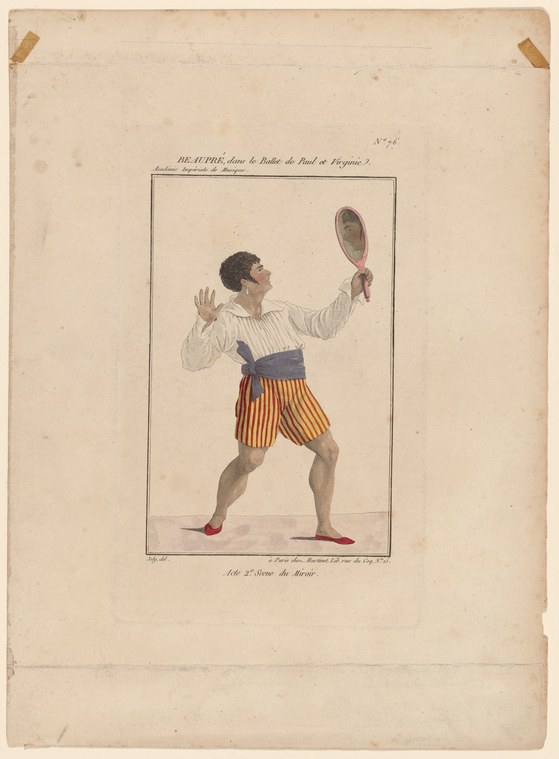
Beaupré dans le ballet de Paul et Virginie, act 2e, scene du miroir.
Unknown artist
- Collection:
- Prints depicting dance
- Source:
- New York Public Library
- Rights:
- Public domain — free to use, share and adapt.
- Recorded as:
- Public Domain
This print documents a specific choreographic moment and a named performer in a canonical work of the late 18th-century ballet, providing concrete visual evidence of how male dancers moved, dressed, and performed in the pantomime-ballet tradition. For dance historians, it illustrates the synthesis of pantomime and academic dance technique that characterized the demi-caractère style, and the shift away from pure virtuosity toward expressive, character-driven narrative. For anyone studying how dance was recorded and circulated before photography, this print demonstrates the role of engraving in creating and sustaining the fame of individual dancers and iconic roles.
What you are looking at
A male dancer stands alone against a plain background, holding a hand mirror up before his face in a moment of self-regard. He wears a white linen shirt with billowing sleeves, a dark blue belt, and striking vertically striped breeches in orange and blue that end above the knee. Red slippers complete his costume. His posture is dynamic and slightly off-balance, with his weight shifted to one side, his free hand raised in an expressive gesture as though caught mid-movement or mid-thought. The composition is intimate despite the solitary figure: the mirror-gazing creates a moment of reflection—literal and metaphorical—that suggests introspection or vanity within a theatrical narrative. The print's muted palette and fine detail suggest a hand-colored engraving or aquatint from the late 18th century.
The dancing
A single male dancer, viewed in profile, demonstrates an asymmetrical, slightly unstable stance with bent knees and weight thrown to one side—a posture associated with French court dance and pantomime of the period. His right arm extends upward and to the side in an open, expressive gesture; his left arm holds the mirror, angled toward his face. The raised heel of the downstage foot and the flexed quality of the legs suggest movement rather than a static pose. His upper body leans forward slightly, creating a sense of momentum or emotional engagement with the object he beholds.
The dance depicted
This image documents a scene from the ballet *Paul et Virginie*, a popular pantomime-ballet of the late 18th century based on Bernardin de Saint-Pierre's sentimental novel. The title specifies Act 2, 'scene du miroir' (mirror scene), suggesting a moment when the character Beaupré confronts his own image—likely a scene of vanity, recognition, or emotional crisis played out in the lexicon of French danseur technique. The costume and pose are consistent with the demi-caractère or noble style of male dancing of this era: not the pure elevation of formal ballet, but the expressive, narrative vocabulary of theatrical dance that combined pantomime with balletic vocabulary. The mirror scene itself was a staple device of stage comedy and sentiment, allowing the performer to address questions of identity and self-awareness.
How it was made
This is a hand-colored engraving or etching, recognizable by its fine linear detail, the precision of the costume pattern, and the restrained color palette applied to white paper. The technique allowed for mass production and circulation among a dance-literate public—this is clearly a commercial theatrical print, likely sold as a souvenir of performance or as a record of a celebrated dancer in a famous role. The hand-coloring suggests it was intended for a wealthier audience or a collector's portfolio. The print bears a caption in French and a reference number, indicating it formed part of a numbered series documenting the ballet or the dancer's repertoire.
About this work
This is a record of a specific moment in a specific performance—the mirror scene from Act 2 of *Paul et Virginie*, a pantomime-ballet that was one of the most frequently performed theatrical works of the late 18th century. The image captures not only the costume and physical vocabulary of French danseur technique in this period, but also the sentimental, narrative style that dominated European theatrical dance after the reforms of Noverre and Lany. The solitary figure, the expressive upper body, the asymmetrical stance, and the focus on pantomimic action rather than pure virtuosity all testify to a moment when ballet was broadening its emotional and narrative range. The print itself is evidence of how dancers and their roles were commodified and circulated in the late 18th-century print market—a visual souvenir for those who had seen the performance and those who wished to know what celebrated danseurs looked like on stage.
How to look at it
Attend to the asymmetry and slight instability of the pose: this is not a moment of perfect balance or formal alignment, but a captured instant of movement or emotional engagement. The open, raised arm and the forward lean of the upper body are characteristic of the expressive pantomimic style of the period—they announce emotion and narrative intention rather than pure physical display. The way the dancer gazes at the mirror and his body responds to that gaze—with a kind of modest pleasure or surprised recognition—is the key to reading this as a theatrical moment rather than a simple portrait. Notice also the precision of the costume detail: the engraver has taken care to render the pattern of the striped breeches and the fit of the shirt, suggesting that these elements were significant to the role's identity and meaning on stage.
The period
This print dates from the late 18th century, a period of extraordinary innovation and reform in European ballet. Following Jean-Georges Noverre's *Lettres sur la danse* (1760) and the reforms he and other choreographers introduced, ballet began to move away from the purely formal vocabulary of the court toward narrative, character-driven works grounded in pantomime and emotional expression. *Paul et Virginie* (first choreographed by Dauberval or Deshayes in the 1790s) exemplifies this shift: it adapted a celebrated literary work into a sentimental, exoticizing narrative that required dancers to act and mime as much as to display technical virtuosity. The costume seen here—the striped breeches, the soft slippers, the expressive shirt—is consistent with the demi-caractère style that dominated male dancing in this era, distinct from both the formal nobility of the danseur noble and the broad comedy of grotesque dance. The theatrical print itself reflects the growth of a commercial dance culture and the emergence of the dancer as a celebrity whose image could be commodified and distributed.
Where it lives
The print is held in the New York Public Library's collection of theatrical prints and dance ephemera. It bears a reference number and a caption in French identifying the performer and the work, indicating it was part of a catalogued series, possibly a theatrical scrapbook or a curated collection of dance documentation. Such prints were typically sold as theatrical souvenirs or collected by dance enthusiasts and historians.
Dance in this work
Questions about this work
What is Paul et Virginie and why was it a popular ballet?
*Paul et Virginie* was a pantomime-ballet based on Bernardin de Saint-Pierre's 1787 novel of the same name, a sentimental tale set in Mauritius about two foundlings raised in innocence and virtue. It became one of the most frequently performed ballets of the late 18th and early 19th centuries because it combined contemporary literary prestige with exoticizing imagery, tender emotions, and opportunities for spectacular scenic display. The work exemplified the shift toward narrative ballet and demonstrated that dance could engage with serious literary and moral themes.
What does the mirror scene reveal about late 18th-century dance?
The mirror scene illustrates the period's fascination with pantomime, emotion, and character development in ballet. Rather than displaying pure technical virtuosity, the dancer is called upon to act, to express an inner state through gesture and body language. This reflects Noverre's reforms and the growing belief that dancers should be expressive, thinking performers rather than moving bodies, and that ballet could tell stories and explore human psychology.
How can I tell this is from the late 18th century?
Multiple visual clues point to this period: the style of the engraving itself; the cut and pattern of the costume (the striped breeches, the soft linen shirt, the modest red slippers); the asymmetrical, expressive pose that differs from both earlier court formality and later Romantic ethereality; and the theatrical print format, which was standard for documenting celebrated roles and dancers in this era.
Who was Beaupré?
The print identifies the performer as Beaupré, likely a celebrated danseur of the late 18th century, though individual biographical details are not preserved in this image alone. The fact that his name and specific role are recorded on the print suggests he was a performer of enough prominence to merit commercial reproduction and collection.
More dance artwork





