49 works in this view — arrow keys or swipe to move between them.
Dance in Art
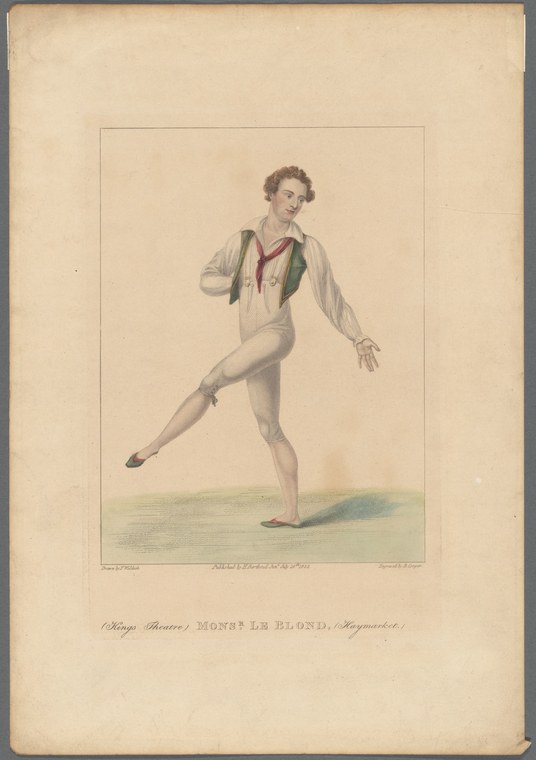
Monsr. Le Blond (King's Theatre) (Haymarket)
Unknown artist
- Collection:
- Prints depicting dance
- Source:
- New York Public Library
- Rights:
- Public domain — free to use, share and adapt.
- Recorded as:
- Public Domain
This print is a rare named record of a professional male ballet dancer working in London in the 1820s–1830s, at a formative moment for Romantic ballet. It documents both the performer's identity and the precise physical technique required of men in classical ballet at that time, making it valuable evidence for the history of male dance technique and the English theatrical dance profession.
What you are looking at
A young male dancer in performance costume stands alone against a pale background, captured mid-movement in a balletic pose. He wears a fitted tunic or short jacket in cream or pale tan with a burgundy collar and trim, paired with flesh-coloured tights and dark slippers. His right leg is extended behind him in a controlled attitude or développé, the supporting leg nearly straight, his torso inclined forward with arms positioned for balance—the left arm extended to the side, the right hand placed on his hip. The pose suggests the moment just after the extension of the leg, with the dancer's weight centered and controlled. The figure is rendered in a hand-coloured engraving or aquatint, with careful attention to musculature and the precise geometry of the extended leg. The composition is formal and instructional, presenting the dancer as a demonstrative example of technique rather than as part of a narrative or social scene.
The dancing
A single male dancer is shown in a classical balletic posture: the supporting leg is nearly straight, the working leg extended well behind the body in a high, controlled line, and the torso held upright with a slight forward inclination from the hips. The arms frame the body—one extended laterally, the other placed on the hip—suggesting balance and control rather than expressiveness. The dancer's port de bras is economical and geometric. The musculature of the legs is carefully rendered, emphasizing the technical precision of the position. This is not a moment of abandon but of held control, typical of male classical technique in the early 19th century.
The dance depicted
This appears to be a study of classical male ballet technique, likely Romantic-era ballet (early 19th century). The pose—an extended développé or similarly controlled balletic attitude—would have been part of the male dancer's vocabulary of supported adagio and phrase-work. The costume and style are consistent with English theatrical dance of the 1820s–1840s. Monsr. Le Blond's association with the King's Theatre, Haymarket (one of London's principal venues for opera and dance) suggests he was a professional stage dancer of some standing. The image functions as a technical demonstration or portrait, showing a dancer in formal dress rather than in character costume, which may indicate it was intended for circulation as a print among dance professionals or enthusiasts.
How it was made
This is a hand-coloured engraving or aquatint, a reproductive print technique well-suited to the dissemination of both portraits and technical studies. The careful linear work defining musculature and the subtle wash of colour applied to the figure's body and costume suggest skilled craftsmanship. The technique allowed for relatively affordable mass reproduction, making such prints common as souvenirs of popular performers, technical references for dancers, or collectibles for theatre-goers. The inscription and attribution at the base (partially legible) indicate this was a commercial publication, likely sold as a separate sheet or collected in portfolios of theatrical performers.
About this work
This is a formal portrait of a named performer, Monsr. Le Blond of the King's Theatre, Haymarket, presented as a technical study of classical male ballet in the Romantic period. The image serves a dual function: it is both a commercial souvenir of a professional dancer and a demonstrative record of balletic technique as it was taught and performed in early 19th-century England. The print preserves a moment of canonical male technique—the high extension, the controlled frame, the precise musculature—at a time when such technique was increasingly codified and taught.
The work sits within a tradition of theatrical dance portraiture that flourished in the 19th century, when lithographs and engravings of celebrated dancers were collected by both professionals and amateurs. It documents not only a performer's likeness but also the aesthetic and technical standards of his era, offering historians a window into how male dancers were trained, how they dressed, and what constituted technical excellence on the London stage.
How to look at it
Observe the precise geometry of the extended leg and the way the artist has rendered the musculature to convey control and strength. Note the dancer's upright carriage and the careful positioning of the arms—this is not a moment of improvisation but of technical demonstration. The isolated figure against a plain background emphasizes the pose as a canonical form rather than as part of a narrative. Compare the leg position and frame to modern ballet vocabulary to see what has remained stable in technique over nearly two centuries.
The artist
The artist's name is not recorded in the catalogue, though the engraving bears a signature at the base (partially legible in the image). Such theatrical prints were often executed by specialist reproductive engravers working from drawings or paintings by portrait artists; the print may have been based on a life study or a performance sketch. The commercial nature of the work suggests it was produced by or for a print publisher operating in London's theatre district.
The period
This print dates to the height of the Romantic ballet era in Britain, when male dancers held significant status and celebrity was documented and marketed through theatrical prints. The early 19th century saw a codification of ballet technique under the Cecchetti and Vaganova methods (though this work predates or is contemporaneous with their full development). The King's Theatre was a principal venue for opera and ballet in London, and male dancers at such houses were celebrated performers whose images were sold to the public. This was also the era when technical instruction in dance was increasingly standardized and when prints served as both souvenirs and instructional references.
Where it lives
The work is held in the New York Public Library's collection of prints depicting dance, a major repository for such materials. This indicates it was significant enough to be preserved and collected systematically, likely as part of a broader effort to document theatrical history.
Dance in this work
Questions about this work
Who was Monsr. Le Blond?
Le Blond was a professional male dancer performing at the King's Theatre, Haymarket, in London during the early 19th century. Beyond his association with that theatre, little is currently recorded about his career, life, or influence. This print is one of the primary surviving documents of his work and technical practice.
What is this pose called?
The pose appears to be a développé or attitude derrière, classical balletic positions in which the working leg is extended fully behind or to the side while the dancer maintains an upright carriage. These are fundamental positions in ballet technique and would have been essential to the male dancer's vocabulary in the Romantic era.
Why is the dancer shown alone?
The isolated presentation served multiple purposes: it functioned as a theatrical souvenir portrait, it allowed viewers to study the technical precision of the pose, and it positioned the dancer as the sole subject of attention and admiration. This format was standard for such instructional and commemorative prints.
What does the print tell us about male ballet technique in this period?
The controlled extension, the upright carriage, the geometric precision of the arm placement, and the muscular definition all suggest that early 19th-century male ballet technique emphasized strength, control, and formality. This contrasts with later Romantic ballet, which increasingly emphasized male dancers as partners to female dancers and placed more emphasis on lightness and elevation.
More dance artwork





