49 works in this view — arrow keys or swipe to move between them.
Dance in Art
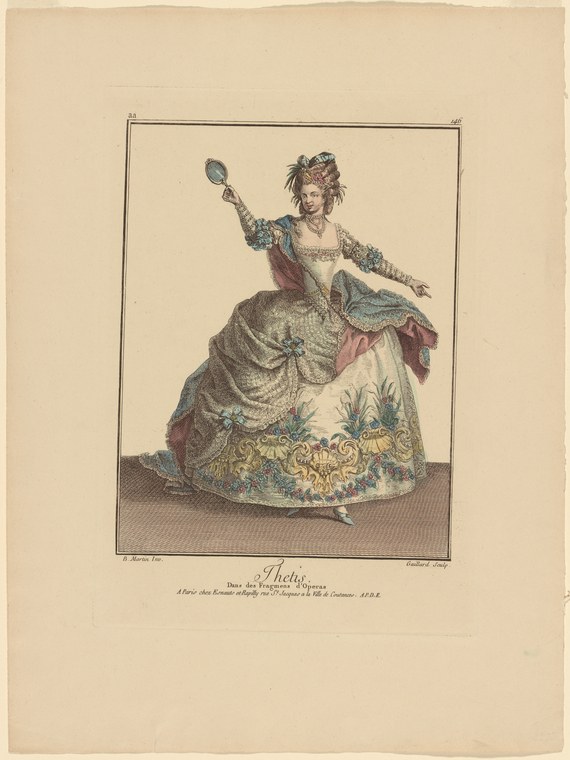
Thetis. Dans des fragmens d'operas
Unknown artist
- Collection:
- Prints depicting dance
- Source:
- New York Public Library
- Rights:
- Public domain — free to use, share and adapt.
- Recorded as:
- Public Domain
This print is a rare visual document of how an actual eighteenth-century theatrical dance was presented to the public: it captures not a generic dance type but a specific character with a specific costume, moment, and movement vocabulary. For dance historians and performers, it offers concrete evidence of the port de bras, the line of the body, the relationship between costume and movement, and the theatrical aesthetic that governed court-derived dance on the stage during the Rococo period—information that cannot be reliably reconstructed from written notation alone.
What you are looking at
A single female dancer occupies the center of the composition, positioned in a three-quarter view against a plain background. She wears an elaborate court dress of the mid-eighteenth century: a pale silk bodice with tight corseting, short sleeves decorated with ornamental brocade, and a voluminous skirt of cream silk with deep blue-green brocaded ornament at the hem. A rich burgundy or wine-colored silk drape is thrown over her left shoulder and loops dramatically across her body. She holds a small ornate hand mirror aloft in her raised right arm, which she regards with a pleased expression, her body tilted in a graceful contrapposto. Her left arm extends gently outward in an open gesture. Her hair is styled in the fashion of the period, gathered up with decorative elements. The figure stands on a stippled ground line that suggests a stage or performance space. The entire composition is enclosed in a simple rectangular border, rendered in the formal manner of a theatrical costume or character print.
The dancing
The dancer's weight rests primarily on her left leg, while her right leg appears to step forward with a slight bend at the knee—a refined, courtly posture rather than a vigorous one. The elevated right arm holding the mirror establishes the primary line of the composition and draws the eye upward. Her torso is held upright with the characteristic refinement of eighteenth-century court dance, the shoulders back and the spine extended. The left arm, held at roughly waist height with the palm facing outward, shows the kind of gentle control typical of aristocratic movement. There is a singular, studied quality to the pose—this is a representational moment rather than a fleeting instant of action.
The dance depicted
This appears to be a theatrical dance character from French opéra-comique or ballet of the mid-eighteenth century, most likely depicting a shepherdess, nymph, or similar allegorical or pastoral figure. The title *Thetis* (a nereid from classical mythology) combined with the notation 'Dans des fragmens d'operas' (In fragments of operas) suggests this is a character or solo dance extracted from a larger operatic work. The refined, courtly vocabulary of the movement—the restrained arm positions, the turned-out leg, the focus on graceful display rather than virtuosity—is consistent with French court dance adapted for the stage during the Rococo period. The hand mirror as a prop is characteristic of coquettish or playful feminine characters in this era's theatrical vocabulary. The pose suggests a character presenting herself or admiring her own reflection, a moment of theatrical vanity or self-display that would have had clear meaning to the contemporary audience.
How it was made
This is a hand-colored engraving, likely French, from the eighteenth century. The fine line work characteristic of engraving is visible in the rendering of the fabric patterns, the delicate details of the embroidered sleeve, and the decorative elements of the headdress. The engraver has employed cross-hatching and stippling to create shadow and dimensional form, particularly evident in the folds of the drapery and the modeling of the figure's body. Hand coloring in watercolor or gouache has been applied over the engraved line, with particular attention to the rich brocaded silks and the subtle modeling of flesh tones. The technique allowed for precise detail and relatively economical reproduction and distribution, making such character prints popular and affordable for collectors, theater enthusiasts, and dancers themselves in the eighteenth century. The formal framing and the credited artists' names (visible at bottom) indicate this was a published print, likely issued as part of a series documenting theatrical performers or character dances.
About this work
This hand-colored engraving documents a theatrical dance character from mid-eighteenth-century France, almost certainly a solo or featured character dance from an opéra-comique or ballet. The figure identified as Thetis wears the sumptuous costume and adopts the refined, courtly movement vocabulary of the Rococo stage. The print belongs to a well-established tradition of theatrical character prints that served as mementos, souvenirs, and instructional or aspirational documents for the dancing public. Such prints were collected, pasted into scrapbooks, and circulated among dance professionals and society patrons, making them one of the primary visual records of how theatrical dance looked and moved in this period. The work preserves not only the costume and accessories but also the particular aesthetic and physical values of the era—the emphasis on elegant proportion, courtly refinement, and theatrical display over dramatic intensity or technical display.
How to look at it
Attend to the dancer's posture and arm positions: notice how the body is held upright with a particular refinement and restraint, how the arms are not dramatically extended but carefully placed, and how the weight is balanced and centered. The hand mirror is not incidental—it defines the character and the moment: this is a figure engaged in the theatrical display of herself, and that display is inseparable from courtly grace. Look at how the costume—the massive skirt, the tight bodice, the ornamental sleeves—shapes and constrains the movement; the dance moves within and through the costume, not against it. The pose itself is a kind of stillness, a moment of presentation rather than action; this reflects the eighteenth-century aesthetic in which the *attitude* of the dancer was as important as motion itself.
The artist
The engraver and colorist are not identified in the catalogue record, but the quality and formal presentation of the work indicate it was produced by a professional printmaking workshop, likely in Paris. The inscription at the bottom would originally have credited the artists; the visible credit lines suggest this was part of a commercial publishing venture, possibly one of the well-known Parisian print publishers who specialized in theatrical and costume imagery.
The period
The mid-eighteenth century saw an explosion in the publication of theatrical costume and character prints, particularly from France. This coincided with the development of opéra-comique as a popular theatrical form and with a broader Rococo aesthetic that valued grace, refinement, and the display of elegant dress and movement. Theatrical dance of this period was still deeply rooted in the courtly vocabulary of the *danse noble*—it had not yet undergone the Romantic revolution that would transform ballet in the 1830s. The taste for such prints reflected a newly broad theatrical public eager to own images of famous dancers and to engage with theatrical culture as consumers. At the same time, these prints served a practical purpose for dancers, choreographers, and dancing masters, who could study them to learn steps, gestures, and the proper carriage of the body in a given role or character.
Where it lives
This engraving is part of the New York Public Library's collection of prints depicting dance, a collection that includes theatrical costume prints, dance instruction prints, and theatrical scene prints from the sixteenth century to the modern era. Such prints were produced in substantial numbers in the eighteenth century and many have survived in institutional collections, libraries, and private holdings.
Dance in this work
Questions about this work
Who was Thetis, and why would she be dancing in an opera?
Thetis was a nereid (sea nymph) in classical mythology, mother of Achilles. In eighteenth-century opera and ballet, classical mythological figures were routinely adapted as characters, often in pastoral or allegorical contexts. A character named Thetis would have been a nymph or goddess figure—graceful, refined, and often connected to themes of beauty, nature, or romantic intrigue. The title 'Dans des fragmens d'operas' suggests this particular dance was extracted or compiled from multiple operatic sources.
Is this what an actual eighteenth-century dancer looked like?
The costume is certainly authentic to the period and to theatrical practice. What we see here represents an idealized, formalized presentation rather than a candid moment—this is a finished print intended for publication and circulation, not a drawing from life. The refined posture, the elegant display of the figure, and the carefully arranged drapery reflect both the actual aesthetic of court-derived theatrical dance and the conventions of how that dance was represented in prints for public consumption.
What is the hand mirror for?
The mirror is both a practical prop and a symbolic one. Practically, it allowed the character to regard her own reflection and could be incorporated into the choreography. Symbolically, the mirror carried associations with vanity, feminine display, and narcissism—themes that were popular in Rococo theatrical and artistic culture. The pose suggests a moment of self-admiration or coquetry, a character moment rather than pure dance virtuosity.
How was this print made, and who would have bought it?
This is a hand-colored engraving, made by incising lines into a copper plate, inking the plate, and printing it on paper. Color was then applied by hand, making each print unique in its coloring. Such prints were purchased by theater patrons as souvenirs, by dancers and dancing masters as references, and by the general public as affordable art and entertainment imagery. They circulated widely and were often collected or pasted into scrapbooks.
More dance artwork





