49 works in this view — arrow keys or swipe to move between them.
Dance in Art
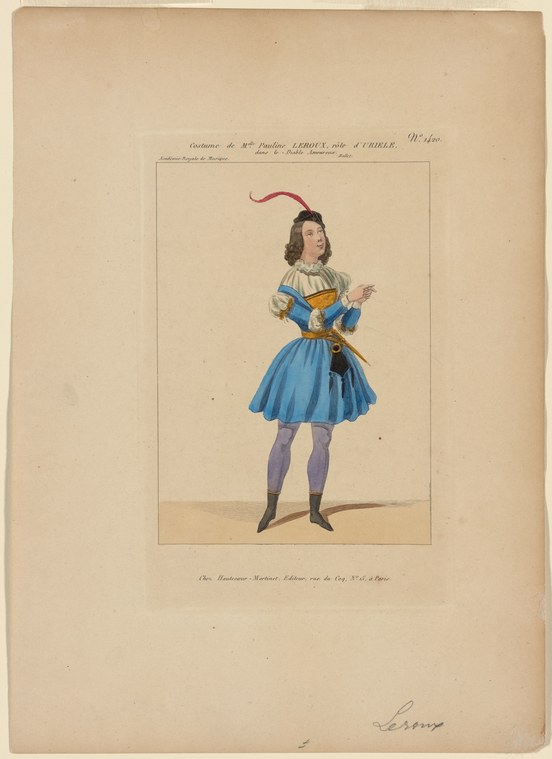
Costume de Melle. Pauline Leroux, rôle d'Uriele, dans Le diable amoureux, ballet, Académie royale de musique
Unknown artist
- Collection:
- Prints depicting dance
- Source:
- New York Public Library
- Rights:
- Public domain — free to use, share and adapt.
- Recorded as:
- Public Domain
The print preserves a record of a specific historical performance and performer, offering direct visual evidence of how a role was costumed and presented. It illustrates the Romantic ballet aesthetic—the emphasis on ethereal, feminized costume and the dancer as a vehicle for character and spectacle—and the formal documentation practices by which the Paris Opera validated and circulated knowledge of its productions.
What you are looking at
A young female dancer in performance costume stands in a three-quarter pose against a plain cream background. She wears a striking blue tulle skirt that falls to mid-knee, gathered full at the waist, paired with a blue bodice trimmed with a white ruffled collar and blue silk ribbons at the waist. Dark stockings and heeled shoes complete the ensemble. A long red feathered plume arises from her hair, curving upward in an elegant arc. Her right arm is extended outward in a graceful line; her left hand rests near her body. Her posture is upright and composed, her gaze directed outward. The hand-colored nature of the print—particularly the vivid blue pigment and delicate feather—suggests this is a costume study for a named role in a specific ballet production.
The dancing
The dancer stands in an engaged, presentational pose rather than mid-movement. Her weight appears evenly distributed, her frame open and frontal. The extended right arm is held at approximately shoulder height with an elegant curve; the left arm hangs naturally. Her head is held high and turned slightly to engage the viewer. The pose reads as a formal presentation of costume and character rather than an action captured mid-step, typical of theatrical costume documentation of the period.
The dance depicted
This is a costume design or performance documentation for a named role—Uriele—in the ballet *Le Diable amoureux* (*The Amorous Devil*), performed at the Académie royale de musique (the Paris Opera). The work depicts Pauline Leroux in this role. The full skirt, fitted bodice, and feathered headdress are consistent with Romantic ballet costume of the mid-19th century, though the specific theatrical context of this particular ballet and Leroux's performance would determine the exact date and choreographic tradition. The presentation is archival rather than narrative—a record of a specific performer in a specific costume.
How it was made
This is a hand-colored engraving or lithograph on paper, likely produced from a drawn original. The technique allowed for fine detail in the costume elements and the careful rendering of fabric texture—the tulle's transparency, the bodice's construction, the silk ribbons' fall. The hand-coloring (watercolor or gouache) was applied after printing, accounting for the vivid blue and the delicate feather detail. This production method was standard for theatrical documentation and circulation among performers, designers, and the theater-going public in 19th-century Paris.
About this work
This is a costume documentation print from the Paris Opera, recording the costume worn by dancer Pauline Leroux in the role of Uriele in the ballet *Le Diable amoureux*. It belongs to a tradition of theatrical prints that served multiple functions: as a record of a specific historical performance, as documentation of a character type and costume design, and as a commodity for audiences who wished to preserve the memory of a celebrated performer. Such prints were widely circulated and collected, and they constitute a primary visual archive of 19th-century ballet practice, casting, and aesthetic values. The work documents both the dancer's appearance and the material reality of Romantic-era costume construction.
How to look at it
Attend to the costume elements: the proportion and construction of the skirt, the detail of the bodice trim, the treatment of the feather, the choice of stockings and shoes. These elements record the material conditions of performance. Notice also the pose itself—its formality and presentation rather than action—which reflects the conventions of theatrical portraiture. The dancer's direct engagement with the viewer is characteristic of costume documentation prints, which were meant to immortalize a specific performer in a specific role.
The period
This print was produced during the height of Romantic ballet in the mid-19th century, when the Paris Opera was the preeminent ballet institution in Europe. The aesthetic of the costume—the full tulle skirt, the fitted bodice, the elaborate headdress—reflects the Romantic movement's embrace of fantasy, ethereality, and feminized spectacle. Ballets with supernatural or fantastical plots (like *Le Diable amoureux*) were popular, and the printed record of costumes and performances was an important medium for documenting and promoting the work of celebrated dancers. The hand-colored print was the standard technology for such documentation before photography became widely available for theatrical documentation.
Where it lives
The work is held in the New York Public Library's collection of prints depicting dance. The inscription at the foot of the page attributes it to the Paris Opera (Académie royale de musique) and names the performer and role.
Dance in this work
Questions about this work
Who was Pauline Leroux?
The catalogue record identifies her as a dancer at the Paris Opera who performed the role of Uriele in *Le Diable amoureux*. Beyond that, the print itself does not contain biographical information. Further research would require consulting ballet history sources and archives of the Paris Opera.
When was this print made?
The catalogue record does not provide a date. The style of the costume and the printing technique suggest the mid-19th century (approximately 1830–1860), consistent with the Romantic ballet period, but a precise date would require additional archival research.
What ballet is this from?
*Le Diable amoureux* (*The Amorous Devil*) was a ballet performed at the Paris Opera. The print documents a costume from this production, but it does not provide information about the ballet's plot, choreography, composer, or performance history beyond what appears in the inscription.
Why was this print made?
Costume documentation prints served multiple purposes: they were records of specific historical performances, promoted celebrated dancers to the theater-going public, and were collected as souvenirs. They were a standard medium for circulating knowledge of opera and ballet productions before photography became widely available.
More dance artwork





