49 works in this view — arrow keys or swipe to move between them.
Dance in Art
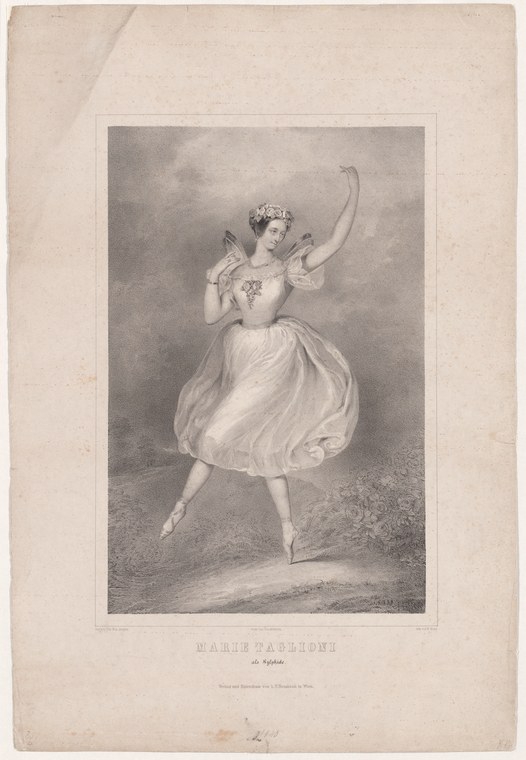
Marie Taglioni als Sylphide
Unknown artist
- Collection:
- Prints depicting dance
- Source:
- New York Public Library
- Rights:
- Public domain — free to use, share and adapt.
- Recorded as:
- Public Domain
Marie Taglioni and *La Sylphide* were the hinge on which ballet turned toward Romanticism; her performance in this role in the 1830s established the aesthetic and technique that still govern classical ballet. This portrait, in its technical execution and distribution, shows how that change was communicated visually to a wide audience. For anyone studying the history of ballet, the aesthetics of the Romantic movement, or the role of theatrical prints in 19th-century culture, this is a primary source.
What you are looking at
A young woman in a filmy white dress performs a graceful, weightless leap against a soft grey background. She is caught mid-jump, her body arched slightly backward, left leg extended upward and behind her, right leg bent beneath. Her arms are raised asymmetrically—one lifted high with palm open, the other extended at shoulder height. She wears a floral crown or wreath in her dark hair and appears to be dancing on or just above the stage floor, which is rendered with minimal detail. The image is executed as an engraving or lithograph, a monochromatic reproduction that emphasizes the ethereal quality of her pose through soft gradations of tone. The composition is vertically oriented and carefully framed, suggesting this is a formal portrait of a celebrated dancer rather than a documentary scene.
The dancing
The dancer stands alone, poised on one foot in a balletic attitude or arabesque variation. Her upper body is relaxed and lightly twisted, creating a sense of effortless elevation. The lifted arm (stage left) is softly curved rather than rigidly extended, and her gaze is directed upward and away, not toward the audience. The pose suggests weight distributed primarily through one leg, with the supporting foot pointing downward—consistent with turnout and the balletic vocabulary of the Romantic era. There is no partnering, mime, or floor contact; the entire composition celebrates the illusion of weightlessness.
The dance depicted
This is a Romantic ballet portrait, almost certainly a depiction of Marie Taglioni performing the title role in *La Sylphide*, the foundational work of Romantic ballet. The sylph costume—the short white tulle skirt, the floral crown, the gauzy quality—and the ethereal pose are iconic to this role and this dancer. *La Sylphide* premiered in 1832 and made Taglioni a phenomenon across Europe; she was the first and definitive Sylphide. The image shows the dancer in one of the role's characteristic moments: a passage of weightless, gravity-defying movement, the sylph's otherworldly nature conveyed through the impossibly light quality of the jump and the upward gaze that refuses earthly engagement.
How it was made
This is a steel engraving or possibly a lithographic reproduction, rendered in grayscale. The technique allows for fine tonal gradations that emphasize the dancer's white costume against the neutral background, and the monochrome palette suits the ethereal, dreamlike quality of the subject. Such prints were produced in quantity and distributed widely across Europe and North America, making them among the most accessible forms of theatrical imagery in the 19th century. The formal framing and finish suggest this is a professional theatrical portrait intended for collectors and admirers of the dancer, not a scene study or documentary record.
About this work
This is a Romantic-era ballet portrait documenting the legendary Marie Taglioni in the role that defined her career and shaped the history of ballet: the Sylphide in *La Sylphide*. The work captures both a specific moment in the choreography and the broader visual language of Romantic ballet—the weightless leap, the ethereal costume, the upward gaze, the solitary dreaming figure. As a print, it circulated widely and helped establish the Sylphide as one of ballet's archetypal roles and Taglioni as one of its foundational figures.
This image is a key document of 19th-century dance history: it shows how a revolutionary performer and role were marketed, remembered, and celebrated among the educated public, and it preserves a visual record of a costume and a movement quality that would define an era.
How to look at it
Attend to the moment of suspension in the leap: the dancer is caught weightless, her body at its highest point, which creates the illusion that gravity does not apply. The upward gaze and the soft, open arm positions reinforce the sense of dreamlike transcendence rather than earthly effort. Notice how the artist has rendered the tulle skirt with careful tonal gradation, creating volume and translucence. The choice to show the dancer alone, against a neutral ground, with no stage furnishings or other figures, focuses attention entirely on the body and its elevation—a technique suited to the ballet portrait's purpose of celebrating and immortalizing a performer.
The artist
The artist is not recorded in the available catalogue information. The print is likely a commercial theatrical portrait from a London, Paris, or other European printmaking house active in the 1830s–1840s, made to capitalize on Taglioni's immense popularity. Such prints were often based on sketches made during or after performances, or on earlier portrait paintings; the print itself would have been the vehicle for mass circulation and was often more economically significant than the original work. The engraver or lithographer would have been a skilled technical practitioner rather than an original artist.
The period
The 1830s saw the full emergence of Romantic ballet in Europe, marked by a shift from the Classical vocabulary of turn-out, symmetry, and earthbound virtuosity toward an emphasis on the ethereal, the fantastical, and the illusion of weightlessness. *La Sylphide*, which premiered at the Paris Opéra in 1832, was a watershed: its plot (a mortal man pursued by an unattainable supernatural being), its setting (a dreamlike forest), and its visual language established the template for Romantic ballet. Marie Taglioni's technical innovations—her use of the pointe shoe, her long extensions, her fluid arm work—became synonymous with the role and the era. Prints like this one were crucial to the dissemination of these new aesthetics; they circulated in parlours and theatres across Europe and helped define what ballet was understood to be.
Where it lives
This print is held in the New York Public Library's collection of prints depicting dance. It is a commercial theatrical print, likely produced between the 1830s and 1850s, and would have been sold individually or in sets of theatrical portraits. Such prints were a standard form of theatrical merchandise and fan culture.
Dance in this work
Questions about this work
Is this really Marie Taglioni?
The title on the print reads 'Marie Taglioni als Sylphide' (Marie Taglioni as the Sylph). The catalogue record confirms this identification. However, the print is not a portrait from life in the modern sense—it is a romanticized theatrical image, likely based on a sketch or earlier painting, idealized to convey the role and the dancer's fame rather than documentary likeness.
Why does she look like she's floating?
That is precisely the point. The Sylphide in *La Sylphide* is a supernatural being—ethereal, weightless, unattainable. The choreography and the dancer's technique were designed to create the illusion of flight. The artist has captured that illusion through the pose (pointe, lifted leg, upward gaze) and the soft, dreamlike rendering of the image.
What is the white dress?
That is the Sylphide costume: a short tulle skirt, close-fitting bodice, and delicate crown of flowers or feathers. This costume became iconic—it defined the 'ballet dress' for generations and is still the standard costume for this role. The white color and the translucent tulle were central to the romantic aesthetic.
When was this made?
The exact date is unknown, but it was likely produced sometime after *La Sylphide*'s premiere in 1832, when Taglioni's fame was at its height. It could have been made at any point through the 1840s or later, as prints of celebrated dancers were reprinted and recirculated for decades.
More dance artwork





