49 works in this view — arrow keys or swipe to move between them.
Dance in Art
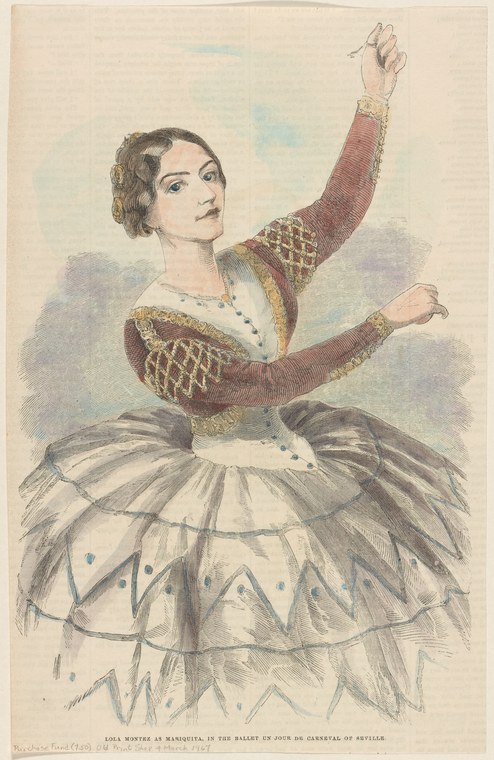
Lola Montez as Mariquita, in the ballet Un jour de carneval of Seville
Unknown artist
- Collection:
- Prints depicting dance
- Source:
- New York Public Library
- Rights:
- Public domain — free to use, share and adapt.
- Recorded as:
- Public Domain
The print documents a historically significant performer and a specific theatrical work during the height of Romantic ballet, showing how Spanish or Mediterranean subject matter was absorbed into the ballet repertory. It is primary evidence for costume design, performance aesthetics, and the visual culture of nineteenth-century theatrical dance promotion. For historians of dance iconography and performance, it establishes what the role looked like and how it was presented to the public.
What you are looking at
A single female dancer is depicted in a moment of theatrical performance, captured in three-quarter view against a pale background with soft blue-grey wash. She wears a striking costume of deep burgundy or maroon silk with ornamental gold brocade patterning on the bodice and sleeves, paired with a voluminous white tulle skirt composed of multiple layers with subtle blue accents or shading that suggests dimensional movement. The skirt's hem is jagged and uneven, a distinctive feature that appears intentional rather than damaged. Her dark hair is styled in tight waves close to her head in the fashion of the 1840s–50s. Her left arm is raised expressively overhead with an open hand, while her right arm extends outward at shoulder height. Her pose suggests mid-movement—a moment of dynamic lift and extension characteristic of the Romantic ballet vocabulary. The composition isolates the figure against empty space, emphasizing her silhouette and the lines of her extended limbs.
The dancing
The dancer stands in a balletic frame with weight appearing to be lifted through the torso, her posture erect and elongated. Her raised left arm curves gently overhead in a classical port de bras, while the right arm extends in a horizontal line, both positioned in an open, outward gesture. Her legs appear to be in a supporting position, though the voluminous skirt obscures precise footwork. The upward tilt of her gaze and the extension of her arms create an impression of aspiration and ethereal lightness—key qualities of Romantic-era ballet performance.
The dance depicted
This is a Romantic ballet dancer, almost certainly performing a character dance or a scene from a narrative ballet set in a Spanish or Mediterranean setting, given the title's reference to a carnival scene in Seville. The jagged skirt hem and the ornamental bodice costume suggest a character role rather than a classical tutu. The pose and bearing are consistent with mid-nineteenth-century ballet technique, with emphasis on verticality, arm extension, and a quality of sustained grace. The work documents how Romantic ballet incorporated national or exotic character dances as diversissements or as part of larger narrative spectacles.
How it was made
This is a hand-colored lithograph or engraving, executed with the soft, romantic aesthetic typical of theatrical prints of the 1840s–50s. The delicate watercolor wash provides modeling and atmosphere, while the underlying line work is precise and descriptive. The technique allowed rapid, economical reproduction for theatrical publicity and for sale to audiences and collectors—these prints circulated widely and were affordable, making them the mass medium for dance documentation of the period. The softness of the medium and the careful rendering of costume detail suggest this was a commercial print of professional quality, likely sold as a souvenir or theatrical memento.
About this work
This is a hand-colored theatrical print documenting a performer identified as Lola Montez in the role of Mariquita from an unspecified ballet titled *Un jour de carnaval de Seville* (A Day of Carnival in Seville). Lola Montez was a prominent Spanish dancer and performer of the nineteenth century, known for her dramatic presence and her role in European salon and theatrical culture. The print captures a single iconic moment from a character dance role, preserving both the visual spectacle of Romantic-era ballet costume and the balletic movement vocabulary of the period. It belongs among dance's documentary heritage as evidence of how theatrical dance was choreographed, costumed, and marketed to audiences in the mid-nineteenth century.
How to look at it
Attend to the artist's choice to freeze the moment at the apex of a rising gesture—arms extended, body lifted—rather than at the moment of weight transfer or descent. This choice emphasizes the Romantic ideal of weightlessness and aspiration. Notice the care lavished on the costume, especially the ornamental bodice and the unusual jagged hem of the skirt, which may indicate either a stylized or fantastical element or authentic Spanish dress as understood in Paris and London. The soft modeling of the figure and the pale background create an atmosphere of theatrical artifice rather than naturalism; this is not a life study but a stage image.
The artist
The artist is not recorded. The work is a commercial theatrical print from a known holding collection at the New York Public Library. Such prints were typically produced by established printmaking workshops in London, Paris, or New York, often in collaboration with theatrical producers and dancers' agents. The quality and finish suggest a professional commercial operation rather than an artist working independently.
The period
This print dates to the 1840s–50s, the height of Romantic ballet in Europe. This was the era of *Giselle* (1841), *La Sylphide* (1832), and *La Peri* (1843)—works that combined supernatural or exotic subject matter with a new vocabulary of lightness, verticality, and emotional expression. Character dances, often set in Spain, Italy, or the Middle East, were popular diversissements within longer ballets or as independent showpieces. Lola Montez was a contemporary of the great Romantic ballerinas such as Marie Taglioni and Fanny Elssler, though she was known as much for her dramatic persona and her affairs as for her dancing. The print circulated in an era when theatrical prints were the primary visual documentation of dance—photographs of dancers in costume were rare and expensive, so lithographs and engravings served as the main record.
Where it lives
The print is held in the New York Public Library's collection of prints depicting dance. It was acquired as part of the library's systematic collection of theatrical documentation and performance iconography, and is catalogued as a work of unknown artist and uncertain date, though the style, costume, and printing technique suggest the 1840s–50s.
Dance in this work
Questions about this work
Who was Lola Montez?
Lola Montez (1821–1861) was a Spanish-born dancer and performer who achieved fame across Europe as a solo dancer and theatrical personality. She was known for dramatic roles and for her independence and public persona as much as for her dancing technique. She performed in major European cities and was a contemporary of the great Romantic ballerinas, though she worked somewhat outside the ballet establishment, often performing as a solo artist or in varied theatrical contexts.
What is this costume made of?
The costume appears to be made of burgundy or deep wine-colored silk for the bodice and sleeves, with gold brocade or embroidered patterning applied for ornament. The skirt is white tulle—a lightweight, sheer cotton-silk or silk-linen weave—arranged in multiple layers to create volume and movement. The jagged or tattered hem may be a stylistic choice to suggest a character or fantastical role.
What ballet is this from?
The catalogue identifies the work as *Un jour de carnaval de Seville* (A Day of Carnival in Seville), with Lola Montez in the role of Mariquita. This does not appear to be a major work in the surviving ballet repertory, and no further information about its choreography, music, or performance history is currently recorded.
How were dancers promoted in this era?
Hand-colored lithographs and engravings like this one were the primary visual promotion for dancers and theatrical works. They were sold as theatrical souvenirs, distributed by theaters, collected by fans, and published in periodicals. They served as advertising, as documentation, and as mementos of memorable performances, circulating widely among audiences and collectors.
More dance artwork





