49 works in this view — arrow keys or swipe to move between them.
Dance in Art
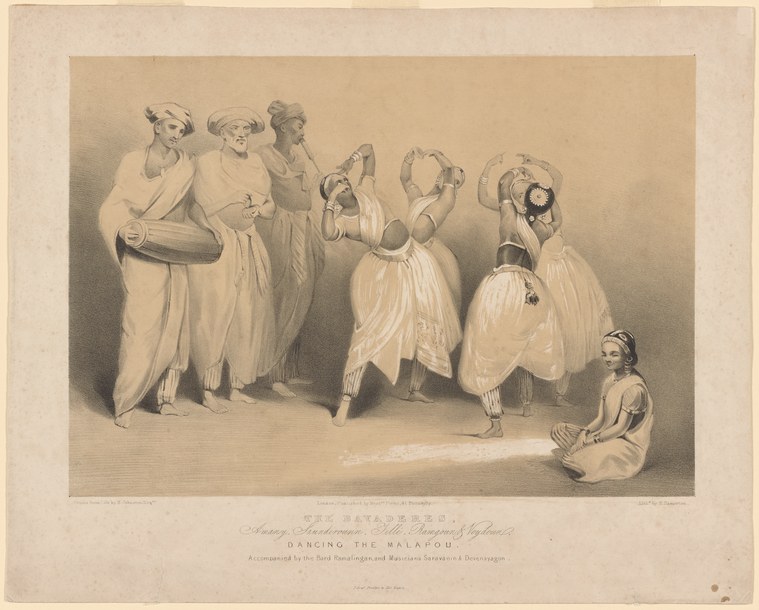
The Bayadères: Amany, Saundirounn, Tillé, Ramgoun & Veydoun dancing the malapou, accompanied by the bard Ramalingan and musicians Saravanini & Devenayagon
Unknown artist
- Collection:
- Prints depicting dance
- Source:
- New York Public Library
- Rights:
- Public domain — free to use, share and adapt.
- Recorded as:
- Public Domain
This engraving is vital evidence for how South Indian classical dance was perceived, represented, and ultimately appropriated in European culture during the Romantic era. It shows that *bayadères* and their dances were known and spectacularized in Europe before the 20th-century codification of Bharatanatyam, and it reveals the gap between the actual technique of South Indian dance and its Western theatrical interpretation.
What you are looking at
Five female dancers in classical drapery stand center stage in a formal group arrangement, their bodies angled to display their forms. Each wears a light, high-waisted dress that falls to mid-calf, with fabric gathered and swept to suggest movement. The dancers hold various poses—some with arms raised and curved, others with hands at their sides or touching neighboring figures. A sixth figure, smaller and seated on the ground to the right, watches the group; this appears to be the musician or bard mentioned in the title. The background is plain and neutral, rendered in soft wash tones. The composition is frontal and theatrical, arranged as though for an audience viewing the spectacle directly. The engraving technique creates a warm, sepia-toned image with careful modeling of drapery folds and the play of light across the bodies.
The dancing
The dancers stand in relaxed, open positions with minimal physical contact—one figure has an arm around another's shoulder, but most are autonomous within the group. Arms are held in soft curves, some raised to shoulder height or extended gently outward. The bodies are upright, with weight evenly distributed and no visible turnout or heightened extension. The poses suggest stillness or a momentary pause in movement rather than dynamic action or traveling steps. The overall framing is symmetrical and frontal, with the figures arranged like a formal tableau or processional line rather than in the closed holds of European social dance.
The dance depicted
The title identifies this as the *malapou*, danced by the five named bayadères (temple dancers of South India) accompanied by a bard and musicians. The *bayadère* was a figure of intense fascination in European culture during the late 18th and 19th centuries, often romanticized through ballet and theatrical spectacle. This engraving appears to document—or more likely, to interpret—the actual appearance and costume of South Indian classical dancers for a European audience. The poses and gathering of drapery suggest a stylized Western representation rather than a precise record of classical Indian dance technique, which typically emphasizes complex footwork, hand mudras (symbolic gestures), and lateral weight shift.
How it was made
This is a hand-colored engraving, identifiable from the fine parallel lines (hatching and cross-hatching) that model the forms and create shadow. The warm sepia tones suggest hand-coloring with watercolor or tint applied after the plate was pulled. Engraving was a labor-intensive medium that required both technical skill and significant time investment, which implies this work was intended for a cultivated audience willing to pay for such a finished product. The technique allowed for the precise rendering of drapery folds and facial expression, but also imposed a flattened, frontal compositional mode typical of theatrical prints of the period.
About this work
This is a European engraving of five South Indian *bayadères* performing the *malapou*, rendered in the Romantic-era taste for exotic, orientalist spectacle. The work sits at the intersection of several cultures: South Indian classical dance, European theatrical and visual traditions, and the 18th–19th-century appetite for images of 'Orient' that shaped both dance and visual art. The precise date is unknown, but the style and engraving technique suggest the late 18th or early 19th century. The work belongs in a dance gallery precisely because it documents how European artists and audiences understood and imagined South Asian dance, and how that imagination shaped the reception and transformation of *bayadère* figures into theatrical idiom.
How to look at it
The composition freezes a moment of stillness or formal presentation rather than capturing dynamic action. Note how the drapery is arranged to flatter and reveal the body while maintaining formal propriety—this is a European aesthetic applied to South Asian dress. The placement of the five dancers in a frontal, symmetrical line follows the logic of European theatrical display and printmaking convention, not the spatial logic of Indian classical dance. The small figure seated separately signals the presence of musical accompaniment essential to the tradition, but removes it from the space of the dance itself—a distinctly European staging choice.
The period
In the late 18th and 19th centuries, European dance and visual culture became intensely fascinated by 'exotic' and 'oriental' figures, including South Indian temple dancers. This fascination was driven by colonial expansion, trade, travel literature, and the Romantic movement's appetite for sensuality, spectacle, and the imagined 'other.' In dance itself, the *bayadère* became a stock figure in European ballet—most famously in the 1830 ballet *La Bayadère*, which transformed the figure almost beyond recognition into a romantic heroine. This engraving predates or is contemporary with that ballet tradition and shows how the bayadère circulated as an image in the visual culture that fed such theatrical fantasies.
Where it lives
This work is held in the New York Public Library's Prints collection, a repository of visual materials documenting dance, theater, and cultural life. The engraving is catalogued with minimal supporting information, which is typical of broad print collections that prioritize access over detailed documentation.
Dance in this work
Questions about this work
What is a bayadère?
A *bayadère* (from Tamil *devadāsi*) was a temple dancer in South India, traditionally trained in classical dance and music as part of religious practice. In European culture, the term became associated with an exotic, often sexualized female dancer. The historical *bayadères* were highly trained artists; their European theatrical versions were usually fantasies.
Is this a real record of the malapou?
Probably not in any precise sense. While the *malapou* was a real dance (recorded in South Indian classical traditions), this engraving appears to be a European artist's interpretation adapted for Western audiences. The poses, the drapery, and the presentation follow European theatrical and printmaking conventions, not the footwork and gesture vocabulary of South Indian dance.
Who were the actual dancers named here?
The names given—Amany, Saundirounn, Tillé, Ramgoun, and Veydoun—may be transliterations or Westernizations of South Indian names, but without additional documentation we cannot identify these individuals. Many such prints circulated in Europe without linking the dancers to specific historical people.
What does this tell us about how Europeans saw dance?
It shows that non-European dance was understood primarily as spectacle—something to look at, to document, and to reshape for European taste. The removal of the musicians to the margin, the frontal arrangement, and the emphasis on bodily display rather than technical complexity all reflect European priorities, not South Indian practice.
More dance artwork





