49 works in this view — arrow keys or swipe to move between them.
Dance in Art
Souvenir d'adieu de Marie Taglioni
Unknown artist
- Collection:
- Prints depicting dance
- Source:
- New York Public Library
- Rights:
- Public domain — free to use, share and adapt.
- Recorded as:
- Public Domain
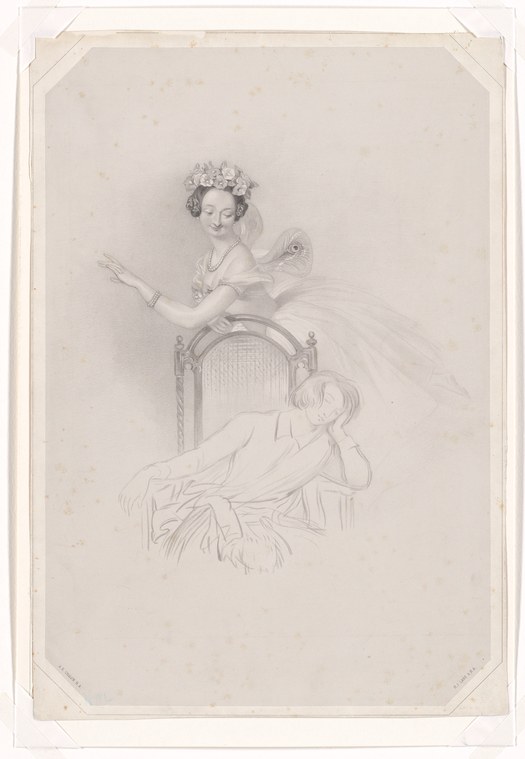
Marie Taglioni was the most celebrated dancer of her era and a founder of Romantic ballet technique. This image, created as a farewell tribute, documents not a performance moment but the mythic status she achieved—a rare glimpse of how a legendary dancer was idealized and mourned by her public through the medium of drawing.
What you are looking at
A delicate pencil drawing on cream paper, presented as a memorial image. In the upper half, a graceful female dancer in a diaphanous tutu and tiara floats with one arm extended forward, the other gesturing upward in a pose of ethereal farewell. Below her, a second figure reclines or drapes across what appears to be a classical chair or architectural element, rendered in softer, less defined lines suggesting memory or absence. The composition is vertically stacked, creating a narrative of ascension or spiritual departure. The drawing technique is precise and controlled in the dancer's upper body, becoming progressively more gestural and sketched toward the lower figure. The overall impression is valedictory—a souvenir marking an ending rather than a moment of performance.
The dancing
The upper figure displays the classical port de bras of early 19th-century ballet: the body held upright with elongated line, one leg apparently in extension, arms positioned in a graceful arc suggesting both movement and restraint. The pose is neither mid-phrase nor landing, but rather a held attitude of elegance—the kind of position a dancer might sustain for a portrait. The lower figure, by contrast, is rendered as weight released, the body surrendering to the architectural support beneath it. There is no dynamic movement between them; instead, they occupy different registers—one ascending or transcendent, one earthbound.
The dance depicted
This is almost certainly a commemorative image of Marie Taglioni, the supreme ballerina of the Romantic era (1804–1884), at the moment of retirement or farewell. The title *Souvenir d'adieu* (Souvenir of Farewell) confirms this is a memorial rather than a performance record. Taglioni revolutionized ballet technique and aesthetic, elevating the art of pointe work and ethereal movement; this image captures her as cultural memory—the dancer suspended between the living performance and the ideal she embodied. The two-figure composition suggests the contrast between her transcendent stage self and the mortal dancer beneath.
How it was made
This is a pencil drawing on paper, executed with the refined technique of early-to-mid 19th-century memorial printmaking. The composition and presentation suggest it may have been a preliminary drawing for an engraving or lithograph—a common practice for circulating images of celebrated performers. The softness and incompleteness of the lower figure and the precision of the upper indicate this is likely a study or finished drawing intended as a private keepsake or as a model for reproduction. The technique permits the artist to render the immaterial quality of the tutu and the gesture with remarkable delicacy.
About this work
This is a farewell portrait of Marie Taglioni, the defining ballerina of early Romantic ballet, drawn as an ideal memory rather than a moment of performance. The vertical composition—with the dancer's ethereal upper half ascending above a more earthbound lower figure—transforms a portrait into an allegory of artistic transcendence and mortality. The image survives as both a souvenir of a legendary career and an artifact of how 19th-century audiences transformed celebrated dancers into cultural icons. It belongs in a gallery of dance because it shows how the art form was commemorated in the minds of those who experienced its greatest practitioners, and how drawing and printmaking served to preserve and circulate the memory of performance.
How to look at it
Notice the stark contrast between the two figures: the upper dancer is complete, poised, and idealized, while the lower figure dissolves into incompleteness and shadow. This is not a study of movement but a portrait of legacy and loss. The artist has chosen not a moment from performance but a pose of farewell—a gesture held, not danced. The tiara and ethereal tutu are rendered with precision, anchoring the image in the visual language of Romantic ballet, while the softer rendering of the lower figure suggests memory, the body released, the spirit departed.
The artist
The artist is not recorded in the catalogue, but the style and intention suggest a working printmaker or illustrator of the mid-19th century, someone commissioned or inspired to create a memorial image for circulation among Taglioni's admirers. The refined technique and respectful iconography suggest professional competence rather than amateur enthusiasm.
The period
Taglioni's career spanned the 1820s to the 1840s, the height of Romantic ballet. During this period, lithography and engraving were the primary means of circulating images of celebrated performers; such prints were collected like photographs, traded, and displayed in homes and theaters. Taglioni's retirement in 1847 would have prompted an outpouring of memorial images. The Romantic aesthetic of ethereal femininity—embodied in Taglioni's technique and persona—was at its cultural peak, and her image became an ideal of grace and otherworldliness.
Where it lives
The work comes from the New York Public Library's collection of prints depicting dance. No catalogue accession number, artist attribution, or date is recorded. It is likely a mid-19th-century drawing or preliminary study for a print, created within a few years of Taglioni's retirement.
Dance in this work
Questions about this work
Who was Marie Taglioni?
Marie Taglioni (1804–1884) was a Swedish-Italian ballerina and the supreme dancer of the Romantic era. She revolutionized ballet technique, notably perfecting and popularizing dancing sur les pointes (on pointe), and became the embodiment of Romantic ideals of ethereal, weightless femininity. Her career spanned from the 1820s to the 1840s; she retired in 1847 and lived in relative seclusion thereafter.
What does 'Souvenir d'adieu' mean?
It means 'Souvenir of Farewell' in French. This is a memorial image, created after Taglioni's retirement or death, as a keepsake for admirers. Such farewell prints and drawings were common in the 19th century, circulated to commemorate the final retirement of celebrated performers.
Why is the lower figure so much less finished than the upper?
The contrast is deliberate and symbolic. The upper, luminous figure represents Taglioni as she was known—ideal, transcendent, eternal in memory. The lower, earthbound and unfinished figure represents the mortal dancer, the body released. This composition suggests the distance between the living performer and the immortal memory she left behind.
Is this a finished work or a sketch?
It appears to be a finished drawing, likely created as a preliminary study for an engraving or lithograph, or as a finished work in its own right intended for framing or collection. The precision of the upper figure and the deliberate softness of the lower suggest intentional artistic choices rather than incompleteness.
More dance artwork





