49 works in this view — arrow keys or swipe to move between them.
Dance in Art
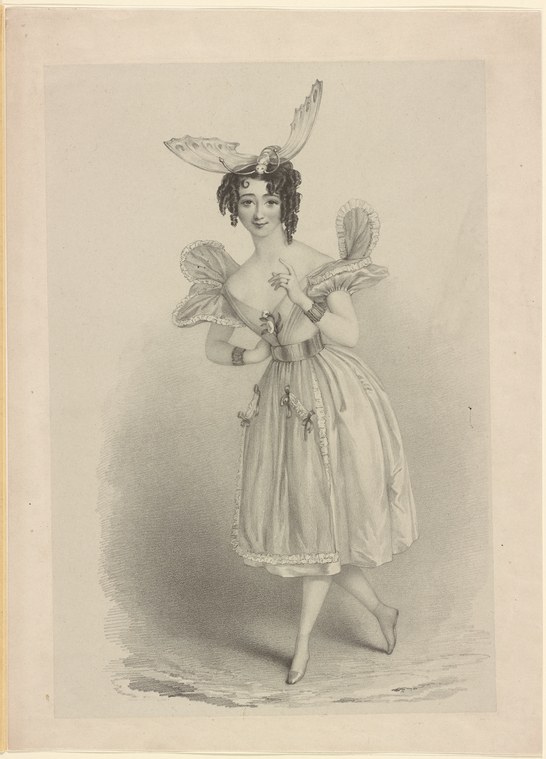
Mrs. Honey as Psyche
Unknown artist
- Collection:
- Prints depicting dance
- Source:
- New York Public Library
- Rights:
- Public domain — free to use, share and adapt.
- Recorded as:
- Public Domain
This image documents the material and visual culture of early 19th-century theatrical dance at a moment when Romanticism was reshaping what ballet could represent and how performers embodied otherworldly characters. The portrait preserves the silhouette, deportment, and costume details of an actual performer in an actual role, providing concrete evidence of how Romantic ideals—weightlessness, aspiration, transcendence—were literally embodied on stage.
What you are looking at
A young woman in Regency-era dress stands in a elegant contrapposto pose against a pale background, gazing upward with a dreamy expression. She wears a high-waisted white or cream muslin gown with short puffed sleeves and a gathered skirt that falls to mid-calf, typical of early 19th-century fashion. Her dark hair is arranged in ringlets and crowned with an ornate headpiece featuring what appears to be feathers or ribbons. Most striking are the large, gossamer-winged appendages—insect or fairy wings—that extend from her shoulders, rendered in fine detail. She holds a matching smaller pair of wings in her hands, as if displaying them. The composition is a three-quarter-length portrait, delicately rendered in what appears to be a stippled or tonal engraving technique that creates soft modeling and atmospheric depth.
The dancing
The dancer's weight is poised lightly on one leg in a classical contrapposto stance, the other leg relaxed and slightly forward. Her torso turns gently, her shoulders remain level and open, and her arms are positioned gracefully—one holding the accessory wings, the other at her side. The pose suggests a moment of suspended, ethereal movement rather than active dancing; the body expresses the refined, elongated line valued in Romantic-era theatrical practice. Her gaze upward and her gentle inclination convey a sense of weightlessness and aspiration.
The dance depicted
This is a theatrical portrait of a dancer performing as a supernatural or mythological figure—most likely Psyche, the figure from Apuleius whose story became popular in early 19th-century ballet and pantomime. The wings are a costume element marking her as a spirit or winged creature rather than a human character. The image documents a particular moment in the dancer's performance or a rehearsal study; the theatrical context is established by the idealized pose, the stage-appropriate muslin gown, and the fantastical costume elements. The identity 'Mrs. Honey' in the title suggests this is a portrait of a named performer rather than a generalized representation of a role.
How it was made
This is a finely executed engraving or stipple engraving, a technique common for theatrical portraits in the early 19th century. The delicate tonal modeling—achieved through fine dots or parallel lines—allows for the rendering of subtle gradations in the muslin fabric, the ethereal quality of the wings, and the softness of the figure's skin. This level of refinement and the subject matter suggest a high-quality theatrical print intended for a sophisticated audience—likely sold as a standalone portrait or as part of a series of performers.
About this work
This is a portrait engraving of Mrs. Honey, a performer in early 19th-century theatre, captured in the act of portraying Psyche or a similar winged mythological being. The work sits at the intersection of theatrical documentation and fine art printmaking: it records both a specific performer and a specific costume or character moment, while also functioning as an elegant portrait in its own right. The Romantic era saw a proliferation of such prints, which served as publicity for celebrated performers and also as collectible images for theatre patrons. This work is a valuable historical record of early Romantic ballet or pantomime practice, particularly in its documentation of costume, pose, and the conventions of how supernatural or allegorical figures were staged.
How to look at it
Observe the fineness of the engraving technique: the way the artist has rendered the translucence of the wings through careful line work, and the softness of the muslin through subtle tonal gradation. Notice the dancer's pose—it is not an action pose but a moment of display and reverie, the body arranged to emphasize verticality and elongation. The upward gaze is crucial: it directs attention away from the human and toward the transcendent or divine. The holding of the smaller wings as an accessory suggests this may be a moment just before or after the main performance action, or a formal portrait pose for the print itself.
The period
The early 19th century saw the rise of Romantic ballet in Europe, characterized by a fascination with the supernatural, the exotic, and the ethereal—themes that found perfect expression in stories like Apuleius's *Metamorphoses*. The 1810s–1830s saw an explosion of theatrical prints documenting celebrated performers; these prints served both as souvenirs for theatre-goers and as a form of celebrity portraiture. The fashion for muslin gowns and the rising interest in ballet technique coincided with a new attention to the body as a vehicle for expressing emotion and transcendence. Psyche as a character appeared in various theatrical forms—ballet, pantomime, and dramatic works—often emphasizing her transformation, her vulnerability, and her eventual apotheosis.
Where it lives
This engraving is part of the New York Public Library's collection of prints depicting dance, a collection assembled to document the visual history of theatrical performance. The print is a theatrical portrait, a category of commercial printmaking that was central to 19th-century theatre culture.
Dance in this work
Questions about this work
Who was Mrs. Honey?
The catalogue record does not identify Mrs. Honey beyond her name and her role as Psyche. She was likely a performer in London or another major theatrical center in the early 19th century, known well enough to merit a published portrait. Such prints were typically created for celebrated or fashionable performers of the moment.
What is Psyche's story, and why would a dancer perform it?
In Apuleius's *Metamorphoses*, Psyche is a mortal woman who becomes the lover of Cupid and is eventually transformed into a goddess. The story appealed to Romantic-era artists and dancers because it centers on transformation, beauty, and the transcendence of the human. Early 19th-century ballets and pantomimes drew heavily on Classical mythology, and Psyche's vulnerability and eventual apotheosis made her a perfect Romantic heroine.
Why are the wings so important in this portrait?
The wings mark Psyche as a supernatural being and are essential costume elements that identify the role. By holding a second pair in her hands, the artist may be documenting an accessory prop, or the second wings may symbolize her dual nature—human and divine, mortal and immortal. The delicate rendering of the wings emphasizes the ethereal, weightless quality central to Romantic aesthetic ideals.
What does the pose tell us about how dance was performed?
The upright, turned-out stance and the emphasis on the line of the body reflect the balletic vocabulary of the period. The dancer is not caught mid-leap or in a dramatic action, but in a posed, display-oriented moment—a convention of theatrical portraiture that also reflects how performers would have held themselves on stage between actions or at moments of heightened emotion or revelation.
More dance artwork





