49 works in this view — arrow keys or swipe to move between them.
Dance in Art
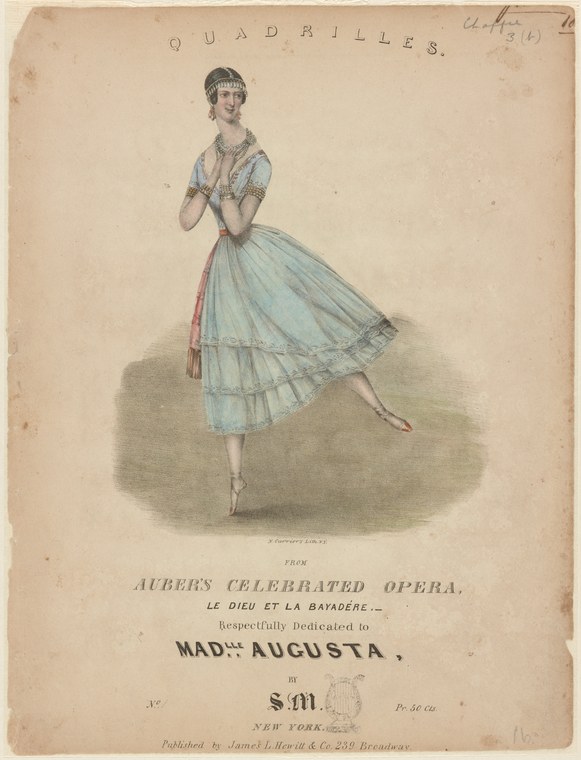
Quadrilles from Auber's celebrated opera Le dieu et la bayadère, respectfully dedicated to Madlle. Augusta, by S. M.
Unknown artist
- Collection:
- Prints depicting dance
- Source:
- New York Public Library
- Rights:
- Public domain — free to use, share and adapt.
- Recorded as:
- Public Domain
This image preserves both the specific costume and movement vocabulary of a role that shaped European understandings of 'Oriental' dance at the moment those fantasies were crystallizing. Because it documents a named performer in a named work on a specific date, it anchors the later history of Romantic ballet and the exotic roles that defined it, making it invaluable for historians tracing how European artists imagined and performed non-European dance traditions.
What you are looking at
A single female dancer stands in three-quarter pose against a plain background, caught mid-movement in a classical theatrical stance. She wears a pale blue gauze skirt with multiple deep flounces edged in darker trim, a fitted white corseted bodice with short puffed sleeves, and a jeweled headdress that frames dark hair. Her left leg is raised and bent, with the foot pointed in a balletic line, while her right leg supports her weight en demi-pointe. Her arms are held in a graceful frame—the left arm extended at shoulder height, the right arm curved at her side. A pink or coral-colored sash drapes from her waist. The entire figure is rendered in soft watercolor with careful attention to the translucency of the skirt fabric and the sculptural quality of the pose. The composition centers the dancer against a subtly shaded background that gives her figure dimensional presence without cluttering the image.
The dancing
A single dancer occupies the frame. Her weight is clearly distributed on the supporting right leg, held in a turned-out position that suggests trained balletic technique, while the raised left leg demonstrates significant flexibility and control. The arm positions and head carriage follow the conventions of early 19th-century theatrical dance—the upper body is composed and formal, with elongated lines through the arms and neck. The turn-out of the supporting leg and the pointed quality of the raised foot indicate this is not social or folk dance but rather trained theatrical technique.
The dance depicted
This is a theatrical dance from the Romantic era, specifically a solo from a ballet or opera-ballet. The inscription identifies it as being from Auber's opera *Le dieu et la bayadère* (The God and the Bayadère), first performed in 1830. The figure labeled 'Madlle. Augusta' is most likely Mademoiselle Augusta (possibly Augusta Maywood or another prominent dancer of the period), suggesting this image documents a star dancer in a celebrated role. The costume—particularly the jeweled headdress and tiered skirt—aligns with the 'bayadère' (Indian dancing girl) roles that became fashionable in European ballet following the success of this work. The pose captures a moment of repose rather than virtuosic action, presenting the dancer as a figure of grace and exoticism rather than technical display.
How it was made
This is a hand-colored engraving or lithograph, a reproductive print made from a drawn or engraved plate. The soft coloring—particularly the subtle gradations in the skirt and the pale flesh tones—suggests hand-application of watercolor or tinted paper over a black printed base, a technique standard for theatrical prints of this period. The high quality of the rendering and the careful anatomical construction indicate a skilled theatrical printmaker, possibly working in Paris, where the opera premiered and where such imagery was widely distributed. This medium allowed multiple copies to reach dancers, audiences, print collectors, and aficionados across Europe and North America, making such images central to how theatrical fashion and performance were circulated and understood.
About this work
This is a theatrical print documenting a specific role in a celebrated early 19th-century opera-ballet. It functions simultaneously as a costume study, a record of a star performer, and a fashionable commodity—the kind of image that audiences collected, dancers studied, and print merchants sold. The work belongs to the tradition of theatrical portraiture that emerged when opera and ballet became central to urban entertainment, and when dancers began to achieve the status of named celebrities whose likenesses audiences wanted to possess. The inscription 'respectfully dedicated to Madlle. Augusta' indicates this was both a commercial product and a form of flattery to the performer, common practice in theatrical print culture of the 1830s-1840s.
How to look at it
Observe the dancer's pose: she is caught not in a moment of motion but in a composed, held position. This is characteristic of Romantic-era ballet portraiture, which froze the dancer in an attitude of grace rather than capturing a leap or turn. The raised leg and the turn-out reveal the trained technique expected of a professional theatrical dancer of the period. The costume is the second thing to study—the tiered gauze skirt, the fitted bodice, the jeweled headdress are all signals of a specific story and a specific cultural fantasy. Finally, attend to the artist's choice to render the figure in soft, almost ethereal tones, with particular attention to the translucency of the skirt. This visual softness is itself part of the Romantic aesthetic, making the dancer appear weightless and otherworldly.
The artist
The print is attributed to S.M., a signature that may indicate a Parisian theatrical printmaker or lithographer whose name is not currently identified in the catalogue. The style and execution suggest professional training in theatrical portraiture and a command of hand-coloring technique. Such printmakers worked within a specialized market serving theaters, dancers, and enthusiasts, and their names are often lost to history even when their work reached wide audiences. The publisher James L. Haven & Co. of New York indicates this image was distributed to the American market, suggesting transatlantic circulation of European operatic culture.
The period
This print dates to the 1830s-1840s, the height of the Romantic ballet era in Europe. Auber's *Le dieu et la bayadère* premiered in 1830 and was one of the most successful operas of the period, performed repeatedly across Europe and America. The work sparked a craze for 'bayadère' roles and exotic Oriental costuming that would dominate ballet throughout the Romantic period. At the same moment, theatrical prints and lithographs were becoming the primary medium through which performers' images reached the public—long before photography, these hand-colored prints were the celebrities' publicity, the audience's souvenir, and the historian's evidence. The role of women as exoticized performers and the visual vocabulary of Orientalism in European dance were both solidifying during this precise moment.
Where it lives
The print is held in the Library of Congress Prints and Photographs collection and is catalogued as part of their dance imagery holdings. It was published in New York by James L. Haven & Co., indicating it reached the American market during the height of European Romantic ballet's influence on American theatrical culture.
Dance in this work
Questions about this work
What is a bayadère and why did European ballet care?
A bayadère is an Indian dancing girl—a figure of exoticism and eroticism in European fantasy. Following the success of Auber's opera, 'bayadère' roles became a staple of Romantic ballet, allowing European dancers to perform fantasy versions of non-European dance and culture. These roles were costume pieces as much as dance roles, built around the visual appeal of jewelry, gauze, and ornament rather than the movement vocabularies of actual Indian dance.
Who was Mademoiselle Augusta?
The catalogue does not identify which performer named Augusta danced this role. Multiple dancers performed in European companies during the 1830s-1840s, and without additional documentation, we cannot confirm the specific performer. The dedication suggests she was a star dancer of sufficient prominence to merit a printed portrait distributed to the public.
Why is this a print and not a painting?
Theatrical prints were far cheaper to produce and distribute than paintings, and they could reach hundreds of copies. They were the primary medium through which theatrical images circulated before photography. A theater-goer might buy a print of a favorite performer for a few cents; a portrait painting was affordable only to the wealthy. The print was the celebrity merchandise of the era.
What can we learn about the actual dance from this image?
The pose tells us about the trained technique required: turn-out from the hip, control and flexibility in the legs, and an upright, composed carriage. It does not show us the choreography or the dynamics of movement, only the aesthetic ideal the dancer was meant to embody. For what the bayadère actually danced, we would need to consult choreographic notation, reviews, or descriptions of the work itself.
More dance artwork





