49 works in this view — arrow keys or swipe to move between them.
Dance in Art
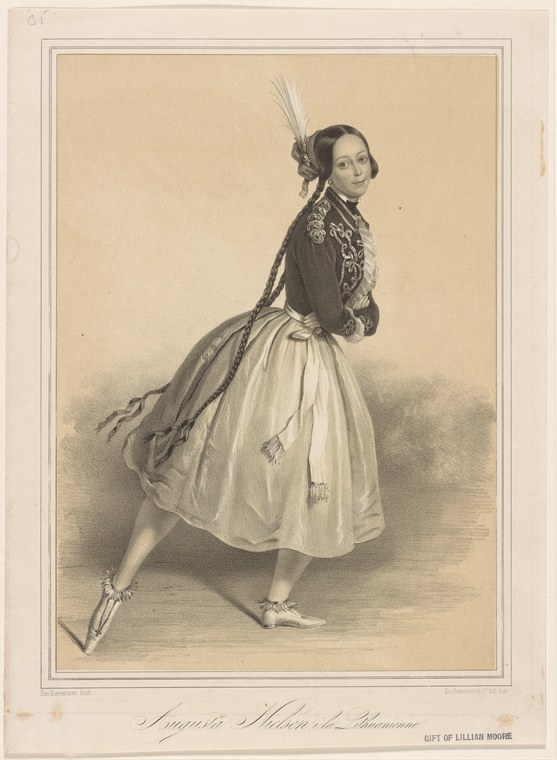
Augusta Nielsen i la Lithuanienne
Unknown artist
- Collection:
- Prints depicting dance
- Source:
- New York Public Library
- Rights:
- Public domain — free to use, share and adapt.
- Recorded as:
- Public Domain
Character dances and national-style pieces were foundational to Romantic ballet and to the careers of its principal female dancers, yet they are often overshadowed in dance history by the more celebrated full-length narrative ballets. This print is direct evidence of how a major performer like Nielsen was marketed and remembered, and of the exotic and picturesque aesthetic that shaped nineteenth-century theatrical dance. The image also documents the hybrid costume language—part balletic, part folk-inflected—that was used to signal 'otherness' and geographical flavor on the European stage.
What you are looking at
A single female dancer in a pale, cream-toned ground occupies the center of the composition. She is captured mid-movement, her body angled away from the viewer in a three-quarter turn, her head turned back over her shoulder to look toward the spectator. Her costume is strikingly hybrid: a dark jacket with elaborate embroidered or patterned detail across the bodice and sleeves, worn over a voluminous, pale skirt that extends to mid-calf. The skirt displays soft, naturalistic folds suggesting movement. A dramatic length of dark fabric—possibly a shawl or train—trails from her waist or shoulders, sweeping across the lower portion of the composition. Her feet are in pale slippers, one leg extended in attitude or in a step. A feathered headdress or plume crowns her head. The image is rendered as a lithograph or fine engraving in black ink with tonal shading, giving it the character of a mid-nineteenth-century theatrical print.
The dancing
A single dancer's weight is poised in an off-balance attitude: the supporting leg is engaged while the other extends backward and upward, neither fully lifted nor grounded. The upper body twists sharply, creating a spiral through the frame. Her arms are not clearly visible in the frontal plane, suggesting they either frame the body along its sides or are engaged in a gesticulation characteristic of dramatic or national dance. The apparent lightness and lift of the trailing drapery, combined with the extended leg and the turn of the head, suggest a moment of traversal across the stage rather than a stable position.
The dance depicted
The title identifies this as 'Lithuanienne'—a character dance or national-style piece. The costume fusion (tailored jacket with full skirt and folk-inflected headdress) is typical of Romantic-era theatrical representations of Eastern European or 'exotic' national identity. The pose and gesture suggest a solo variation showcasing virtuosity and character; the dancer appears to be mid-turn or mid-step across the stage. Character dances of this type were popular numbers in mid-nineteenth-century theatrical ballet and were often performed by principal ballerinas as divertissements. The specific dancer, identified in the inscription as Augusta Nielsen, was a known performer of such roles in European theaters of that period.
How it was made
This is a lithograph or possibly a fine engraving, rendered in black ink with gray tonal wash to create depth and shadow. The technique allows for broad distribution as a theatrical print—these images were sold to audiences as souvenirs and records of famous performers and their celebrated roles. The fineness of the line work and the careful attention to the fall of drapery and the modeling of the face suggest a skilled reproductive printmaker working from a drawing or painting. The medium would have made this work accessible and affordable to a wide theater-going public, establishing it as a document of Romantic-era performance practice and female stardom.
About this work
This is a lithographed portrait of the ballerina Augusta Nielsen in a character dance role, 'La Lithuanienne,' dated to the mid-nineteenth century (likely 1840s–1850s based on style and costume). It belongs to a genre of theatrical prints that documented the great dancers and favorite roles of the Romantic ballet era. The work sits at the intersection of portraiture, dance documentation, and commercial entertainment culture: it is at once a representation of a specific artist's embodied skill, a record of a popular theatrical genre, and a commodity circulating through urban audiences. Such prints were essential to the celebrity of dancers and the dissemination of choreographic fashion across Europe.
How to look at it
Attend to the moment chosen: the dancer is captured not in a moment of stillness, but suspended in a turn, suggesting the velocity and virtuosity of her performance. The eye should follow the twisting spiral of the body and the sweep of the trailing drapery—together they create a sense of motion frozen on the page. Notice how the costume operates: the formal tailored jacket (European, balletic) sits above the full skirt (folk, picturesque), announcing to the viewer that this is a curated theatrical representation of national character, not an ethnographic document. The expression—the glance back over the shoulder—creates intimacy with the viewer while the body remains in action.
The artist
The artist is not recorded in the catalogue. The inscription 'Gift of Lillian Moore' indicates the print came to the New York Public Library through the dance scholar and collector Lillian Moore, who assembled a significant archive of theatrical prints and dance documentation. The print itself is the work of a theatrical lithographer, almost certainly a professional reproductive artist working in a major European printing center (Paris, Vienna, or Berlin), producing images for theatrical distribution and consumption.
The period
This work dates to the Romantic era in ballet (roughly 1830–1850), when character dances and national-style pieces had become essential elements of the theatrical bill. The exotic or pastoral character—whether Neapolitan, Spanish, Hungarian, or Lithuanian—provided contrast and variety within evening-length spectacles. The female dancer had become the principal draw of the theater, and lithographed portraits of celebrated performers were as much a part of theater culture as the programs themselves. In painting and the graphic arts of the same period, there was intense interest in ethnographic and picturesque subject matter, reflected here in the costuming and the dramatic pose.
Where it lives
This lithograph is held in the Prints depicting dance collection at the New York Public Library. It came to the library as a gift from Lillian Moore, the pioneering American dance historian and curator. Moore's collection is foundational to the study of nineteenth-century theatrical dance documentation.
Dance in this work
Questions about this work
Was 'La Lithuanienne' a real Lithuanian dance?
No. Character dances with national names were theatrical inventions of the Romantic era—they were ballets created in European cities to evoke a sense of exoticism or national flavor, not authentic dances from those countries. They tell us more about how Europe imagined distant places than about actual Lithuanian dance traditions.
Who was Augusta Nielsen?
Nielsen was a professional ballerina active in European theaters in the mid-nineteenth century, known for her performances in character and contemporary roles. Little biographical information survives, but her appearance in multiple theatrical prints indicates she was a celebrated performer whose roles were deemed important enough to circulate as prints to theater audiences.
How were theatrical prints like this used?
These prints were sold in the theater lobbies and through print shops, serving as souvenirs of famous performances and as advertisements for upcoming productions. They also functioned as records of how dancers actually dressed and performed—before photography and film, lithographs like this were the primary visual documentation of performance practice.
Why is the costume such a mix of styles?
The jacket-over-skirt costume was a deliberate theatrical construction signaling 'character' or 'national' dress to the nineteenth-century audience. The fitted jacket and plumed headdress added elegance and formality, while the full skirt allowed the virtuosity of footwork to be visible. This hybrid aesthetic was as essential to the appeal of character dances as the music and choreography.
More dance artwork





