49 works in this view — arrow keys or swipe to move between them.
Dance in Art
La cachucha
Unknown artist
- Collection:
- Prints depicting dance
- Source:
- New York Public Library
- Rights:
- Public domain — free to use, share and adapt.
- Recorded as:
- Public Domain
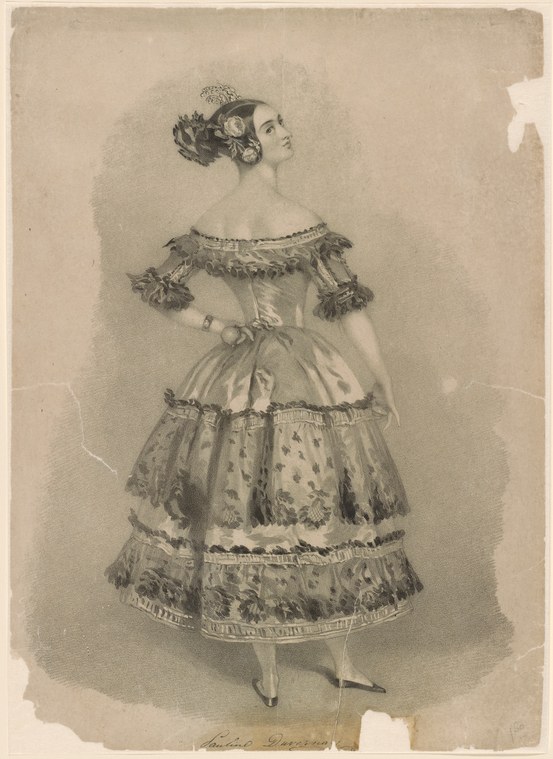
The Cachucha represents a crucial moment when ballet dancers were beginning to move away from strictly European court technique toward the incorporation of national and folk material—a shift that characterizes Romantic ballet. For historians of dance and theater, this print documents not only the choreography and technique of a celebrated solo, but also the costume design that was integral to how the dance was conceived and received. The print itself is evidence of how dance became a commodity and form of celebrity culture in the nineteenth century, circulating images of star dancers to an audience that might encounter them only in these reproductions.
What you are looking at
A young woman in a formal ball gown stands in three-quarter profile, her body turned gracefully to the right. She wears a short skirt composed of three flounced tiers trimmed with ornamental bands—a striking feature of Romantic-era dress. The bodice is an off-shoulder design with short puffed sleeves decorated with dark bows or knots, and the neckline is finished with a broad trim. Her hair is styled in the fashion of the 1840s, swept up and back with an ornamental comb or tiara visible at the crown. The figure is rendered in soft gray tones characteristic of period lithography or engraving, with subtle shading that models the form and fabric. The pose suggests a moment caught mid-performance—the body is upright and poised, with a light, elevated carriage typical of the Romantic ballet dancers of the era. The background is deliberately empty and neutral, throwing all focus onto the figure and costume.
The dancing
The dancer's weight appears to be centered and lightly held, with the body elongated and the posture suggesting the upright carriage of classical technique. One leg is straight and supporting while the other extends slightly, though the exact position is ambiguous in the print. The arms are positioned at a graceful angle, one slightly raised and bent, the other at the dancer's side—a pose suggesting either a moment of stillness between movements or the held line of a step. The overall frame is frontal-facing but with the body turned, creating the classic Romantic ballet profile that displays both the torso line and the volume of the skirt.
The dance depicted
La Cachucha is a Spanish dance in triple meter that became one of the signature showpieces of the Romantic ballet era, particularly associated with the Creole dancer Fanny Elssler, who performed it to enormous acclaim from 1836 onward. Though cachucha is rooted in Spanish folk tradition, the ballet version was a virtuosic solo that combined light footwork, rapid turns, and sharp, rhythmic heel work with the ethereal carriage and line of classical technique. The costume visible here—particularly the short skirt with multiple flounces—is characteristic of how the cachucha was presented in the balletic context, designed to display the dancer's feet and lower legs during rapid petit allegro and sharp articulations. This print likely documents the dance as it was known in the 1840s on the European stage.
How it was made
This is a lithograph or possibly a hand-colored engraving, identifiable by the fine tonal gradations and the characteristic hatching of the background to create atmospheric depth. The print technique allowed for rapid reproduction and wide circulation of images of celebrated dancers across Europe, making this the kind of souvenir a theater-goer might purchase. The medium's softness—particularly in the rendering of fabrics and the figure's luminous quality against the neutral ground—was well-suited to depicting the ethereal aesthetic valued in Romantic ballet. The inscription or signature visible at the base suggests this was a commercial print, likely sold separately or bound into collections of theatrical portraits.
About this work
This is a portrait print of a Romantic-era ballet dancer in the costume of a celebrated Spanish dance that became a staple of the nineteenth-century stage. The La Cachucha, as performed by stars like Fanny Elssler, bridged the gap between folk tradition and classical ballet technique: it required the precise positions and ethereal carriage of the ballet vocabulary but deployed rapid footwork and rhythmic attack drawn from its Spanish roots. The print captures the visual spectacle that made the dance famous—the short, multi-tiered skirt that was radical for its time, designed specifically to expose the legs and allow the display of virtuosic footwork. Such images circulated widely among the theater-going public and documented the appearance and fame of dancers at a moment when lithography made theatrical imagery a form of popular culture.
How to look at it
Attend to the costume: the short skirt with its multiple tiers and ornamental trim is not merely decorative but functional—designed to showcase rapid footwork and the articulation of the legs and feet. Notice the carriage of the body—the upright, elongated line of classical ballet—and how it contrasts with what you might know about Spanish dance. The pose is poised and weightless, capturing the Romantic ideal of the ethereal dancer, yet the costume and the dance's reputation point toward something more earthbound and rhythmically sharp. The print preserves a moment of codification, where folk tradition has been incorporated into the classical ballet vocabulary and made respectable for the European stage.
The artist
The artist is not recorded in the catalogue, but the print itself bears the hallmarks of professional theatrical lithography of the 1840s. Such prints were commonly created by commercial publishing houses in Paris, London, and other theater centers, often working from sketches made during performances or from the dancers themselves. The quality of the work suggests it was produced by a competent practitioner of the medium, likely someone specializing in theatrical and dance imagery.
The period
The 1840s were the height of the Romantic ballet era, a time when European audiences were fascinated by the exotic, the folk, and the ethereal. The popularity of national and character dances—Spanish, Russian, Polish—within the classical ballet framework reflected broader Romantic interests in cultural difference and primitivism. Fanny Elssler, for whom the Cachucha became a signature role, was the great rival to Marie Taglioni and represented a different aesthetic: where Taglioni embodied weightlessness and pure classical line, Elssler brought earthiness, rhythmic precision, and the display of brilliant footwork. The Cachucha, with its folk roots and demanding technique, showcased Elssler's particular gifts and became one of the era's most famous and frequently documented dances.
Where it lives
This print is part of the New York Public Library's collection of dance-related prints and ephemera, documents of the theatrical culture of the nineteenth century. Such collections preserve evidence of how dance was performed, advertised, and circulated as a form of entertainment and celebrity.
Dance in this work
Questions about this work
What is the Cachucha and why is it famous?
La Cachucha is a Spanish-origin triple-meter dance that became a sensation in European ballet when the dancer Fanny Elssler performed it beginning in 1836. It required both the technical precision of classical ballet—positions, turnout, ethereal carriage—and sharp, articulate footwork drawn from Spanish folk tradition. The dance was beloved for its combination of technical difficulty and its representation of the exotic, and it became a signature vehicle for Elssler's particular gifts: brilliant footwork, rhythmic precision, and a more grounded, earthy quality than the weightless aesthetic of her contemporary rival Marie Taglioni.
Why is the skirt so short?
The short, multi-tiered skirt was designed specifically to display the feet and lower legs during the rapid, rhythmic footwork of the Cachucha. It was relatively daring for its time—a departure from the long skirts that had previously dominated ballet costume. The tiers and ornamental trim added visual interest and movement when the dancer turned and jumped, and they allowed the audience to see exactly what the dancer's feet were doing, which was a key part of the Cachucha's appeal.
Who was Fanny Elssler?
Fanny Elssler (1810–1884) was an Austrian dancer who became one of the two great stars of Romantic ballet, the rival of Marie Taglioni. Where Taglioni represented weightlessness, pure classical technique, and the transcendent ideal, Elssler brought brilliant footwork, rhythmic precision, and a more human, earthly quality. She was particularly famous for character dances like the Cachucha, and her performances in Paris, London, and America made her an international celebrity. She had a major influence on how dancers understood the possibilities of technique and characterization.
How do we know this is a Cachucha and not another dance?
The title is inscribed on the print itself. The costume—particularly the distinctive short, multi-tiered skirt with ornamental trim—is also iconic to how the Cachucha was costumed during the Romantic era. The pose and carriage are consistent with the theatrical ballet aesthetic of the 1840s. However, we cannot determine from the image alone whether this portrays a specific dancer or performance; the print may be a generic representation of the dance as it was known during this period.
More dance artwork





