49 works in this view — arrow keys or swipe to move between them.
Dance in Art
Clara Vestris Webster
Unknown artist
- Collection:
- Prints depicting dance
- Source:
- New York Public Library
- Rights:
- Public domain — free to use, share and adapt.
- Recorded as:
- Public Domain
It is a direct visual record of how a celebrated professional ballet dancer of the Romantic era looked, stood, and moved. It shows the silhouette, training, and presentation of Romantic ballet at a moment when the style was at its height, and it names a dancer—Clara Vestris Webster—whose performance has otherwise left few traces in the historical record. For a historian of dance or an artist working in ballet, it is evidence of what the body could do and how it was dressed and valued.
What you are looking at
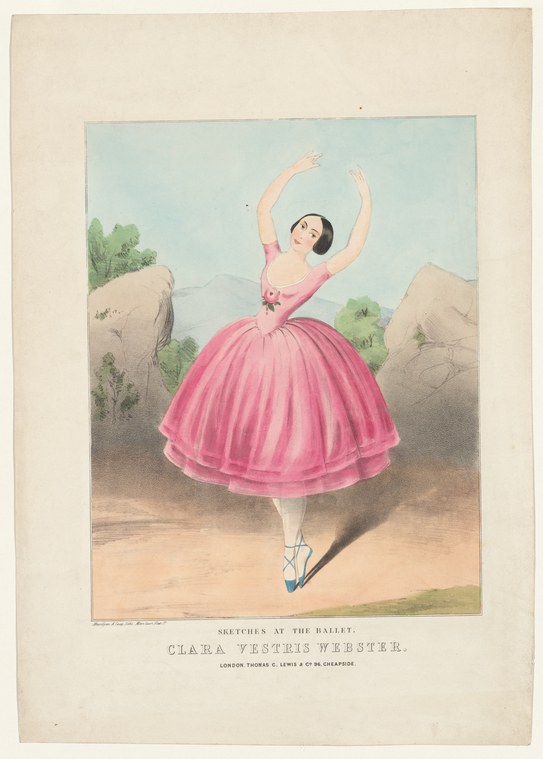
A young female dancer in a vivid pink tulle skirt stands alone in a rocky landscape beneath a pale blue sky. She is captured mid-motion in an attitude or preparation pose, both arms raised above her head in a graceful arc, her body composed and controlled despite the outdoor setting. She wears pink silk or satin at the bodice, and blue heeled pointe shoes. The background shows rough brown boulders and scattered green vegetation, creating a theatrical but naturalistic backdrop. The composition is vertical and formal, centred on the figure against the spare landscape, with the dancer's elongated neck and refined posture emphasising her training and elegance.
The dancing
A single dancer in classical ballet position: feet in turned-out stance (likely fifth position or nearly so), both arms overhead in a soft port de bras, shoulders relaxed and engaged, body held with the upright carriage and length characteristic of mid-19th-century ballet training. The pose is controlled and symmetrical, neither frozen nor caught in violent motion, but held in a moment of stillness or preparation. The dancer's youth, slender frame, and the precision of the position leave no doubt she was trained to professional standard.
The dance depicted
This is a portrait of Romantic ballet as it was performed in the mid-19th century. The image is identified in the inscription as "Clara Vestris Webster," a dancer of the era. The pink tulle skirt and pointe shoes place her in the vocabulary of Romantic ballet, and the pose—classical, composed, elevated—shows a dancer at ease in the vocabulary of the style. The outdoor setting is unusual for a dance scene; it may reflect either a Romantic-era narrative scene (such as a woodland or pastoral moment in a ballet story) or, more likely, a deliberate artistic choice to present the dancer as both a trained classical artist and a figure in nature.
How it was made
This is a hand-coloured engraving or lithograph, executed with fine line work and delicate tinting in watercolour or gouache. The precision of the figure, the careful articulation of the fabric folds in the tutu, and the subtle gradation of the sky suggest professional theatrical print production of the mid-19th century. Such prints were circulated as souvenirs of celebrated dancers and performances, sold to audiences in London's West End theatres and to ballet enthusiasts throughout Britain. The careful finish and formal framing indicate this was a quality production, not a cheap popular print.
About this work
This is a theatrical portrait engraving of a professional ballet dancer of the 1840s–1850s, presented as a souvenir or commemorative image of Clara Vestris Webster. It documents the appearance, costume, and carriage of a Romantic-era dancer at a moment when ballet was transitioning from narrative spectacle to an art centred on the virtuosity and beauty of the female body. The image is both a record of a specific performer and a statement about what ballet had become: a form in which the dancer herself, rather than the story she enacted, was the principal subject. The outdoor setting, though unusual, reflects the Romantic era's fascination with nature, emotion, and the sublime, applying these values even to a formal portrait of a trained artist.
The work sits within the large tradition of theatrical portraiture that flourished in the 19th century, documenting the stars of stage and music. It is a primary source for the history of ballet technique, costume, and the celebrity of dancers in the Victorian era.
How to look at it
Notice the precision of the pose: the dancer is not leaping or turning, but held in a moment of classical stillness. This was a deliberate artistic choice, showing the dancer as a trained, disciplined artist rather than caught in narrative action. Pay attention to the pink tulle skirt and how the artist has rendered its weight and drape—the tutu was a relatively new silhouette in the 1840s, and its depiction here is a record of how it actually hung and moved. Look at the heeled pointe shoes: they are rendered in blue, a practical choice for the print, but they confirm that this was an artist trained to dance on the point of the foot—a relatively recent innovation that defined Romantic ballet. Finally, note the landscape: it is austere and romantic, placing the dancer not in a theatre but in an imagined space where art and nature meet.
The artist
The artist is not recorded on the catalogue. However, the publication information "London: Thomas S. Lewis & Co., 36 Chancery Lane" indicates this was a London theatrical print publisher and distributor. Such firms produced and sold thousands of portrait engravings and lithographs of actors, dancers, and performers, often reproducing designs by professional theatrical artists. The style and execution suggest a trained engraver or lithographer working within the commercial theatrical print tradition, but without a signature or other identifying mark visible in the image, attribution is not possible.
The period
This print dates to approximately the 1840s–1850s, the height of the Romantic ballet era in Europe. This was the period of Marie Taglioni, Fanny Elssler, and the dominance of the pointe shoe and the ethereal female dancer as the central figure of ballet. In England, London's King's Theatre and Her Majesty's Theatre were the principal venues, and dancers performed heavily in short-lived seasonal engagements and benefit performances. The commercial market for theatrical portraiture was enormous: audiences wanted images of the stars they had seen or longed to see, and print publishers met that demand with thousands of engravings and lithographs sold at the theatres and through print sellers. This image sits squarely within that tradition.
Where it lives
The New York Public Library catalogue records this as part of a larger collection of "Prints depicting dance." The publisher information indicates it was a commercial print sold in London in the mid-19th century and circulated to collectors and theatre enthusiasts. It is one of many thousands of similar theatrical portraits produced during the era.
Dance in this work
Questions about this work
Who was Clara Vestris Webster?
She was a professional ballet dancer active in the 1840s–1850s, likely performing in London's West End theatres. Beyond what this image tells us—her training, her association with the Romantic ballet style, and her presence as a celebrated enough performer to warrant a commercial portrait engraving—little is documented in readily available sources. The inscription on the print and this image are primary records of her existence and her art.
Why is she dancing outdoors?
The outdoor setting is unusual for a ballet portrait. It may reflect a specific scene from a ballet narrative (such as a woodland or pastoral moment in a story she performed), or it may be an artistic choice by the print designer to present the dancer as a figure of Romantic sensibility—connecting her art to nature and emotion, which were central values of the Romantic era. Without more information, the precise reason cannot be determined.
How was this print made?
This is a hand-coloured engraving or lithograph. The black line work was produced by a professional engraver or lithographer working from a drawing, and then each print was coloured by hand (or partially by hand) in watercolour or gouache. This was standard practice for theatrical portraits in the 1840s–1850s, and it allowed for relatively quick, affordable production of a high-quality image that could be sold at theatres and to collectors.
What does the pose tell us about ballet at this time?
The classical, upright, symmetrical pose reflects the vocabulary of Romantic ballet: control, grace, elevation, and the perfection of the trained body. The fact that she is not shown leaping or in violent motion suggests that the era valued the dancer's presence and beauty as much as her technical virtuosity—or that portrait engravings were typically composed in moments of stillness rather than action to make the figure clear and legible.
More dance artwork





