49 works in this view — arrow keys or swipe to move between them.
Dance in Art
La Cerrito, grande valse fashionable
Unknown artist
- Collection:
- Prints depicting dance
- Source:
- New York Public Library
- Rights:
- Public domain — free to use, share and adapt.
- Recorded as:
- Public Domain
It captures a specific moment in the professionalization and celebrity of Romantic ballet, showing how individual dancers inspired music and became subjects of elaborate visual commemoration. The work reveals the commercial infrastructure of 19th-century dance culture—the way theatrical fame translated into published music, prints, and domestic performance, reaching audiences far beyond the opera house.
What you are looking at
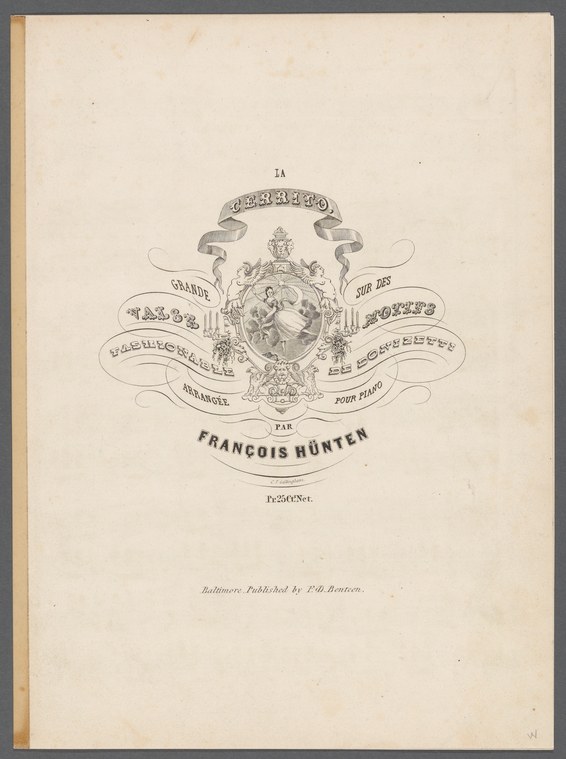
This is a title page or frontispiece engraving for a musical composition dedicated to the dancer Cerrito. The composition consists of an ornate decorative framework containing a central oval medallion that depicts a female dancer in mid-performance, rendered in a lighter tone against darker surroundings. The dancer appears to be in a dynamic pose characteristic of Romantic ballet, with her body lifted and graceful. Surrounding this central image are elaborate heraldic and ornamental elements: a crown at the top, scrolling ribbons bearing French text that reads "LA CERRITO" and "GRANDE VALSE FASHIONABLE," with additional text identifying this as music "COMPOSÉE POUR PIANO" (composed for piano). Below the medallion sits the composer's name, "FRANÇOIS HÜNTEN," in prominent lettering. The entire design is rendered as a refined engraving typical of 19th-century music publication frontispieces, with careful attention to line work and tonal gradation creating an impression of sophistication and prestige.
The dancing
The central figure depicts a single female dancer in an elevated, extended position. She appears to be captured mid-leap or in an attitude, with her body weight lifted and one leg extended, suggesting the balletic vocabulary of the period. Her pose conveys the ethereal, weightless quality prized in Romantic ballet, though the engraver's technique limits detail of precise foot position or arm placement. The figure is surrounded rather than situated in a spatial context, emphasizing the isolation of the dancer as a subject of celebration.
The dance depicted
This is a Romantic-era ballet image, specifically created to honor or commemorate the dancer Cerrito—most likely Fanny Cerrito, one of the most celebrated ballerinas of the 1840s–50s. The title "Grande Valse Fashionable" (Grand Fashionable Waltz) indicates the work is a waltz, a social dance form that was frequently adapted for concert performance and piano composition during this period. The image functions as promotional material for a musical work inspired by or dedicated to the dancer, making it an artifact of 19th-century celebrity culture around the ballet stage. The dance itself is not depicted in action but rather symbolized through the idealized figure of the prima ballerina.
How it was made
This is an engraving, likely steel-engraved or wood-engraved, a technique that allowed for fine detail and wide circulation as a printed image. The careful modulation of line and cross-hatching creates tonal depth, particularly in the rendering of the dancer's body and the shadowed areas of the composition. Engraving was the standard medium for music publication frontispieces and commercial lithographs in the 19th century, indicating this was a work with considerable distribution among middle-class music consumers and ballet enthusiasts. The technical refinement of the execution suggests a professional engraver of some standing.
About this work
This is a title-page engraving for a piano composition, likely from the 1840s or 1850s, dedicated to or inspired by the Romantic ballerina Fanny Cerrito. It belongs to a rich tradition of 19th-century printed ephemera that celebrated the fame of individual dancers, transforming their names and images into marketable commodities for the parlor and concert hall. The work documents the intersection of Romantic ballet culture, music publishing, and visual commemoration—a moment when great dancers became subjects of artistic tribute and commercial celebration. The engraving demonstrates how ballet was disseminated beyond the theater through music, prints, and the cult of personality surrounding celebrated performers.
How to look at it
Observe the engraver's choice to idealize and isolate the dancer rather than situate her in a narrative or theatrical scene. The oval frame device removes her from any specific place or moment, presenting her instead as a timeless, almost iconic figure—a strategy typical of celebrity portraiture from this period. Notice the ornamental apparatus surrounding the dancer: the crown, scrolls, and heraldic elements that elevate her to the status of royalty or national treasure. This visual language transformed a working performer into an abstracted symbol of artistic excellence.
The artist
François Hünten (1802–1878) was a German composer and pianist who composed numerous works for the concert hall and salon, including waltzes, fantasies, and variations on popular themes. He was active during the height of the Romantic era and frequently composed pieces celebrating famous performers of his time. While details of Hünten's involvement in this specific design are unclear from the image, composers of this era often collaborated with engravers and publishers to create visually impressive title pages that would enhance the commercial appeal of their works.
The period
This engraving dates to the heyday of Romantic ballet in Europe, when the art form had become fashionable among the bourgeoisie and celebrated dancers achieved genuine celebrity status. Fanny Cerrito was one of the four great prima ballerinas of the Romantic era (alongside Taglioni, Cerito, and Grahn), performing extensively across Europe from the 1830s onward. The mid-19th century saw an explosion of commercial music publishing aimed at amateur pianists, and Romantic ballet provided a rich source of inspiration and marketing appeal. Images of famous dancers appeared in prints, on sheet-music covers, and in popular lithographs, creating a visual culture around ballet that extended far beyond the theater itself.
Where it lives
This engraving is held in the New York Public Library's print collection documenting dance in art. It is catalogued as a music publication frontispiece or commemorative print, suggesting it was originally the title page of a published piano score distributed to amateur musicians and ballet enthusiasts in the mid-19th century.
Dance in this work
Questions about this work
Who was Cerrito?
Fanny Cerrito (1817–1909) was an Italian prima ballerina and one of the four most celebrated dancers of the Romantic era. She was known for her technical prowess, dramatic presence, and extensive touring throughout Europe. She inspired numerous musical compositions and became a celebrated figure in 19th-century popular culture.
What is a Grande Valse Fashionable?
A Grand Fashionable Waltz was a concert piece for piano based on the waltz, a social dance that became extremely popular in the 19th century. Such pieces were written for amateur pianists and were often inspired by or dedicated to famous performers. They combined the appeal of a popular dance form with compositional sophistication.
Why was this image created?
This engraving served as the title page for a published piano composition, functioning both as advertisement and artistic commemoration. It presented the work to potential buyers—amateur musicians and ballet enthusiasts who would recognize Cerrito's name and be drawn to a piece dedicated to her. The elaborate visual frame elevated both the dancer and the composer.
How was this image distributed?
The engraving was printed and bound as the cover or frontispiece of a sheet music publication, making it accessible to anyone who purchased or borrowed the musical score. Prints and engravings of famous dancers were also sold separately as collectibles, reaching a broad middle-class audience interested in theater, music, and celebrity culture.
More dance artwork





