49 works in this view — arrow keys or swipe to move between them.
Dance in Art
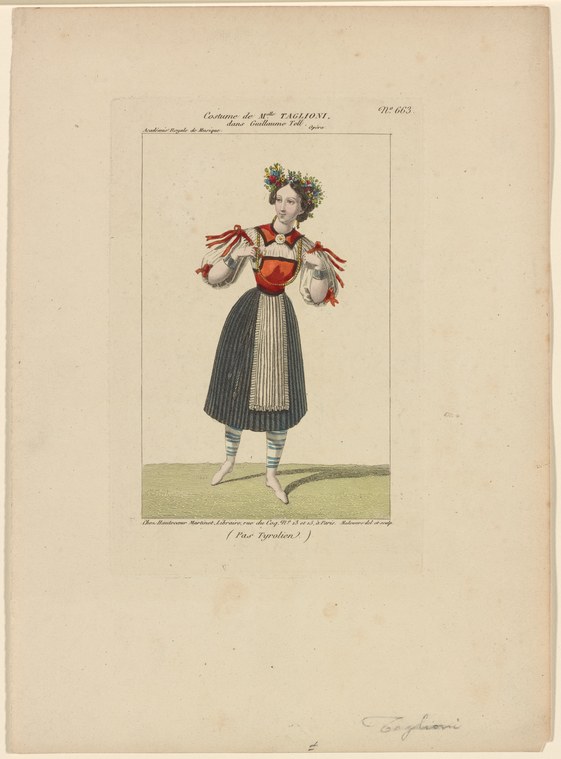
Costume de M'elle Taglioni, dans Guillaume Tell, opéra, pas tyrolien, Académie royale de musique
Unknown artist
- Collection:
- Prints depicting dance
- Source:
- New York Public Library
- Rights:
- Public domain — free to use, share and adapt.
- Recorded as:
- Public Domain
This image documents the emergence of character dance and national exoticism in early Romantic ballet, showing how European peasant dances were adapted for the operatic stage and performed by the era's most celebrated ballerinas. It provides rare visual evidence of Taglioni's actual costume and pose in a specific role, helping historians understand both the visual language of early 19th-century theatre and the way celebrity dancers' images were commercialized and distributed to the public.
What you are looking at
A single female dancer stands alone against a plain background, wearing the traditional dress of a Tyrolean peasant girl. Her costume comprises a dark skirt with vertical pleating, a cream or pale linen chemise with puffy sleeves gathered at the wrist, and a red velvet or silk bodice worn over the chemise. Around her head she wears a wreath or garland of flowers in green and red. Her legs are clad in striped stockings (appearing white with dark stripes), and her feet are positioned in dance pose. Her arms are raised and angled, holding draped fabric or ribbons—red silk scarves or streamers—in each hand, the streamers hanging in elegant curves. The figure is rendered with hand-coloring applied to what appears to be an engraved or lithographed base, giving the work the character of a costume plate or theatrical design study. The composition is frontal and symmetrical, presenting the costume and the dancer's pose for inspection and documentation rather than narrative action.
The dancing
The dancer stands in an upright, presentational pose with weight evenly distributed. Both arms are raised to approximately shoulder height and angled outward, with elbows slightly bent, holding the red silk scarves or streamers that drape downward in graceful arcs. The pose suggests both stillness and potential movement—the body is poised rather than caught mid-action, and the lifted arms with their flowing accessories suggest the arm carriage and upper-body engagement typical of folk or character dance. The dancer's torso is straight and composed, the head held upright beneath the flower crown. The legs appear in a neutral stance, neither in a classical ballet position nor in any marked character-dance step; the focus is on the entire silhouette and the costume.
The dance depicted
This is a theatrical costume plate for a Tyrolean dance (pas tyrolien), identified in the inscription as performed by the celebrated dancer Marie Taglioni in the opera *Guillaume Tell* (William Tell), which premiered at the Académie royale de musique (Paris Opera) in 1829. The Tyrolean dance was a character or demi-caractère dance that formed part of the ballet entr'actes and divertissements in grand opera. Taglioni's performance of this peasant dance in national costume was a celebrated feature of the production. The image documents the costume design and suggests the theatrical presentation of the dance—the raised arms and poised stance indicate a trained dancer performing in character, not a literal peasant but a theatre artist in folk dress. The work demonstrates how the Romantic-era ballet absorbed European regional dances as exoticized character numbers.
How it was made
The work is a hand-coloured engraving or lithograph, a standard format for the dissemination of theatrical costume designs and celebrity portraiture in the early 19th century. The fine linear work of the engraved base (visible in the fabric pleating and facial features) has been selectively colored with watercolor or hand-applied pigment—the red of the bodice and scarves, the green foliage of the wreath, and the striped stockings are all applied by hand rather than printed. This technique allowed for relatively rapid, affordable reproduction of costume documentation that could circulate to theatre-going audiences, amateur dancers, and costume makers. The hand-coloring of individual impressions made each print unique and emphasized the theatrical glamour of the celebrity subject. The border and inscription frame the figure as a formal design document and a souvenir of a celebrated performance.
About this work
This is a hand-coloured engraving of the celebrated Romantic-era ballerina Marie Taglioni in the costume she wore for the Tyrolean peasant dance in Auber's opera *Guillaume Tell*, first performed at the Paris Opera in 1829. The image is a costume plate—a theatrical documentation and celebrity souvenir produced for public consumption. It shows Taglioni in character dress, posed to display both the authentic folk elements of the costume (the flower crown, the embroidered bodice, the pleated skirt) and the grace and training of her performing body. The Tyrolean dance was one of the character dances that punctuated grand opera and early Romantic ballet, offering audiences a taste of European exoticism within the frame of a classically trained dancer's body. Taglioni's fame meant that her costumes and roles were eagerly documented and reproduced; this print is both a record of theatrical design and a fan image celebrating a superstar.
How to look at it
Look at the pose as a statement of character and training together. The flower crown and peasant dress signal a folk or rural identity, but the upright carriage, the lifted arms with their graceful curve, and the controlled, presented stance are all markers of classical ballet training. The artist has frozen the dancer in a moment of display rather than action—this is not mid-leap or mid-turn, but a posed presentation that allows the costume to be seen in full and the body to demonstrate grace and dignity. The red silk scarves are the most theatrical element; watch how they frame the figure and add movement and lightness to the composition. This is a costume plate designed to circulate as both a historical record and a celebrity image, so the balance between documentary and glamour is intentional.
The period
Marie Taglioni (1804–1884) was the dominant ballerina of the Romantic era, celebrated across Europe for her ethereal technique and her pioneering roles in ballets such as *La Sylphide* (1832). In the late 1820s and early 1830s, she performed extensively in grand opera at the Paris Opera (the Académie royale de musique), where *Guillaume Tell* premiered in 1829. Grand opera of this period regularly incorporated ballet and character dances as divertissements, offering opportunities for celebrated dancers to perform in exotic or rural costumes. The Tyrolean dance—or pas tyrolien—was one of several European peasant and regional dances that became fashionable theatrical material in this era, alongside Spanish, Scottish, and Swiss dances. These character pieces allowed Romantic audiences to enjoy a frisson of cultural otherness while remaining assured of the dancer's aristocratic training and refinement. The circulation of costume plates and celebrity images of performers like Taglioni was a major feature of early 19th-century popular culture, creating the first modern star system in dance.
Where it lives
The work is held in the New York Public Library's collection of prints depicting dance. It is a hand-coloured theatrical costume plate from the early 19th century, part of the significant archive of printed ballet and opera imagery produced for public consumption in Paris and other European centres.
Dance in this work
Questions about this work
Who was Marie Taglioni?
Marie Taglioni (1804–1884) was a Swedish-born ballerina trained in the Romantic ballet tradition and the dominant female dancer of her era. She is most famous for her role in the ballet *La Sylphide* (1832), which helped define the Romantic aesthetic in dance. Before that, she performed regularly in grand opera at the Paris Opera, including this role in *Guillaume Tell*. Her technique, grace, and celebrity made her a superstar; her image was widely reproduced and circulated as prints, lithographs, and engravings.
What is a Tyrolean dance?
A Tyrolean dance (pas tyrolien) is a character dance based on the folk traditions of the Tyrol, a region of the Alps in what is now Austria and Italy. In early 19th-century theatre, Tyrolean dances were incorporated into grand opera and ballet as exoticized, regional character pieces—offering audiences a glimpse of European peasant culture as reimagined and refined by trained dancers. These dances were choreographed for the stage and performed in costume, blending folk steps and gestures with ballet technique and theatrical presentation.
What is this image's purpose?
This is a costume plate—a theatrical documentation and celebrity souvenir. It was created to record and publicize the costume design worn by Taglioni in *Guillaume Tell* and to circulate her image to theatre audiences and admirers. Costume plates were printed and hand-coloured, then sold to the public much like modern theatrical or celebrity photographs. They served as both historical documents for costume makers and designers, and as fan images celebrating celebrated performers.
What does the inscription tell us?
The French inscription at the top reads 'Costume de M'elle Taglioni, dans Guillaume Tell, opéra, pas tyrolien' ('Costume of Miss Taglioni, in William Tell, opera, Tyrolean dance'). This identifies the performer, the opera and role, and the specific character dance depicted. The inscription frames the image as an official costume documentation and confirms the theatrical context and celebrity status of the subject.
More dance artwork





