49 works in this view — arrow keys or swipe to move between them.
Dance in Art
Catarina Beretta
Unknown artist
- Collection:
- Prints depicting dance
- Source:
- New York Public Library
- Rights:
- Public domain — free to use, share and adapt.
- Recorded as:
- Public Domain
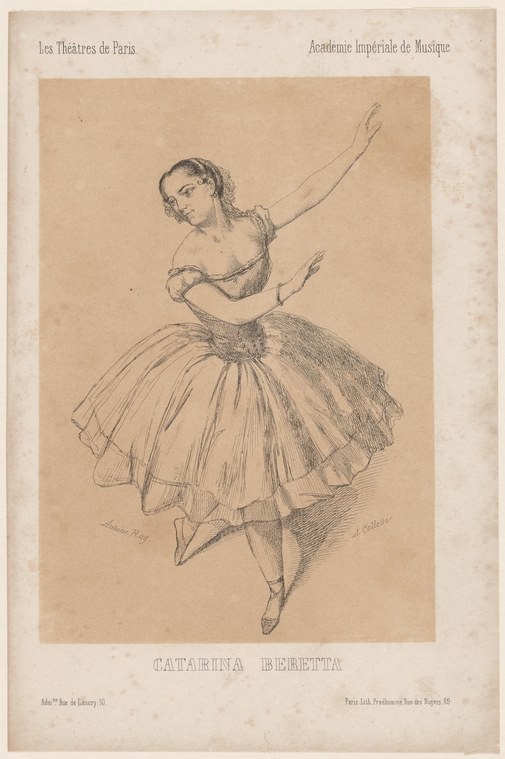
This print is evidence of how Romantic ballet dancers were documented and celebrated in the 19th century. It shows us the exact costume, carriage, and aesthetic values of a named performer at a major institution, making it invaluable for understanding not just what Romantic ballet looked like but how dancers themselves were packaged and marketed as theatrical commodities.
What you are looking at
A young female dancer stands in a controlled contrapposto pose against a plain background, her body angled three-quarters to the viewer. She wears a full tulle skirt with multiple layers that falls to mid-calf, gathered at the waist with what appears to be a decorative belt or corselet. Her upper body is bare or nearly bare, with the fabric beginning only at the waist. Her head is tilted slightly, gaze directed downward and to the side in an attitude of composed grace. Her right arm extends upward and outward in an arabesque position, while her left arm curves across her torso. She stands en pointe or nearly so, her left leg straight and supporting, her right leg positioned for a potential développé or attitude. The drawing is executed in fine ink line work with subtle shading, rendered on tan paper in a style consistent with 19th-century theatrical portraiture.
The dancing
A single dancer in a formal ballet pose. The upper body carriage is upright with squared shoulders and an extended upper-back line. The right arm describes a graceful arc from shoulder to fingertips, suggesting control and extension; the left arm is positioned in a supporting frame across the body. Both arms demonstrate the soft, rounded port de bras typical of Romantic-era ballet. The weight appears centered over the supporting leg, with no visible twist or spiral in the torso—a reading consistent with classical technique rather than character dance.
The dance depicted
This is a Romantic-era ballet dancer, most likely a soloist or principal performing a variation or divertissement. The pose and costume—the bare or minimal upper body, the layered tulle skirt worn at natural waist, the delicate pointe work, and the ethereal arm placement—are characteristic of the 1830s–1850s Romantic ballet aesthetic. The controlled, vertical carriage and the absence of any narrative or character gesture suggest this is a classical solo, probably a variation from a three-act ballet. The title *Catarina Beretta* indicates this may be a named dancer or the character she portrayed.
How it was made
This is a lithographic print or engraving on paper, as indicated by the fine linear rendering and the tonal work visible in the skirt and surrounding areas. The technique allows for precise capture of line and delicate shading, making it well suited to theatrical portraiture and costume documentation. The print was likely created for circulation among theatre patrons, dancers, and print collectors—a common and prestigious form of theatrical publicity in the 19th century. The presence of text at the top and bottom (indicating title, venue, and likely publisher information) confirms its role as a commemorative theatrical print.
About this work
This is a portrait of a dancer identified as Catarina Beretta, rendered as a lithographic or engraved theatrical print in the mid-19th century. The work documents both the dancer and the Romantic ballet aesthetic of her era: the ethereal tulle skirt, the bare-shouldered costume, the refined arm and leg positions all speak to a period when ballet was moving toward abstraction and ethereality. The print likely circulated as a souvenir of a specific performance at the Académie Impériale de Musique (identified in the header) or as part of a series of celebrated dancers of the day. It belongs in a dance archive as evidence of both Romantic ballet technique and the visual economy of 19th-century theatrical stardom.
How to look at it
Attend to the precision of the arm and leg positions: they tell us exactly what technique and aesthetic the artist (and the dancer) valued. Notice how the skirt is rendered—not as a naturalistic garment but as a formal architecture of tulle, an essential element of Romantic ballet silhouette. Observe the stillness and the absence of obvious narrative: this is not a moment of dramatic action but a pose that showcases line, balance, and the dancer's ability to inhabit a classical frame. The downward gaze and the gentle angle of the body create an impression of introspection and otherworldliness, central to Romantic ballet's emotional register.
The artist
The artist is not recorded. The style and context strongly suggest a professional theatrical lithographer or engraver working in Paris in the mid-19th century, likely associated with one of the major Parisian printmakers who specialized in operatic and ballet portraiture. The refined technique and the official venue notation indicate a commission or publication by a major house.
The period
This work dates to the height of Romantic ballet (1830s–1850s), when the genre had moved decisively away from the pantomime and narrative spectacle of earlier ballets toward works centered on the supernatural, the dreamlike, and the virtuosity of the female dancer. Ballet had become a primarily visual and corporeal art; the ballerina's body, costume, and grace were paramount. The lithographic print was the dominant medium for documenting and promoting dancers of the era, making such images standard commodities in urban culture.
Where it lives
This print is held in the New York Public Library's collection of prints depicting dance. The headers at top identify both the venue (Académie Impériale de Musique) and the collection context (Les Théâtres de Paris), indicating this is part of a larger series of theatrical portraiture.
Dance in this work
Questions about this work
Who was Catarina Beretta?
The title identifies her as a dancer, likely a soloist or principal at the Académie Impériale de Musique in Paris during the Romantic era. Without additional archival research, we cannot establish her biography from the print alone, but her inclusion in this official series suggests she was a celebrated or notable performer of her time.
What ballet is she dancing in?
The print does not indicate a specific ballet title. The costume and pose are consistent with a solo variation from any number of Romantic-era works—*La Sylphide*, *Giselle*, *La Péri*, or similar pieces. Without additional documentation, we cannot determine which ballet or which specific role this represents.
What does the costume tell us?
The tulle skirt, bare shoulders, and pointe work are hallmarks of Romantic ballet, roughly 1830s–1850s. The short tulle skirt (called a tutu) was a relatively recent innovation in the 1830s, designed to showcase the dancer's legs and the new vocabulary of pointe work. The simplified upper body emphasizes line and extension over ornament.
Is this a lithograph or an engraving?
Based on the linear technique and tonal qualities visible in the reproduction, this appears to be either a lithograph or a finely executed engraving. Both techniques were standard for theatrical portraiture in 19th-century Paris. Without examining the original, we cannot be entirely certain, but the delicacy of line is consistent with lithographic printing, which allowed for broad circulation and relatively affordable reproduction.
More dance artwork





