49 works in this view — arrow keys or swipe to move between them.
Dance in Art
Fanny Elssler
Unknown artist
- Collection:
- Prints depicting dance
- Source:
- New York Public Library
- Rights:
- Public domain — free to use, share and adapt.
- Recorded as:
- Public Domain
Fanny Elssler was one of only two ballerinas to define the Romantic ballet era, and this image is a primary visual document of her stage presence and the conventions of her performance. For historians and dancers, it provides a rare contemporaneous glimpse of what a celebrated ballerina of the 1830s–1840s actually looked like in the moment of her fame, before photography replaced the engraved theater portrait.
What you are looking at
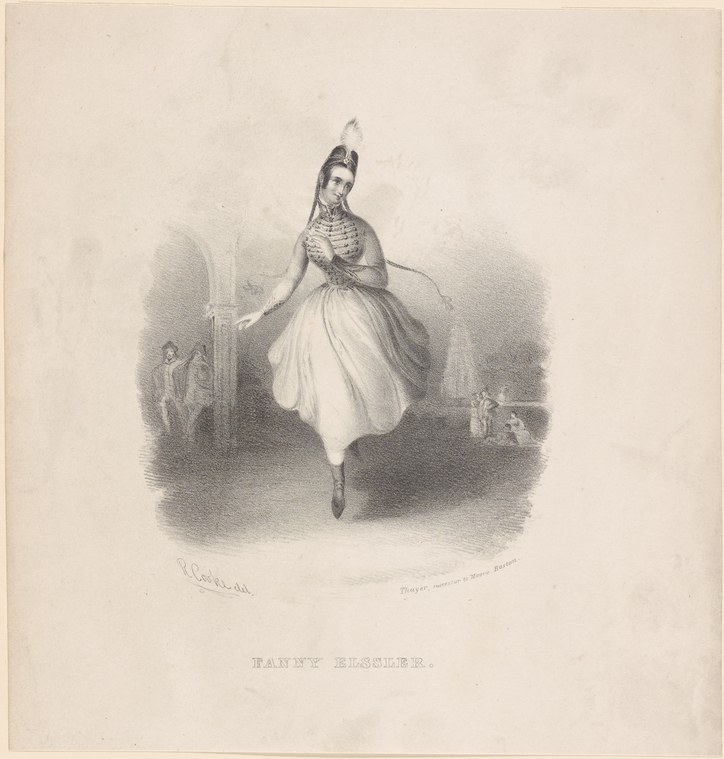
A young woman in Romantic-era theatrical dress stands alone in a spotlight, her body caught mid-turn or in a suspended moment. She wears a white bell-shaped skirt that extends to mid-calf, a fitted dark bodice with an ornate jeweled or embroidered neckline and short sleeves, and an elaborate headdress adorned with feathers and jewels. Her left arm extends outward with grace; her right arm is held closer to her body. The setting is dimly rendered in soft gray tones, with indistinct figures or scenery barely visible in the background shadows—possibly other performers or the wings of a stage. The composition isolates her figure against this murk, emphasizing her as the focus of attention. The print bears a handwritten inscription at the bottom that reads "Fanny Elssler," identifying the subject.
The dancing
The dancer stands in a balletic pose with a refined, upright carriage typical of early nineteenth-century academic ballet. Her weight appears to be on one leg, with the other foot pointing delicately; the torso is held erect and turned slightly away from the viewer, creating a three-quarter view. Her arms are held with the soft rond that was characteristic of the period, neither sharply extended nor tightly controlled. The elongation and the turned-out positioning suggest training in the ballet vocabulary, though the moment is one of presentation or display rather than dynamic movement.
The dance depicted
This is almost certainly a portrait of Fanny Elssler (1810–1884), the Austrian-Italian ballerina who was one of the most celebrated performers of the Romantic era. Elssler was known for her dramatic technique, her prowess in national dances like the cachucha and tarantella, and her rivalry with Marie Taglioni for dominance of the European stage. The image likely depicts her as she appeared in a theatrical role, possibly the cachucha, for which she was especially famous, though the costume elements do not uniquely identify a specific ballet. The pose is that of display and self-presentation rather than active choreographic movement.
How it was made
This is an engraving or possibly a lithograph, as indicated by the fine line work, tonal gradation through cross-hatching, and the characteristic pale cream paper. The technique was common for theatrical portraiture and the dissemination of images of celebrated performers in the 1830s and 1840s. The signature or mark visible in the lower left is consistent with such commercial prints. The medium allowed for wide circulation among theater-goers and collectors, making Elssler's image a commodity and advertisement.
About this work
This is a formal theatrical portrait engraving of Fanny Elssler, one of the two greatest ballerinas of the Romantic period, rendered in the print medium that was the standard for promoting and immortalizing stage performers of the era. The work preserves her image in the costume and pose that made her an icon: the white Romantic tutu, the jeweled bodice, the graceful arm position, and the stage presence that commanded European audiences. It belongs in a dance archive as both a historical record of how Elssler presented herself and as evidence of how Romantic ballet was visualized and marketed to its public.
How to look at it
Attend to the moment chosen: the artist has frozen Elssler in a pose of repose and display rather than explosive movement. The emphasis is on the line of her body, the elegance of her arm position, and the luxurious detail of her costume—all elements that would be readable to an audience from the back of a theater house. The three-quarter turn and the gentle extension of the arms follow the conventions of portrait pose-making, adapted to the needs of theatrical self-presentation. The isolation of the figure against the shadow suggests the spotlight and the solitude of the stage star.
The artist
The print is unsigned in a way that permits attribution, but the catalogue record does not record the artist. Many such theatrical portraits were created by commercial engravers working from sketches or from life, or after paintings by portrait specialists. The practice was standard in the theatrical world of the 1830s–1840s, and such prints were sold as merchandise in theater lobbies and through print shops.
The period
Fanny Elssler's career spanned the height of Romantic ballet (1830s–1840s), an era defined by the ethereal femininity of the ballerina, the dominance of the white tutu, and the cult of the female dancer as an object of desire and artistic veneration. Elssler's rivalry with Marie Taglioni polarized European audiences: Taglioni was seen as the ethereal, otherworldly spirit, while Elssler was celebrated for technical brilliance, dramatic power, and her mastery of character dances rooted in European folk traditions. The engraved theater portrait was the primary means of distributing images of celebrated performers; these prints were collected, exchanged, and displayed. This print dates to the peak of Elssler's fame.
Where it lives
The print is held in the New York Public Library's collection of prints depicting dance. It is part of the documentary and commercial print culture of Romantic-era theater, which was extensive and widely distributed.
Dance in this work
Questions about this work
Who was Fanny Elssler?
Fanny Elssler (1810–1884) was an Austrian-Italian ballerina and one of the two greatest dancers of the Romantic era, rivaling Marie Taglioni in fame and artistic influence. She was known for her technical virtuosity, dramatic presence, and mastery of national character dances, especially the cachucha. She performed across Europe and in America and was a major celebrity of her day.
What is this garment?
She wears the standard Romantic-era ballet costume: a bell-shaped white muslin skirt (the tutu) extending to mid-calf, a fitted bodice with an ornate neckline and short sleeves, and an elaborate headdress. This was the uniform of the ballerina in the 1830s–1840s, designed to emphasize the lightness, femininity, and otherworldliness that Romantic ballet celebrated.
Why is this a print and not a painting?
Theater portraits were widely reproduced as engravings so they could be sold cheaply to audiences, collected, and distributed through theater lobbies and print shops. A single engraved plate could be printed hundreds of times, making the ballerina's image available to a mass audience. This was the primary technology for circulating celebrity images before photography.
What dance is she doing?
The pose is a formal, static presentation rather than the depiction of a specific choreographic moment. Elssler was most celebrated for the cachucha, a Spanish character dance, but this image may represent her simply as a star, in costume, rather than in the middle of a particular ballet or national dance.
More dance artwork





