49 works in this view — arrow keys or swipe to move between them.
Dance in Art
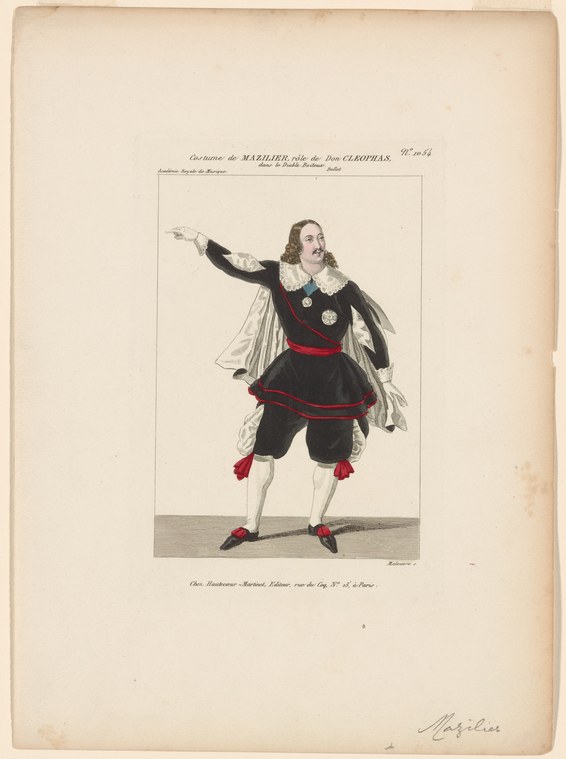
Costume de Mazilier, rôle de Don Cleophas, dans Le diable boiteux, ballet, Académie royale de musique
Unknown artist
- Collection:
- Prints depicting dance
- Source:
- New York Public Library
- Rights:
- Public domain — free to use, share and adapt.
- Recorded as:
- Public Domain
This image is one of the primary documents of how the male dancer's body and role were conceived and presented in Baroque court ballet. It shows us not a fleeting moment of movement but rather the formal ideal of male nobility and authority that the role embodied—a stillness and presence that was itself a form of dance training and performance.
What you are looking at
A single male dancer in a theatrical costume stands alone against a plain background, captured in a moment of dramatic gesture. He wears a black doublet with red trim and ornaments, white collar, white cuffs, and red-ribboned breeches that end at the knee, paired with red-heeled shoes—the formal dress of a seventeenth-century nobleman. His left arm extends outward in a broad, gesturing movement while his right arm hangs at his side; his torso is angled and his weight shifts onto his right leg. His expression is animated and his long hair falls past his shoulders. The pose is one of aristocratic command and theatrical presence rather than active steps: this is a moment from the narrative action of a ballet, not a traveling step or turning figure.
The dancing
A single dancer occupies the entire composition. His stance is asymmetrical and weight-forward, with one arm lifted and extended in a declarative gesture and the other relaxed. His legs are straight rather than bent, and his feet are planted rather than in motion. The pose is characteristic of French Baroque court ballet, in which beauty of line and noble carriage were valued above technical facility. The dancer's entire frame reads as statuary and oratorical—a figure in repose between movements, or striking an attitude for effect.
The dance depicted
This is a costume study for a male dancer in *Le diable boiteux* (The Lame Devil), a ballet performed at the Paris Académie royale de musique (Opéra). The title indicates this figure represents the role of Don Cleophas as danced by a performer named Mazilier. The style of dress and the restraint of the pose are consistent with the French Baroque ballet of the late seventeenth or eighteenth century, when male dancers in such works wore court dress and the vocabulary emphasized épaulement, elongation, and noble stillness rather than jumping or turning.
How it was made
This is a hand-colored engraving or etching, established by the fine black line work and the method of applying color—flat, bright washes of red, black, and flesh tone that do not blend or model form. The technique was standard for theatrical costume documentation across Europe from the seventeenth century onward. Such prints were inexpensive to produce and distribute, making them the primary visual record of how dancers and roles looked; they circulated among artists, dancers, theater managers, and courtiers, and were often collected into albums or bound volumes. This print's small format and even margin suggest it was designed for a bound collection of dance and theater imagery.
About this work
This is a costume plate for a named role in a known ballet performed at the royal theater in Paris. It documents not a specific historical moment but rather the appearance and bearing expected of a male dancer in a particular courtly role—a fixed image to which dancers of the part would aspire to conform. The work belongs to a vast archive of theatrical costume prints that served the dance world as a form of publication, circulation, and standardization before photography. Because the figure and role are identified by inscription, this print also functions as a historical record of an individual dancer's association with a celebrated part.
How to look at it
Attend to the stillness and asymmetry of the pose: the extended arm is not raised high but held at a measured, controlled height, and the gesture is one of indication or utterance rather than virtuosity. The impression is of a person pausing mid-action or holding a moment of dramatic significance. The black costume makes the white collar and cuffs graphic, drawing the eye upward to the dancer's face and upper body—the zones of expression that mattered most in Baroque theater. The red shoes and ribbon knots are the only bright accents on the figure, signaling expense and status.
The period
This work dates from the era of French court ballet, when the Paris Opéra (Académie royale de musique) was the center of European choreographic authority and dancers were trained in a vocabulary inherited from court dancing masters. Male roles in theatrical ballet of this period were typically danced by highly trained professionals who had also learned the conventions of court decorum and oratory. The figure's pose and dress reflect the assimilation of ballet into the courtly aesthetic, in which physical elegance and social rank were inseparable.
Where it lives
This print is held in the New York Public Library's collection of prints depicting dance. Such collections typically assembled images from theatrical archives, ballet academies, and the estate libraries of dancers and choreographers, and often lack complete provenance information. The print's inscription suggests it once belonged to a dancer's reference collection or a theater library.
Dance in this work
Questions about this work
Who was Mazilier and what was his role in *Le diable boiteux*?
The inscription identifies a dancer named Mazilier performing the role of Don Cleophas in this ballet, but without additional archival information we cannot determine whether this was a star dancer of the period or a secondary member of the company. The *diable boiteux* ballets were popular across Europe and saw multiple productions, so Mazilier may have danced the role at one of several venues.
What was the purpose of printing costume designs like this?
Costume plates were published to document and celebrate performances, to provide reference material for dancers learning a role, and to circulate images of celebrated productions beyond those who could attend the theater. They were also collected as luxury items by patrons and theater enthusiasts.
How does this compare to images of female dancers in the same period?
Female dancers in Baroque ballet were typically shown in lighter, more decorative costumes and often in positions that emphasize verticality, extension, and visual lightness. Male dancers were more often shown in court dress, and their poses tend to emphasize nobility, control, and authority rather than ethereal grace.
More dance artwork





