49 works in this view — arrow keys or swipe to move between them.
Dance in Art
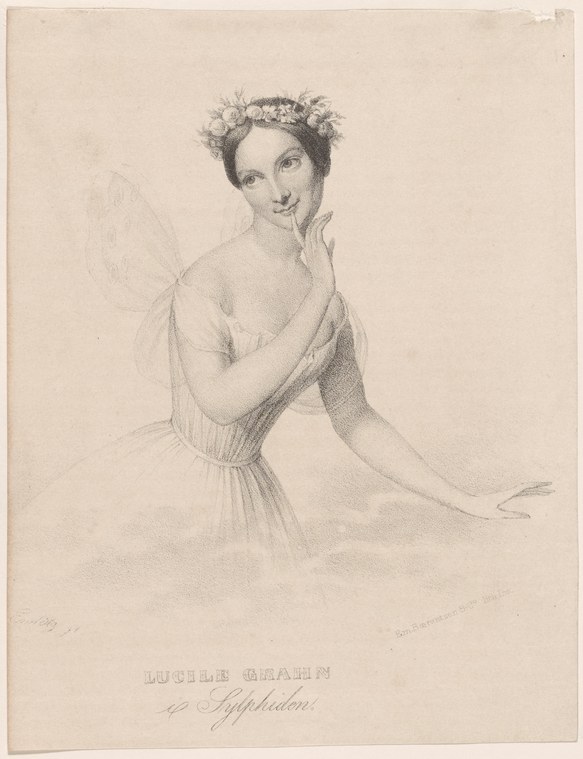
Lucile Grahn i Sylphiden
Unknown artist
- Collection:
- Prints depicting dance
- Source:
- New York Public Library
- Rights:
- Public domain — free to use, share and adapt.
- Recorded as:
- Public Domain
Lucile Grahn was a foundational figure of Romantic ballet and one of the four *Sylphides* in the original 1845 Paris premiere of *La Sylphide*—one of the most consequential roles in ballet history. This portrait circulated her image as an emblem of the ethereal, otherworldly ideal that defined Romantic ballet aesthetics. For any study of how 19th-century dancers were represented, commodified, and remembered through print culture, this image is central evidence.
What you are looking at
A half-length portrait of a young woman in classical dress, posed three-quarter view against a plain background. She wears a draped white chiton or tunic, cross-armed in a graceful gesture that exposes her left shoulder. Her dark hair is crowned with a wreath of flowers and leaves. The figure is rendered in the academic drawing style of the 19th century, with careful attention to the modelling of her shoulder and torso, the fall of the drapery, and the delicate features of her face. Her expression is serene and her gaze direct. The drawing is executed on toned paper in graphite with the utmost refinement.
The dancing
A single female figure, lightly and classically posed with weight settled on her right side. Her arms are crossed at the chest in a gentle, contemplative gesture; her left arm is drawn upward and across, right arm lower. The shoulders are naturally aligned, with the upper body in a relaxed contrapposto. This is portraiture rather than action, but the pose suggests the kind of classical training and awareness of line that shapes theatrical dancers of the period.
The dance depicted
This is a portrait of Lucile Grahn, inscribed below the image, rather than a documentation of a specific dance. However, Grahn was a principal dancer of the Romantic ballet era, and the inscription's reference to *Sylphiden* (The Sylphide) identifies the work she was famous for performing. The classical drapery and floral crown evoke the ethereal, sylph-like character she embodied on stage, suggesting she is portrayed in the role or in the manner of that persona. The pose itself is not a captured moment of dancing but an idealized portrait in classical dress.
How it was made
This is a lithographic print, recognizable from its characteristic line quality, the tonal variations typical of the process, and the way the image sits on a cream-coloured ground. Lithography was the dominant reproductive medium for theatrical portraiture in the 19th century, allowing wide circulation of images of celebrated performers at modest cost. The refinement of the line work and the careful rendering of form suggest a skilled hand; the technique was suitable for publication and sale to theatre audiences, making Grahn's image accessible well beyond those who could attend performances.
About this work
This is a portrait print of Lucile Grahn, a celebrated Romantic-era ballerina, shown in idealized classical dress and explicitly associated with her most famous role, the Sylphide. The image belongs to a vast 19th-century culture of theatrical portraiture, in which lithographic prints circulated images of celebrated performers to the paying public. It is not a representation of dance in motion, but rather an artifact of how dancers were marketed, remembered, and aspired to: as classical ideals of beauty and grace. For historians of dance and theatre, such prints are primary documents of the period's visual culture and of how the ballet world understood and presented its stars.
How to look at it
Note the deliberate classicism of the pose and costume—the artist has removed Grahn from the theatrical context entirely and presented her as a classical figure, as if she were a figure from antiquity. The wreath and drape evoke sculpture and neoclassical painting. Yet the inscription anchors her to *Sylphiden*, reminding the viewer that this classical ideal is a dancer's professional identity. The refinement of the line and the delicacy of the modelling are characteristic of lithographic portraiture at its best; the artist had to create the entire image on the stone through a single, unforgiving process.
The artist
The artist is not recorded. The hand is competent and the execution refined, suggesting a professional lithographer working for a theatrical print publisher, likely based in Paris or London where Grahn performed and where such portraits were actively produced and marketed. The style is typical of theatrical portraiture of the 1840s–50s.
The period
The Romantic ballet era (roughly 1830–60) placed unprecedented emphasis on the female dancer as an ethereal, otherworldly being. *La Sylphide* (1832) established the aesthetic of the sylph—a supernatural creature, costumed in the white tutu that became the uniform of Romantic ballet, crowned and winged. Lucile Grahn's interpretation of the title role made her an international star. Lithographic prints of celebrated dancers were produced in vast numbers during this period, sold to theatre audiences and collected as mementos. These prints were often idealized rather than realistic, presenting the dancer as the public imagined them in their greatest roles.
Where it lives
This print is held in the NYPL's collection of theatrical and dance-related prints. It is the kind of commercial portraiture that would have been sold in theatre lobbies and through print sellers to admirers of the ballet and to collectors of theatrical ephemera.
Dance in this work
Questions about this work
Who was Lucile Grahn?
Lucile Grahn (1819–1907) was a Danish-Swedish ballerina and one of the principal dancers of the Romantic era. She created and danced the title role in the Danish version of *La Sylphide* and was celebrated across Europe for her ethereal technique and presence. She was one of the 'four sylphides' in the famous Paris premiere of 1845.
What is *Sylphiden*?
*Sylphiden* is the Danish/Scandinavian title for *La Sylphide*, the foundational Romantic ballet choreographed by Filippo Taglioni to music by Jean-Madeleine Schneitzhoeffer. First performed in 1832 in Paris, it established many conventions of Romantic ballet: the ethereal heroine, the white tutu, the supernatural subject matter, and the doomed love of the male dancer for an otherworldly female.
Why is she dressed in classical drapery rather than the theatrical costume?
The classical costume was a convention of theatrical portraiture in this period. By showing Grahn in idealized Greco-Roman dress and pose, the artist elevated her to the status of an ancient muse or classical ideal—a way of suggesting her transcendent beauty and artistry. It also made the print more acceptable as a work of 'art' rather than mere theatre publicity.
Is this a photograph or a drawing?
This is a lithographic print, a reproductive technique that uses stone and chemistry rather than a camera or pencil. The artist drew the image on a prepared limestone surface, which was then printed. Lithography could capture fine detail and subtle gradations of tone, making it the preferred method for theatrical portraiture before photographic processes became widespread in the 1860s.
More dance artwork





