49 works in this view — arrow keys or swipe to move between them.
Dance in Art
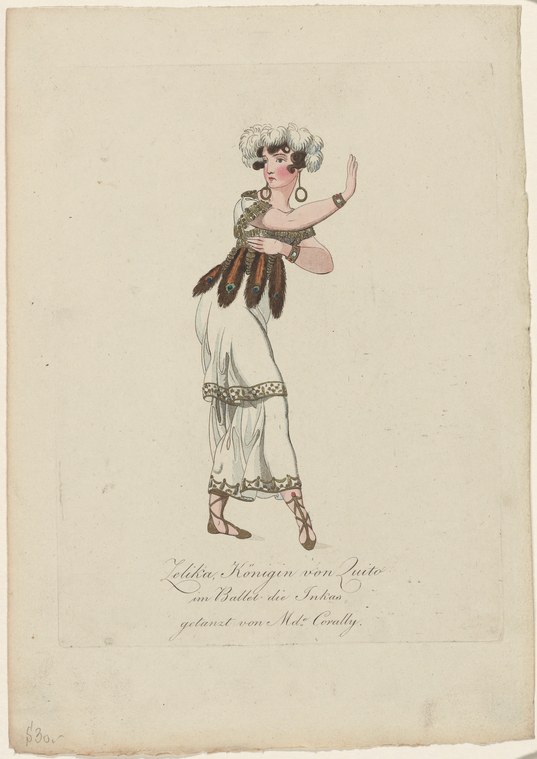
Zelika, Königin von Quito im Ballet die Inkas, getanzt von Mde. Corally
Unknown artist
- Collection:
- Prints depicting dance
- Source:
- New York Public Library
- Rights:
- Public domain — free to use, share and adapt.
- Recorded as:
- Public Domain
This image preserves both a specific theatrical moment and the material culture of dance promotion in the Romantic era. It shows how European ballet engaged with and exoticized non-European subjects, and it documents a named performer whose work otherwise left no recorded trace—making it a rare primary source on women dancers of the period.
What you are looking at
A single female dancer is depicted in a standing pose against a plain cream background. She wears a white columnar dress with decorative bands at the hips and ankles, the silhouette characteristic of Neoclassical-inspired theatrical costume. Her upper body is bare-shouldered, with draping fabric across one arm. She has styled blonde or light-colored hair arranged in loops or curls on either side of her head, and wears a long feathered or fringed ornament draped across her torso like a sash or accessory, in warm brown and orange tones. Her pose is frontal with one arm raised in a gesture of greeting or presentation, the other lowered. She stands in a relaxed contrapposto stance. The figure fills the composition centrally, with significant empty space surrounding her that emphasizes her isolation as a portrait of a specific performer.
The dancing
The dancer stands in an upright, frontal position with weight evenly distributed. Her raised right arm is extended at roughly shoulder height with the palm open and facing outward in a gesture of acknowledgment or salutation. Her left arm hangs naturally at her side, hand open. The pose is static and presentational rather than caught mid-movement, suggesting this is a portrait of the dancer in character rather than a moment of active choreography. No partner or ensemble is present; the focus is entirely on the soloist's silhouette and adornment.
The dance depicted
The inscription identifies this as 'Zelika, Königin von Quito im Ballet die Inkas, getanzt von Mde. Corally'—Zelika, Queen of Quito in the ballet *The Incas*, danced by Mademoiselle Corally. This indicates a theatrical ballet with an exotic (specifically South American Indigenous) theme, likely from the Romantic era when such subjects were fashionable in European dance. The static pose and costume portrait format suggest this is a souvenir or advertisement of the ballet and its star performer rather than documentation of actual choreography. The ballet itself cannot be identified from available sources with certainty.
How it was made
This is a hand-colored engraving or aquatint, executed with fine line work for the figure and drapery, with watercolor or gouache applied to achieve the delicate flesh tones, the blonde hair, and the warm ochre and brown tones of the decorative sash. The technique was typical of early 19th-century theatrical prints—economical to produce in multiple copies and designed for circulation as souvenirs or promotional material. The hand-coloring indicates this was a more expensive version, likely sold to wealthier patrons or collectors of dance imagery.
About this work
This is a hand-colored engraving documenting a specific performance and performer in early 19th-century European theatrical dance. It depicts Mademoiselle Corally in the role of Zelika, Queen of Quito, in a ballet titled *The Incas*—part of a broader Romantic-era fascination with exotic, non-European settings and characters as subjects for dance spectacle. The work functions simultaneously as a portrait of the dancer, an advertisement for the ballet, and a record of theatrical costume and styling of the period. Such prints were mass-produced and distributed to audiences, making them key documents of how dance was marketed and consumed in the early 1800s.
How to look at it
Notice the emphasis on the dancer's face, hair styling, and the exotic accessory (the feathered or fringed sash) as markers of the character Zelika. The costume is a hybrid: the Neoclassical white column dress echoes high-art aspirations, while the decorative sash and hairstyle signal 'otherness' and theatricality. The frontal, still pose is typical of theatrical portraiture of the period—it presents the performer as an object to be admired rather than caught in motion. The empty background keeps all attention on the figure and her adornment.
The period
This print belongs to the Romantic era in European ballet (roughly 1830–1860), when choreographers and impresarios eagerly adopted exotic, historical, and fantastical themes. *The Incas* reflects contemporary European interest in non-European cultures, often filtered through colonial fantasy rather than ethnographic accuracy. Mademoiselle Corally was a professional dancer in this context, likely performing in Paris or another major European theatrical center. The engraving format was the standard method for circulating images of celebrated performers and ballets; hand-colored prints like this one were luxury items sold to devoted fans and collectors.
Where it lives
This print is held in the New York Public Library's collection of prints depicting dance. It is a theatrical souvenir or promotional print, the kind mass-produced for sale to audiences and collectors during the Romantic era.
Dance in this work
Questions about this work
Who was Mademoiselle Corally?
She was a professional dancer performing in early 19th-century European theaters. Beyond this print and its inscription, little else is recorded about her career. She is one of many performers documented only through such theatrical prints.
What ballet was this from?
A ballet titled *The Incas* (in German: *die Inkas*), in which Corally danced the role of Zelika, Queen of Quito. The ballet itself has not been identified in standard dance histories, though the Romantic era saw numerous such exotic-themed works that are now largely forgotten.
What language is the inscription in?
German. The inscription reads: 'Zelika, Königin von Quito im Ballet die Inkas, getanzt von Mde. Corally'—indicating this print circulated in German-speaking territories, likely Austria or Prussia.
Why is the costume designed this way?
The white Neoclassical column dress and bare shoulders reflected early 19th-century ballet aesthetics and the body ideal of the time. The decorative sash and particular hair styling were meant to signal 'exoticism' and mark Zelika as a non-European character, though the costume is more European fantasy than historically accurate.
More dance artwork





