49 works in this view — arrow keys or swipe to move between them.
Dance in Art
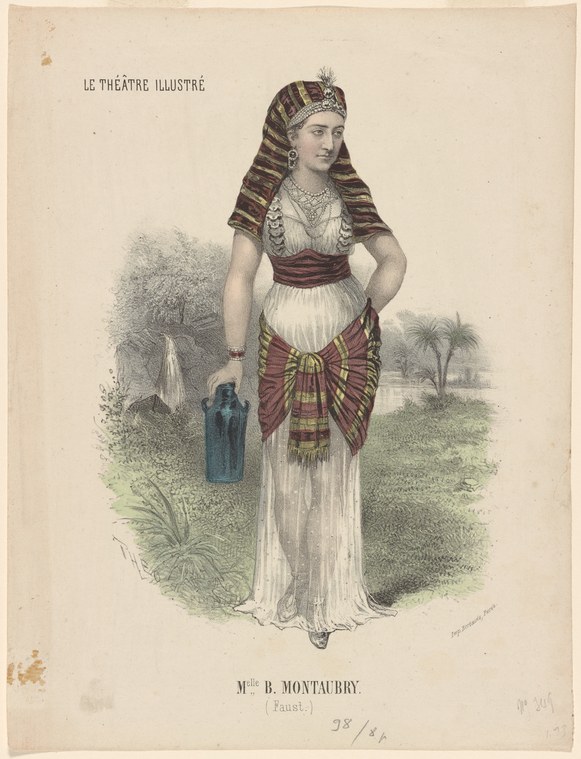
Melle B. Montaubry.: Faust
Unknown artist
- Collection:
- Prints depicting dance
- Source:
- New York Public Library
- Rights:
- Public domain — free to use, share and adapt.
- Recorded as:
- Public Domain
This print preserves the visual record of a specific performer in a specific role at a specific moment in theatre history, naming both the dancer (Montaubry) and the production (*Faust*). For historians of Romantic ballet and opera-ballet, it is primary evidence of costume design, character conception, and the marketing of theatre through portraiture. It demonstrates how Orientalism and exoticism were translated into stage dress and how individual performers were branded and circulated to the public.
What you are looking at
A woman stands in profile against a landscape of palm trees and distant architecture, posed in a moment of theatrical display. She wears a long white pleated chiton or classical draped skirt that falls to her feet, with a deep burgundy and gold patterned sash tied at the waist in an elaborate bow. Her upper body is bare except for a decorative white beaded or embellished collar. She wears an ornate striped linen headdress in burgundy, gold, and white—styled as Egyptian or ancient Near Eastern royal dress—and holds a blue vessel or urn in her left hand at her side. Her pose is frontal and statuesque, with her weight evenly distributed and her gaze directed away. The setting is sketched in soft tones: verdant vegetation in the middle ground and classical ruins or temples barely suggested in the distance.
The dancing
The figure presents a single dancer or performer in an upright, formally composed stance with no dynamic action. Her posture is symmetrical and held, with shoulders back and spine extended. The right arm hangs naturally while the left carries a prop. There is no active footwork visible, no partner relationship, and no mid-movement capture; instead, this is a presentation of costume and character.
The dance depicted
This is almost certainly a representation of a performer from the Romantic ballet era, specifically depicting a character from Gounod's opera *Faust* (1859) or a theatrical adaptation of it. The label identifies her as Mademoiselle B. Montaubry, a known performer of the period. The Egyptian or Orientalist dress and the classical setting suggest this is either Marguerite in an exotic or fantasy scene, or more likely a specialized character or entr'acte number. The pose and costume align with the theatrical conventions of 1860s–1870s ballet and opera-ballet, where such 'national' or 'exotic' characters were staple roles. The absence of pointe shoes and the formal, nearly statuesque presentation suggest this may depict a character dance or dramatic moment rather than a technical ballet sequence.
How it was made
This is a hand-coloured engraving or lithograph, recognisable by the fine line work, the delicate tonal washes particularly in the landscape, and the selective application of colour (the headdress and sash are vivid while the body and setting remain pale). The technique allowed for mass circulation as a theatrical print—these were sold as souvenirs and publicity for opera and ballet performances. The precision of the line and the decorative quality of the colouring indicate a commercial print of moderate quality, produced for a popular theatrical audience. The inscription 'LE THÉÂTRE ILLUSTRÉ' at top left identifies this as part of an illustrated theatrical journal or album.
About this work
This is a theatrical portrait of a performer in character costume, drawn from the Romantic era's fascination with exotic and historical dress on the operatic and balletic stage. Mademoiselle Montaubry is presented as a character from *Faust*—likely Marguerite in an Orientalist or fantastical guise—in a hand-coloured print from a theatrical publication. The work records not a moment of dance but a moment of theatrical display: the costume, the character, and the performer's public image. It belongs in a dance archive because it documents the visual spectacle and dramatic costuming that shaped the theatrical dance of the mid-nineteenth century, and because it names a performer and a specific production, anchoring our knowledge of how Romantic-era ballet and opera-ballet were staged and publicised.
How to look at it
Attend to the stillness and frontality of the pose: this is not a dance action frozen mid-movement, but a formal presentation of character. The costume tells almost the entire story—the Egyptianate headdress, the classical drapery, the prop vessel—all declare the role before any gesture does. Notice how the artist has balanced the figure against an empty landscape, making the performer the sole object of visual interest. The hand-colouring is restrained except where it counts: the headdress and sash are vivid, drawing the eye to the performer's head and torso, while the body dissolves into pale white. This is a publicity portrait first and a dance image second.
The artist
The artist is not recorded in the catalogue. The work is attributed only to publication in *Le Théâtre Illustré*, a Parisian theatrical journal of the mid-nineteenth century. Based on style and technique, this is likely the work of a commercial theatre illustrator or engraver working for the periodical, whose name is not preserved in this copy. Such prints were typically unsigned or bore only the printer's name.
The period
This print dates to the height of the Romantic ballet era in Paris, when the Opera was a centre of artistic and social prestige. The 1860s saw a continuation of Romantic themes—exotic locales, supernatural characters, historical and literary adaptations—alongside a growing appetite for visual documentation and celebrity. *Faust* itself, adapted from Goethe and set to music by Gounod in 1859, was enormously popular and spawned multiple theatrical and balletic interpretations. The costume shown here reflects the period's love of historically or geographically 'authentic' detail (or its theatrical fantasy of such detail), which justified elaborate mise-en-scène and gave performers opportunities for character acting within the ballet. Theatrical prints like this were a primary form of mass media and advertising, circulating widely among theatre-goers and collectors.
Where it lives
The print is held in the New York Public Library's collection of prints depicting dance. It bears the library's accession marking (visible at lower right) and is catalogued as part of a larger collection of theatrical prints, likely acquired as a collection or as part of the Library's documentary project on nineteenth-century theatre. The source record identifies it as coming from NYPL.
Dance in this work
Questions about this work
Who was Mademoiselle B. Montaubry?
Montaubry was a performer active in Paris in the mid-nineteenth century, known for character and exotic roles in ballet and opera-ballet. Beyond her appearance in this production of *Faust*, details of her career are not well recorded in standard sources. This print is primary evidence of her existence and her roles.
Is this a ballet or an opera?
The source is Gounod's opera *Faust* (1859), but the character and costume suggest this may depict a ballet entr'acte or a character dance inserted into an opera performance, which was common practice. The pose and lack of visible pointe shoes suggest a theatrical rather than technical ballet moment.
Why is the costume Egyptian or Oriental when *Faust* is set in medieval Germany?
Romantic-era opera and ballet frequently departed from historical accuracy in favour of visual spectacle and exotic fantasy. A character like Marguerite might appear in multiple versions or elaborations, including Orientalist fantasies. Alternatively, this may depict a subsidiary role or a special scene not in Gounod's score.
What is the blue vessel she is holding?
The vessel is a theatrical prop, likely a water urn or ritual object associated with the character's role. Without further documentation of the production, its specific meaning cannot be determined, but it is a key part of the costume's visual vocabulary.
More dance artwork





