49 works in this view — arrow keys or swipe to move between them.
Dance in Art
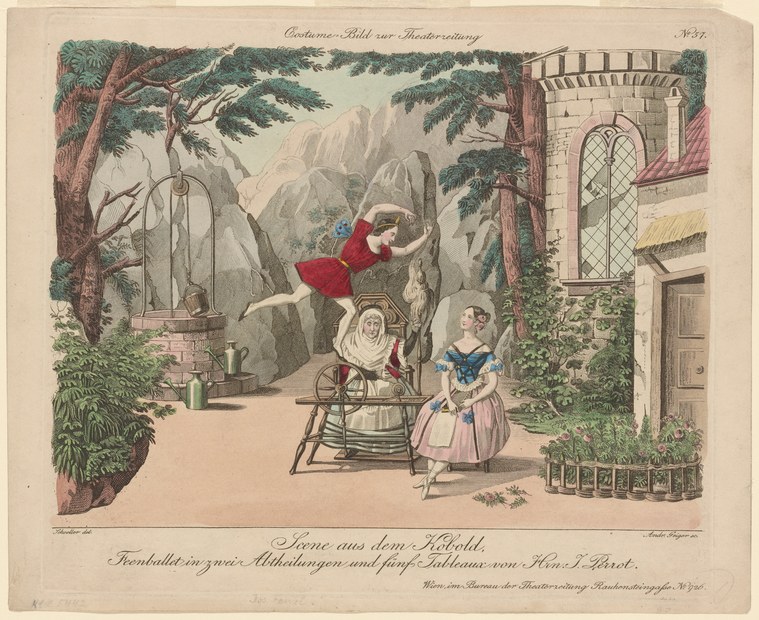
Scene aus dem Kobold.: Feenballet in zwei Abtheilungen und fünf Tableaux von Hrn. J. Perrot
Unknown artist
- Collection:
- Prints depicting dance
- Source:
- New York Public Library
- Rights:
- Public domain — free to use, share and adapt.
- Recorded as:
- Public Domain
Jules Perrot was one of the most influential choreographers of the Romantic ballet era, and *Le Kobold* was among his most celebrated creations. This image is documentary evidence of how a major fairy-ballet narrative was staged, what the dancers wore, and how the choreography engaged with supernatural themes through sustained elevation and weightless gesture. For scholars and dancers studying Romantic ballet practice, it is primary source material showing both the aesthetic and the technical apparatus—the machinery and costuming—that made the fairy-ballet genre possible.
What you are looking at
A theatrical scene from a fairy ballet unfolds in an enchanted grotto. Rocky outcroppings and tall evergreen trees frame a natural archway, while a fortified structure with crenellations and a barred window rises on the right. A female dancer in a red tunic and flesh tights executes a dramatic leap or hovering pose center-stage, captured mid-gesture with one arm raised. Below her, a young woman in pale blue dress and a wide hat sits at a spinning wheel, operating it with both hands. The ground is bare earth; the lighting is cool and naturalistic, suggesting an outdoor or semi-outdoor setting. The composition uses the forest and architecture to create theatrical depth, with the spinning wheel and fairy-tale machinery grounding the scene in domestic magic while the aerial figure above embodies supernatural wonder.
The dancing
The central figure—likely a fairy or spirit—achieves a sustained elevation or hover above the ground, with one arm curved overhead and the body in a controlled, weightless posture that defies naturalistic movement. Below, the seated woman operates the spinning wheel with both hands actively engaged in the turning mechanism, her posture bent slightly forward in concentration. The two figures create a clear hierarchy: ethereal and airborne above, grounded and industrious below. The costume contrast—bare legs and tunic of the dancer versus the clothed, hatted figure at the wheel—marks them as belonging to different orders of being.
The dance depicted
This is a scene from *Le Kobold* (or *Der Kobold*), a fairy ballet in two acts and five tableaux choreographed by Jules Perrot, one of the most celebrated choreographers of the Romantic era. The work belongs to the fairy-tale tradition of Romantic ballet—narratives involving spirits, transformations, and supernatural encounters set in magical landscapes. The image captures a moment of otherworldly intervention: the fairy or spirit dancer suspends in space above a mortal woman at her daily work, illustrating the meeting of two worlds that is central to Romantic ballet themes. The spinning wheel is the mechanical device around which the fairy magic turns.
How it was made
This is a hand-colored engraving or lithograph, a reproduction technique that allowed theatrical scenes to circulate widely among audiences who could not attend the Opéra. The careful color work—the reds and blues of the costumes, the greens of foliage, the warm ochre of stone—was applied after printing, suggesting this was a commercial theatrical souvenir or illustration meant for an educated public interested in the fashions and spectacles of Paris opera. The technique of layering colored inks and hand-finishing allowed for precise detail of architecture and costume while maintaining the flatness and graphic clarity of an engraving. Such prints served as the primary visual record of choreography for those who did not see the performance.
About this work
This is a documented scene from *Le Kobold*, a Romantic-era fairy ballet choreographed by Jules Perrot and performed in the 1840s–50s. The work exemplifies the theatrical fairy-tale tradition that dominated European ballet in the mid-nineteenth century, emphasizing supernatural encounters, magical settings, and the spectacle of the aerial dancer. The image preserves not only the narrative moment but also crucial information about Romantic-era dance costuming, stage design, and the technical capabilities and visual vocabulary of mid-century ballet. It is one of comparatively few images that show the actual staging and choreographic intention of a major work from this formative period in ballet history.
How to look at it
Attend first to the suspended figure and the gesture of weightlessness the choreographer has chosen: one arm curved, the body buoyant, the sense of hovering rather than jumping. This is the Romantic-era solution to representing supernatural presence through the body—not through mime or facial expression alone, but through a sustained elevation that appears to defy gravity. Notice how the composition places her above and apart from the mortal woman at the wheel, enforcing the narrative separation of worlds. The surrounding architecture and forest are not mere backdrop but active framing devices that guide the eye to the supernatural encounter and domesticate the magical apparatus (the spinning wheel) within a recognizable theatrical space.
The artist
The engraving is attributed to a theatre-print publisher whose mark appears on the plate. In the mid-nineteenth century, such prints were typically produced by workshops rather than individual artists, under commission from ballet companies or theatrical producers eager to circulate images of celebrated works and dancers. The quality and detail suggest the work of a skilled theatrical lithographer familiar with stage design and costume convention.
The period
This print dates to the height of the Romantic ballet era (1830s–1850s), when fairy tales, supernatural narratives, and the technological marvel of making dancers appear to float became the dominant aesthetic. Jules Perrot, a former dancer and mime, emerged as the supreme choreographer of this period, following in the tradition established by Michel Fokine's predecessors but exceeding them in narrative complexity and technical invention. Perrot's ballets were performed across Europe and established the vocabulary and thematics that Romantic ballet would maintain for decades. The 1840s and 1850s saw intense competition among European opera houses to stage the most elaborate and visually spectacular fairy ballets, with machinery, lighting effects, and costume all contributing to the illusion of supernatural presence. This engraving captures that fusion of narrative, spectacle, and technical innovation.
Where it lives
This hand-colored theatrical engraving is held in the New York Public Library's collection of dance-related prints. It is catalogued as part of a larger collection documenting nineteenth-century ballet stagings and was likely distributed as a souvenir or illustration in contemporary theatrical publications and collections.
Dance in this work
Questions about this work
Who choreographed Le Kobold?
Jules Perrot, one of the most celebrated choreographers of the Romantic ballet era. He was also an accomplished dancer and mime performer early in his career. *Le Kobold* premiered in the 1840s and became one of his signature works, performed across European opera houses.
What is a fairy ballet?
A fairy ballet is a Romantic-era narrative work featuring supernatural beings, magical transformations, and enchanted settings. These ballets typically explored themes of otherworldly intervention in mortal life and made extensive use of stage machinery, lighting effects, and costume to create the illusion of weightlessness and magic. *Giselle*, *La Sylphide*, and *Le Kobold* are canonical examples.
How was the 'floating' effect achieved?
Dancers trained in sustained balance and elevation techniques created the illusion of weightlessness through controlled positioning and the strategic use of costume, lighting, and the surrounding environment. The actual staging mechanics—wires, lifts, or other apparatus—are not always visible in period engravings, but the choreography itself (the held, buoyant gesture) conveyed the supernatural quality to audiences.
Why was this scene printed and distributed?
Theatrical prints were the primary way ballet companies and producers circulated images of celebrated works to a paying public hungry for visual records of performances they had attended or heard about. These engravings served simultaneously as theatrical souvenirs, fashion plates (showing the latest stage costumes), and narrative documentation, preserving the work for posterity and encouraging attendance at performances.
More dance artwork





