49 works in this view — arrow keys or swipe to move between them.
Dance in Art
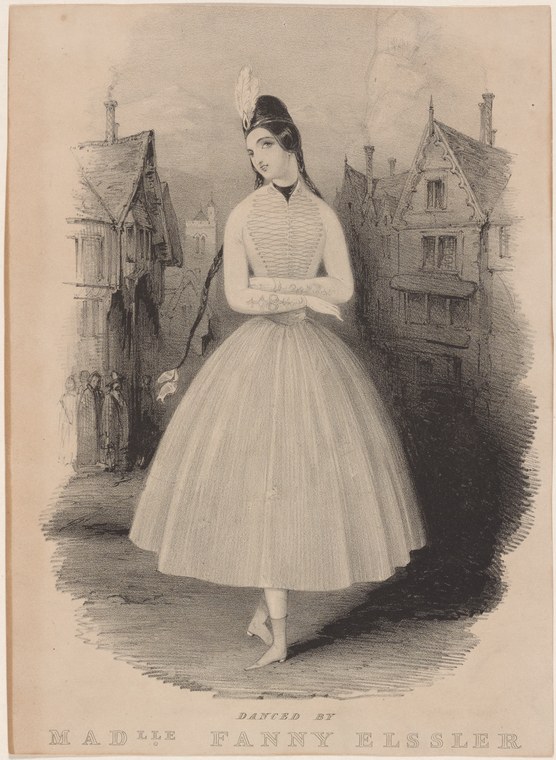
Danced by Madlle Fanny Elssler
Unknown artist
- Collection:
- Prints depicting dance
- Source:
- New York Public Library
- Rights:
- Public domain — free to use, share and adapt.
- Recorded as:
- Public Domain
Fanny Elssler was one of the defining dancers of the Romantic ballet movement and a rival to Marie Taglioni; she brought dramatic intensity and technical brilliance to roles that shaped the repertory of the 19th century. Images like this one are primary evidence of how Romantic dancers presented themselves and were presented to audiences—the silhouette, the pose, the emotional register—all of which shaped what later dancers learned and performed.
What you are looking at
A young woman in Romantic-era theatrical costume stands alone in a dramatic architectural setting of Gothic or medieval townhouses. She wears a fitted bodice with horizontal pleating and a voluminous skirt of gauzy white fabric that falls to mid-calf, a silhouette characteristic of 1830s–1840s ballet. Her dark hair is styled up with what appears to be a decorative comb or tiara. She stands in a composed pose with her arms held gracefully at her sides, one hand resting near her torso, and gazes directly outward with a composed expression. The shadowy, cross-hatched background emphasizes verticality and enclosure, suggesting a narrow European street or courtyard. The lighting is subtle, creating volume in the skirt through fine hatching while leaving the upper body in relative clarity. The overall mood is romantic and melancholic rather than joyful—a portrait of a dancer in character or in repose, not mid-performance.
The dancing
The dancer stands upright with a relaxed but dignified posture, her weight evenly distributed and her body aligned vertically. Her arms are held softly at her sides with hands graceful but not actively gesturing; this is a presentational pose rather than a moment of active dancing. Her feet are not distinctly rendered, but her stance suggests she is not en pointe—her weight appears to rest flatly on her feet. The bodice is fitted and structured, the skirt supported by the bell-shaped silhouette of the period. There is no indication of a partner or group; she is a solitary figure, self-contained.
The dance depicted
This is almost certainly a representation of Fanny Elssler, the celebrated Austrian dancer who dominated European stages in the 1830s and 1840s. The inscription confirms the subject. Elssler was renowned for her dramatic presence, technical virtuosity, and her signature roles in Romantic ballets—most famously *La Sylphide* (in which she replaced Marie Taglioni) and her own vehicle *La Cracovienne*. The costume depicted here—the fitted bodice and bell skirt—is consistent with the stage dress of the Romantic ballet period, though this image shows her in a formal portrait rather than in the midst of a choreographed phrase. The pose and presentation suggest this is a theatrical portrait made for circulation and sale to the public, a common practice for celebrated dancers of the era.
How it was made
This is an engraving or lithograph, most likely a lithograph given the tonal gradations, the fine cross-hatching used to build shadow and volume, and the soft rather than strictly linear character of the line work. The technique allowed for wide circulation of images of celebrated performers; lithographs were cheaper and faster to produce than engravings and could reach a mass audience of theatre-goers and devotees. The tonal subtlety visible here—the way light falls on the skirt, the atmospheric quality of the background—suggests an artist with skill in the medium. The image has the character of a commercial theatrical portrait, a genre that flourished in the early 19th century.
About this work
This is a theatrical portrait of Fanny Elssler, one of the dominant figures of Romantic ballet, rendered as a lithographic print in the 1830s or 1840s. Elssler stands in formal pose in period costume—the fitted bodice and bell skirt characteristic of the era—before an evocative architectural backdrop. The work belongs to a vast body of lithographic portraiture that circulated among theatre audiences of the period, serving as both souvenir and advertisement. It documents the visual presentation of a canonical Romantic dancer at the height of her fame and illustrates how dancers of the period were marketed and consumed by the public through reproducible prints.
How to look at it
The viewer should attend to the pose and its stillness: this is not a moment caught mid-movement, but a composed portrait that presents the dancer as a complete figure and a celebrity. Note the silhouette of the skirt and how it is rendered with light and shadow to create volume and movement even in a static pose. The architectural setting is not accidental; it places the dancer in a specific European context and suggests both grandeur and melancholy. The facial expression—direct and dignified—is as important as the costume; this is a portrait of a person, not a generic representation of the dance.
The artist
The artist is not recorded, which is typical for commercial theatrical portraiture of the period. The work bears the mark of a competent lithographic practitioner working in a well-established commercial tradition. Many such portraits were produced by printing houses in major theatrical cities (London, Paris, Vienna) and sold unsigned or with only a publisher's name. The quality of the draughtsmanship and the tonal sophistication suggest a professional hand, but the absence of a signature is not unusual for work of this type.
The period
This print was made during the height of Romantic ballet, roughly 1830–1845. This was the era of *La Sylphide* (1832) and *Giselle* (1841), ballets that defined the aesthetic of weightlessness, otherworldliness, and emotional expressivity that still defines ballet today. Lithographic portraiture of dancers was a booming commercial practice in this period: theatres, dancers, and print publishers competed to satisfy the appetite of urban audiences for images of celebrated performers. The silhouette shown here—the bell skirt, the pointe shoe emerging from beneath it, the Romantic hairstyle—became iconic and was endlessly reproduced. Elssler's career (1823–1851) spanned this entire era and in many ways defined it.
Where it lives
This work is part of the New York Public Library's collection of prints depicting dance. It is a commercial theatrical portrait, one of thousands produced and distributed in the 19th century as souvenirs and publicity materials.
Dance in this work
Questions about this work
Who was Fanny Elssler?
Fanny Elssler (1810–1884) was an Austrian dancer and one of the two supreme stars of Romantic ballet, rivaling Marie Taglioni. She was known for her dramatic presence, technical virtuosity, and earthy energy; her famous roles included *La Sylphide*, *Giselle*, and *La Cracovienne*, a showcase for her brilliant technique. She performed across Europe and made a triumphal tour of the United States in 1840–1842.
What is the dress in this portrait?
The costume shown here is the typical stage dress of Romantic ballet: a fitted, structured bodice laced tightly to create a small waist, and a long skirt of translucent fabric (usually silk or gauze) layered to create volume and movement. Dancers wore soft pointe shoes beneath; Elssler is one of the first generation to perform regularly en pointe, though this portrait does not clearly show the shoes. This silhouette became iconic and is still associated with classical ballet today.
Why are there so many lithographic portraits of dancers from this period?
Lithography was a relatively new and efficient technology in the 1830s–1840s, allowing prints to be produced quickly and cheaply in large numbers. Dancers were celebrities, and their images were valuable commodities. Theatres, dancers themselves, and independent print publishers competed to sell portraits to theatre-goers. These prints served as souvenirs, publicity materials, and objects of devotion; collecting them was a common hobby.
Is this portrait from a specific performance?
The inscription tells us the portrait is of Elssler, but it does not specify a role or a performance. The costume is consistent with several of her famous roles. Such theatrical portraits were often generic representations meant to showcase the dancer's celebrity and beauty rather than to document a specific moment on stage.
More dance artwork





