49 works in this view — arrow keys or swipe to move between them.
Dance in Art
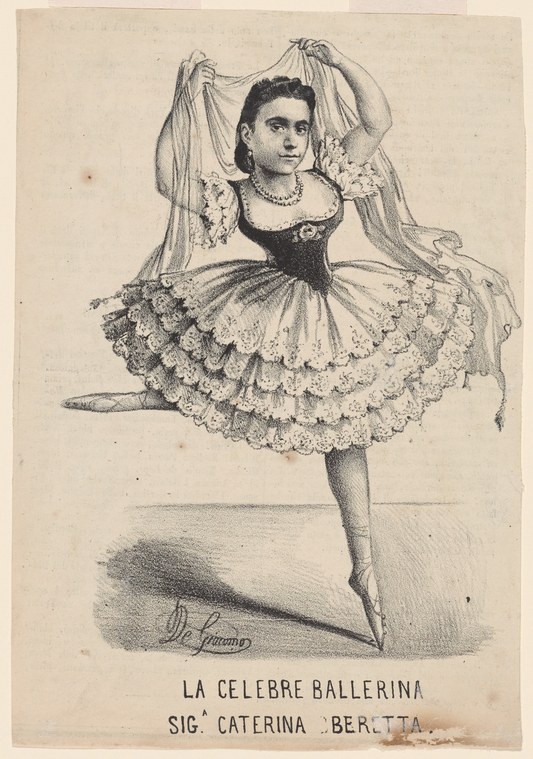
La celebre ballerina Sig'a Caterina Beretta
Unknown artist
- Collection:
- Prints depicting dance
- Source:
- New York Public Library
- Rights:
- Public domain — free to use, share and adapt.
- Recorded as:
- Public Domain
For historians and dancers, this portrait is a primary document of how Romantic-era ballet was marketed to audiences and how the dancer's body was framed as an aesthetic ideal. The extraordinary emphasis on the skirt—the tulle consumes nearly half the visual field—reveals contemporary assumptions about what audiences came to see: not technique or expression, but an idealized, weightless feminine form. The image also preserves a record of a working professional whose name might otherwise be lost to history, making it valuable for reconstructing the networks and hierarchies of 19th-century ballet.
What you are looking at
A young woman in performance costume stands alone against a plain background, posed in a classical ballet attitude. She wears a dark corseted bodice with a deep square neckline and a pearl necklace, from which extends an extraordinarily full skirt of white tulle, arranged in tiers of gathered lace that cascade from hip to just below the knee. The skirt is so voluminous it dominates the composition. A delicate lace veil or headdress is held above her head by both hands, the fabric billowing behind her in an elegant arc. She stands en relevé (on the balls of her feet), her weight lifted, her supporting leg extended in a classical line. Her expression is serene and composed, her gaze directed toward the viewer with the characteristic hauteur of mid-19th-century ballet portraiture. The entire image is rendered as an engraving, with fine cross-hatching creating depth and texture, particularly in the folds of the tulle skirt.
The dancing
A single dancer occupies the frame in a formal pose typical of classical ballet promotion. Her right leg is extended in a supported position while the left foot maintains relevé, creating the lifted, ethereal line characteristic of Romantic-era ballet technique. The arms are raised gracefully to frame the veil above the head, a pose that emphasizes the dancer's elegant proportions and the verticality of her frame. The torso is held erect with the characteristic posture of trained classical dancers. There is no dynamic movement or interaction—this is a static, dignified presentation of the dancer as a theatrical commodity.
The dance depicted
This is a promotional portrait of a professional ballet dancer, almost certainly from the Romantic ballet era (1830s–1850s), when such engraved portraits were mass-produced and circulated widely to promote celebrated performers. The costume—the fitted bodice, voluminous tulle skirt, pointe shoes (evident from the relevé stance), and ornamental headdress—is consistent with the classical ballet of the mid-19th century, particularly the sylph-like aesthetic that defined that period. The inscription identifies the subject as Caterina Beretta, described as 'la celebre ballerina' (the celebrated ballerina), though without further date or biographical context from the record, her specific nationality and career cannot be confirmed from the image alone. The pose and presentation follow the conventions of ballet portraiture from this era, in which the dancer was shown in full costume in an idealized moment of performance.
How it was made
This is a steel or copper engraving, a reproductive print medium that allowed mass circulation of celebrity portraits in the 19th century. The fineness of the line-work, the delicate cross-hatching used to model the folds of tulle, and the precise rendering of the lace all demonstrate the engraver's considerable technical skill in capturing textile detail. The engraving process, which required translation from an original drawing or painting, meant such portraits reached a broad public—dancers, theatre-goers, collectors, and print shops—far beyond the reach of original oils. This was the dominant method of theatrical promotion before photography became accessible, making such works crucial documents of how performers were marketed and how audiences understood theatrical beauty.
About this work
This is a mid-19th-century engraved portrait of the professional ballet dancer Caterina Beretta, presented in formal stage costume. The print documents both the visual conventions of Romantic ballet and the promotional machinery of theatre in the era before photography. The extraordinary detail of the engraving—particularly in the rendering of the tiered tulle skirt that consumed resources and attention to produce—speaks to the commercial value of ballet celebrity and the technical virtuosity demanded of the medium itself. The work belongs in a dance archive as evidence of how dancers were presented to public imagination, how costume functioned as a sign of artistry and social aspiration, and how the engraving trade sustained the celebrity system of professional theatre.
How to look at it
Attend first to the architectural impossibility of the skirt: the tulle is so densely gathered and so voluminous that it could barely be moved, yet this is the silhouette that defined Romantic ballet beauty. Notice the engraver's technique in differentiating the textures—the fine lace edging of each tier, the sheen suggested by line-weight in the tulle itself, the contrast with the dark bodice. The pose is static and formal, not a frozen moment of action but a composed presentation; this is how Caterina Beretta was presented to the public, not how she moved. The elevation of the body on relevé and the lift of the arms suggest the strain and discipline required to inhabit this ideal of effortless grace.
The artist
The artist is not recorded in the catalogue. The engraver's signature or mark, if present, is not legible in the available image. The style is consistent with mid-19th-century theatrical portrait engraving, a specialized trade in which skilled reproductive artists translated dancers' images into widely distributed prints. Such works were often collaborative—produced from drawings made at the theatre, from paintings, or from sittings—and rarely attributed to the engraver in contemporary publication.
The period
This portrait dates to the apex of Romantic ballet (approximately 1830s–1850s), when the art form was at peak cultural prestige and when the female dancer had become the primary focus of theatrical choreography and fantasy. The emphasis on weightlessness, ethereality, and an impossible beauty reflects the Romantic era's aesthetic investment in the unreal and transcendent. The proliferation of engraved ballet portraits in this period responded to a boom in theatre-going and a appetite for celebrity imagery that anticipated modern fan culture. Simultaneously, ballet was becoming professionalized and globalized—dancers like Caterina Beretta traveled throughout Europe, and the engraving trade followed the circuit of celebrated performers.
Where it lives
The print is held in the New York Public Library's collection of prints depicting dance. It belongs to a significant archive of 19th-century theatrical portraiture, the majority of which remain unattributed to engravers and often undated. Such prints were often produced in series and distributed through print shops, making provenance difficult to establish.
Dance in this work
Questions about this work
Is Caterina Beretta a famous ballerina I should know?
The catalogue record does not provide her biographical details, but the inscription 'celebre ballerina' (celebrated ballerina) indicates she was a professional performer of note. Romanticera ballet had a large international circuit of touring performers, many of whom are now remembered primarily through such portraits and playbills. A full biography would require additional research in theatre archives and dance histories specific to 19th-century European and possibly Italian ballet.
Why is the skirt so enormous?
The voluminous tulle skirt was the defining silhouette of Romantic ballet in the mid-19th century, a visual expression of the era's aesthetic ideals: weightlessness, grace, and otherworldliness. The more fabric and the fuller the gather, the more the dancer appeared to defy gravity. However, these skirts were extremely heavy and restrictive in practice, requiring great strength to move in them—the appearance of effortlessness masked considerable physical effort.
What is an engraving and why was it used for ballet promotion?
An engraving is a print made by incising lines into a metal plate (usually copper or steel), inking the plate, and pressing it onto paper. Before photography became widely available, engraving was the primary method of mass-producing celebrity portraits and theatrical images. Engravings could be reproduced in unlimited quantities, making them affordable for a broad audience and essential to theatre marketing and fan culture in the 19th century.
More dance artwork





