49 works in this view — arrow keys or swipe to move between them.
Dance in Art
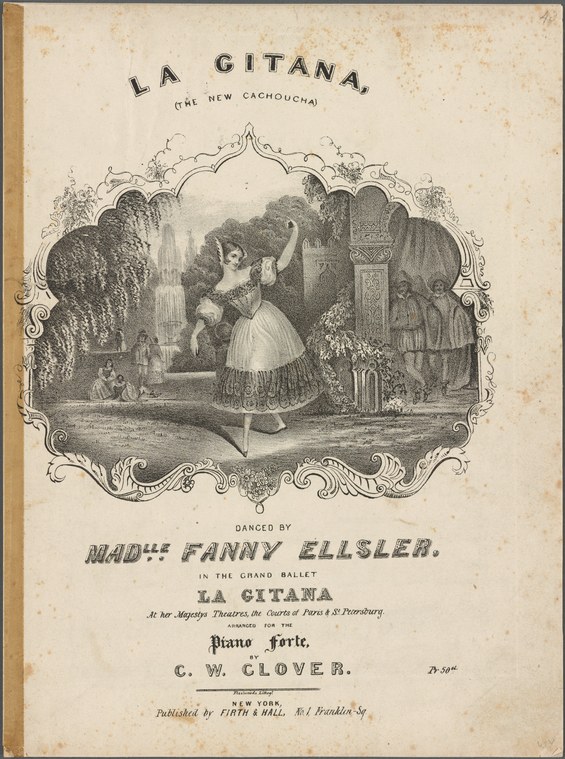
La gitana, (The new cachoucha), danced by Madlle Fanny Ellsler [sic], in the grand ballet La gitana: at her Majestys Theatres, the courts of Paris & St. Petersburg
Unknown artist
- Collection:
- Prints depicting dance
- Source:
- New York Public Library
- Rights:
- Public domain — free to use, share and adapt.
- Recorded as:
- Public Domain
Elssler and ballets like *La gitana* transformed the repertoire by legitimizing character dance within high ballet; this image is evidence of how that aesthetic was produced and sold to a mass audience. The engraving documents the actual silhouette, pose, and theatrical setting of a work that influenced European and American dance for decades and established conventions still taught today.
What you are looking at
This is a wood engraving or steel engraving, recognisable as sheet-music cover art from its ornate decorative border and publication information. The image shows a woman in a white Romantic-era ballet dress—a knee-length skirt with fullness and a fitted bodice—posed in a garden setting with classical architecture and climbing vines in the background. She stands in a graceful attitude, one arm raised and curved, the other extended, her weight on one leg in a pose that suggests she has just completed or is about to complete a turn. The setting is theatrical and idealized: stone arches frame the composition, and the play of light and shadow suggests a stage space rather than a real garden. The surrounding decorative rococo border, with its scrolls and flourishes, frames the entire composition, and at the bottom are the publication details identifying this as music for solo piano.
The dancing
The single female figure occupies the centre of the composition, captured in a moment of balletic posture. Her arms are held in a soft, rounded position typical of Romantic ballet—one arm curved and raised, the other extended to the side at approximately shoulder height, creating an open frame around her body. Her weight appears lifted and distributed through one supporting leg, while the other leg is extended or lightly placed, suggesting motion arrested mid-sequence. The pose demonstrates a command of classical turnout and line. Her upper body is upright and elongated, with no tension visible in the shoulders, and her head is tilted gently in the direction of the raised arm.
The dance depicted
This is a Romantic-era classical ballet, titled *La gitana* (The Gitana or The Gypsy), which was a vehicle for Fanny Elssler, one of the era's greatest virtuosi. The subtitle indicates it is a variant or popularization of a movement known as the cachoucha, a Spanish-influenced character dance that was integrated into the Romantic ballet repertoire. The image captures the moment as it would have been performed on stage—a solo turn or adagio sequence rather than the virtuosic footwork for which Elssler was also celebrated. The pose and the idealized garden setting reflect the Romantic ballet aesthetic of the 1830s–1840s, when exotic or national character dances (Spanish, Hungarian, Polish) were absorbed into classical technique and presented as romantic spectacle.
How it was made
This is a wood or steel engraving, a relief printing technique that allowed mass production of sheet-music covers and promotional images. The fine lines, uniform tone, and precise detail visible in the fabric, foliage, and architectural elements are characteristic of mid-nineteenth-century engraving. The ornamental border and typography were integral to the engraving block, meaning the entire cover—image, design, and text—would have been printed as a single sheet. This technique made such covers affordable and relatively easy to distribute, enabling wide circulation of images of celebrated dancers like Elssler to audiences who could not attend performances. The medium was ideal for capturing the delicate line work of a balletic figure and the romantic mood the publisher wished to convey.
About this work
This is the cover of a piano reduction of *La gitana*, a Romantic-era ballet showcasing Fanny Elssler's interpretations of Spanish and other national character dances. The engraving presents the dancer as an emblem of Romantic ballet aesthetics: ethereal, posed mid-gesture, set within a dreamlike architectural landscape. The work documents both the style of movement Elssler performed and the visual language through which that performance was marketed and remembered. Sheet-music covers like this one served as a primary means by which nineteenth-century ballet imagery circulated beyond the theatre, reaching amateurs and collectors across Europe and the Atlantic.
The image is significant because it captures a moment of Romantic dance at the height of its fashion and because Elssler was one of the period's most influential performers. Unlike the ethereal, weightless aesthetic associated with Marie Taglioni, Elssler was celebrated for a grounded, earthy technique and for her mastery of character dances. This cover, though it presents an idealized balletic pose, illustrates how national character material was integrated into the classical repertoire and how a single performer could define both a role and a style.
How to look at it
Look first at the pose: the dancer is captured in a balanced attitude or preparation for a turn, not at the apex of a jump or the climax of a gesture. This reflects a key convention of dance imagery—artists often chose moments of poise or control rather than extreme extension or velocity, partly because such moments were easier to draw accurately, but also because they conveyed elegance and control. Notice the contrast between the precise architectural framing of the figure and the soft, shadowy treatment of the background; this guides the eye inward and emphasizes the balletic line. The ornamental border signals that this is a commodified image—a musical score, not a documentary record—and the idealized setting (the vines, the arches) should be read as theatrical rather than literal.
The artist
Not recorded. The engraver is not identified in the publication data. The cover was commissioned by the publisher Firth & Hall of New York, who specialized in sheet music and theatrical music publishing in the mid-nineteenth century. The musical arrangement is by C. W. Clover, a composer and arranger active in the same period, suggesting the engraving was prepared by an in-house or commissioned craftsman working to the publisher's standards.
The period
This work dates to the era of Romantic ballet, approximately 1835–1845, when the vocabulary of classical ballet was expanding to incorporate Spanish, Hungarian, Polish, and other European national dances. Fanny Elssler's career (1810–1884) spanned this period and helped define it. She famously toured the United States in 1840–1842, where *La gitana* was performed to enthusiastic audiences. The cachoucha, the dance referenced in the subtitle, originated in Spain and became a staple of ballet after being adapted for the Paris Opera. Simultaneously, the popularity of the lithograph and engraving for music publishing meant that images of dancers and works became commodities in their own right, circulating independently of theatrical performance and helping shape public memory of both the dancer and the work.
In the visual arts, the Romantic era privileged mood, nature, exoticism, and the idealization of the female form, all evident in the ornamental frame, garden setting, and graceful posture depicted here. The engraving's soft, romantic tonality—the interplay of shadow and light, the ethereal costume—aligns with the broader visual culture of the 1830s–1840s.
Where it lives
The work is held in the Prints collection of the New York Public Library. It is a published sheet-music cover, printed and distributed by Firth & Hall, New York. Sheet-music covers and promotional dance imagery are standard holdings in nineteenth-century print collections and were a primary mode of disseminating images of celebrated performers before the photograph became dominant.
Dance in this work
Questions about this work
Who was Fanny Elssler and why was she important?
Fanny Elssler (1810–1884) was an Austrian dancer and one of the two greatest ballet stars of the Romantic era (the other being Marie Taglioni). Unlike Taglioni, who embodied ethereal, weightless classicism, Elssler excelled in character dances—Spanish, Hungarian, Neapolitan—and was celebrated for a grounded, energetic technique. She famously toured the United States in 1840–1842, which cemented her international fame. *La gitana* was one of her signature roles.
What is the cachoucha?
The cachoucha is a Spanish dance in triple meter, originally performed in Spanish theatrical and popular contexts. In the 1830s, ballet choreographers, particularly at the Paris Opera, adapted it as a character dance for classical ballet, retaining Spanish rhythmic and gestural elements while integrating it into the technique and vocabulary of ballet. Elssler's performance of the cachoucha in *La gitana* was renowned and helped establish it as a standard item in the Romantic ballet repertoire.
How were dance images circulated in the nineteenth century?
Before photography became standard, the primary means of circulating images of dancers were lithographs and engravings. Sheet-music covers were one of the most successful vehicles: audiences who attended a ballet performance could purchase the music, and those who did not could still buy the cover image. Publishers like Firth & Hall recognized dancers as marketable properties and invested in high-quality engravings to attract buyers. These images shaped how audiences remembered performers and roles.
What does the ornamental border signify?
The elaborate rococo-style border was a standard design convention for mid-nineteenth-century music publishing, signalling both refinement and commodity status. It frames the dancer as a precious object within the page and reflects the aesthetic principles of the Romantic era—ornamentation, visual richness, and the integration of text and image. The border also made the cover recognizable and attractive on a music-seller's shelf.
More dance artwork





