49 works in this view — arrow keys or swipe to move between them.
Dance in Art
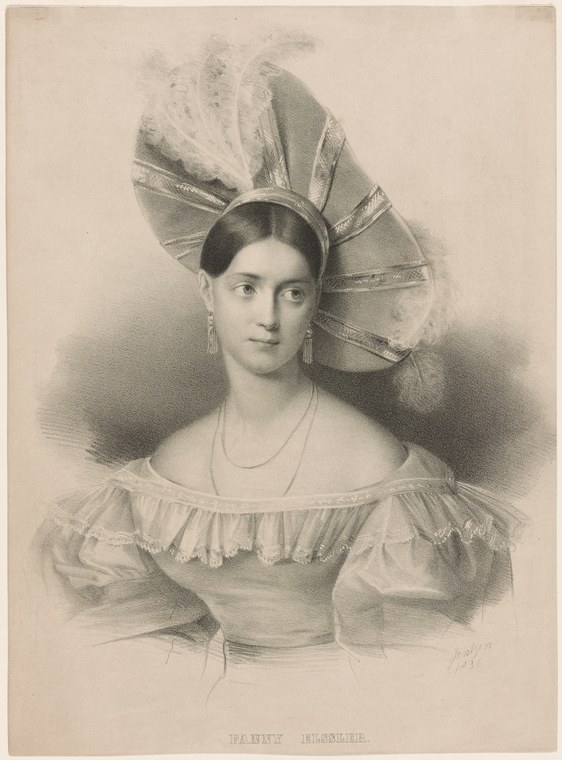
Fanny Elssler
Unknown artist
- Collection:
- Prints depicting dance
- Source:
- New York Public Library
- Rights:
- Public domain — free to use, share and adapt.
- Recorded as:
- Public Domain
Fanny Elssler was one of the two supreme ballerinas of the Romantic period—a rival to Marie Taglioni in fame and influence—and her image in costume is crucial to understanding how the Romantic ballerina was perceived and marketed. This print, circulated widely during her career, shaped the visual imagination of dance in the era and documents the costumes and theatrical presentation that defined her performances.
What you are looking at
A three-quarter-length portrait of a young woman in Romantic-era dress, shown from approximately the waist up against a plain background. She wears a white, off-shoulder gown with dramatically voluminous short sleeves gathered at the bicep, and a deep neckline trimmed with gathered white fabric. Most striking is her headdress: a large, fan-shaped structure of pleated or fluted material that rises from a band around her head, spreading outward and upward in an elaborate radiating pattern, as though constructed from thin, stiffened white or pale fabric. Her dark hair is parted and smoothed back beneath this ornament. The pose is formal and frontal, with her gaze directed outward in a direct but gentle expression. The rendering is in fine pencil or engraving technique, with careful attention to the sheen and texture of the fabrics, the delicate modeling of her face, and the intricate patterning of the headdress. The overall effect is one of studied elegance and theatrical presentation.
The dancing
The figure is stationary and posed rather than caught in movement. The shoulders are squared and still; the arms are not visible beyond the short, voluminous sleeves, placed at rest or relaxed at the sides. There is no indication of weight shift, extension, or the dynamic tension of a body in motion. The posture is upright and formal, befitting a portrait meant to display costume and ornament rather than the dancer's technical capability or the nature of any performance.
The dance depicted
This is a portrait of Fanny Elssler, the celebrated Austrian dancer of the Romantic era (early to mid-19th century), known for her technical brilliance in ballet and for the creation of character dances, most famously the Cachucha. The image appears to be a costume portrait or character study rather than a documentary of her in performance. The elaborate headdress and white gown suggest a theatrical costume, possibly from one of her famous roles, though the static, formal pose and the portrait convention prevent us from seeing the actual movement or style of her dancing. Elssler was renowned for her elevation, speed, and earthy, sensual performance quality—qualities this image cannot convey.
How it was made
This is a fine engraving or steel engraving, likely produced in the 1830s–1840s when Elssler was at the height of her fame. The technique involved careful crosshatching and fine linear work to model form, create texture in the fabrics, and render the delicate features of the face and the intricate pleating of the headdress. This reproductive print medium allowed for relatively inexpensive mass production and wide distribution, making Elssler's image available to the theatre-going public and enabling her iconic status. Such prints were common merchandise associated with celebrated performers and served both as souvenirs and as a form of publicity.
About this work
This is a formal portrait engraving of Fanny Elssler in theatrical costume, probably dating from the 1830s or 1840s. It captures not her dancing but her presence and the glamor of her stage costume—the exquisite white dress, the extraordinary pleated headdress, and her composed, direct gaze. As a printed image, it is a document of how a famous Romantic-era ballerina was marketed, remembered, and visualized by the public; it tells us something about the aesthetic of the era, the importance of costume and spectacle, and the celebrity status of the prima ballerina. The image belongs in a dance archive not because it depicts the act of dancing, but because it is an iconic portrait of one of the period's most influential dancers and a record of how she presented herself to the world.
How to look at it
This is a costume portrait, not a movement study, so the viewer should attend to the details of dress and presentation. Notice the extreme artificiality and height of the headdress—a construction that could not have been comfortable but was designed to catch light and draw attention from the stage. The off-shoulder neckline and the short, gathered sleeves were fashionable in the 1830s and became synonymous with the Romantic ballerina's silhouette. The calm, composed expression and direct gaze are characteristic of early 19th-century portrait convention; the face and posture convey dignity, refinement, and a kind of composed authority rather than joy or abandon. This is how a celebrated performer wished to be seen and remembered: not in the heat of performance, but as an elegant, composed, almost regal figure.
The artist
The artist is not recorded. This appears to be a professional portrait engraving made during Elssler's performing career, likely commissioned by her management or a publisher to capitalize on her celebrity. Elssler's fame was international; she performed across Europe and in America, and her image was reproduced in multiple formats and by multiple hands. The quality and care of this engraving suggest a skilled practitioner working for a reputable publisher, but without inscription or signature visible in the impression shown, attribution is not possible.
The period
This portrait belongs to the height of the Romantic ballet, approximately 1830–1845. This was the era of the ethereal sylph, of the ballerina en pointe, of the dominance of the female dancer and the eclipse of the male dancer from the center of attention. Elssler emerged as the great rival to Marie Taglioni, with a style emphasizing technical precision, playfulness, and sensuality in contrast to Taglioni's spirituality and otherworldliness. Character dances—national and exotic dances incorporated into ballets—were a key vehicle for Elssler's stardom, and her famous Cachucha (a Spanish dance) was a signature role. In this period, the ballerina's image became a commodity: lithographs, engravings, and other prints of celebrated dancers were sold as souvenirs, collected, and displayed. The headdress visible here—elaborate and theatrical—is characteristic of costumes designed for stage effect and visibility from a distance.
Where it lives
This print is held in the New York Public Library's collection of prints depicting dance. It is a printed reproduction, probably from the 1830s or 1840s, and may exist in multiple impressions.
Dance in this work
Questions about this work
Who was Fanny Elssler?
Fanny Elssler (1810–1884) was an Austrian ballerina and one of the two supreme dancers of the Romantic era, rivaling Marie Taglioni in fame and influence. She was celebrated for her technical virtuosity, her earthy and sensual performance quality (in contrast to Taglioni's ethereal style), and her signature role in the Cachucha, a character dance with Spanish flavor. She performed across Europe and toured the United States, where she achieved legendary status.
What is the headdress she is wearing?
The elaborate pleated fan-shaped structure is a theatrical headdress, likely designed for a specific character role or costume. Its exact purpose and name are not recorded here, but such ornaments were a key element of Romantic-era stage costume, designed to be visible from the audience and to enhance the visual spectacle of the performance. It may have been part of a national or character costume, possibly related to her famous Spanish or other exotic roles.
Why is this a portrait and not a picture of her dancing?
This is a formal costume portrait made for circulation as a print, a common way to market celebrated performers in the 19th century. Such prints were sold as souvenirs and helped build the public image of famous dancers. A static portrait allowed for careful detail, fine finish, and repeated reproduction, whereas a movement study would have been harder to compose and print. The portrait tradition emphasized the performer's elegance and refinement off-stage as much as her dancing.
What dance style did Elssler perform?
Elssler was a classical ballet dancer trained in the technique of the Romantic era. She danced in full-length ballet narratives (like La Sylphide) but was especially celebrated for character dances—theatrical dances drawing on national and exotic traditions, often integrated into ballets. Her most famous role, the Cachucha, was a Spanish character dance that became her signature and a defining moment in Romantic ballet history.
More dance artwork





