49 works in this view — arrow keys or swipe to move between them.
Dance in Art
Men dancers and choreographers in prints
Unknown artist
- Collection:
- Prints depicting dance
- Source:
- New York Public Library
- Rights:
- Public domain — free to use, share and adapt.
- Recorded as:
- Public Domain
This image documents the physical and sartorial ideals of male ballet performance in the Romantic era, showing how dancers were trained to embody noble bearing and composed restraint. For dance historians, it is a primary source for understanding costume, posture, and the visual presentation of masculinity in 19th-century theatrical dance. The print's existence in the New York Public Library collection confirms that such images were widely circulated and valued as records of professional practice.
What you are looking at
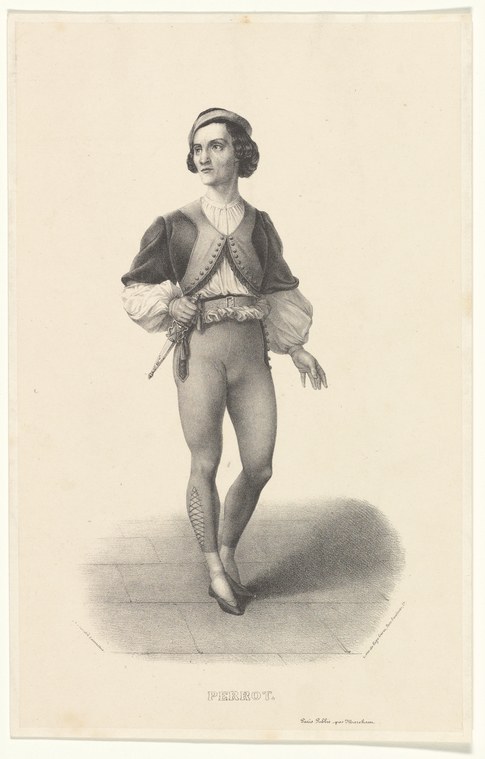
A single male dancer stands in a neutral pose against a plain background, rendered in a formal engraved or lithographed style typical of 19th-century theatrical prints. He is dressed in the costume of a Romantic-era ballet performer: a fitted dark jacket with a short cape or pelisse over the shoulders, white tights, and soft ballet slippers. His upper body is turned slightly, with his gaze directed upward and to the side in a classically composed attitude of noble pensiveness. His arms hang naturally at his sides, one hand resting near his hip. The figure is positioned in three-quarter view, standing on what appears to be a shallow stage platform rendered by subtle shading beneath his feet. The composition is clean and didactic—a study of the costume and bearing of a male dancer from the period, with no narrative action or setting beyond the dancer himself.
The dancing
The single figure exhibits a relaxed standing position with weight evenly distributed, the body in soft alignment typical of ballet carriage. Both arms are lowered, one slightly extended toward the hip; there is no tension in the frame and no indication of active movement—this is a posed presentation rather than a captured moment of dance. The head is held with the formal noble bearing expected of male ballet dancers, the gaze directed away from the viewer. The overall impression is of a model or portrait study designed to display the costume and bodily deportment of a professional male ballet dancer.
The dance depicted
This is a print of a male ballet dancer in the Romantic era costume, likely from the mid-19th century. The soft ballet slippers, tight knee-breeches, and short tailored jacket are hallmarks of the male dancer's dress during the Romantic period (roughly 1830s–1870s). The print appears to be a costume or role study—a theatrical documentation print rather than a scene from a specific ballet. Such prints were made to record how dancers of note appeared in signature roles, serving as a visual archive of performance practice and costume detail. The figure's static pose and formal presentation suggest this is a study of the costume and bearing rather than a depiction of choreography or movement.
How it was made
This is a black and white engraving or lithograph, likely produced in the mid-19th century for wide theatrical circulation. The fine, delicate line work and the subtle tonal modeling of the fabric suggest engraving; the signature area at the bottom indicates publication or print attribution. Such prints were produced in series and sold both as theatrical souvenirs and as reference documents for dancers, choreographers, and designers. The technique allowed for rapid reproduction and wide distribution, making images of celebrated performers and their costumes accessible to a theater-going public eager for visual records of the stars they admired.
About this work
This is a formal theatrical print documenting the appearance of a male ballet dancer in Romantic-era costume. It belongs to a long tradition of performance portraiture that treated dancers' bodies and dress as objects worthy of fine-art printmaking. Such works served multiple purposes: souvenirs for theater patrons, reference materials for costume makers and dancers, and visual records of how the dancers of a given era were trained to stand and move. The print captures a moment in the history of the male dancer's role—a period when male ballet performers in Europe were increasingly defined by athletic prowess and noble carriage rather than by the virtuosity of their female counterparts.
How to look at it
Study the costume in detail: the cut of the jacket, the finish of the tights, the style of the slippers. These are precise records of what dancers actually wore. Notice the posture—the alignment of the spine, the placement of the head, the carriage of the arms—as an idealized model of how a male ballet dancer was expected to stand when not in motion. The upward gaze and the slight turn of the body convey the emotional register of Romantic ballet: introspection, nobility, a presence that acknowledges the viewer but does not engage directly. This is a teaching image as much as a portrait: it shows the aspirant dancer what to aim for.
The period
This print was made during the height of Romantic ballet in Europe (1830s–1870s), when the genre's aesthetic ideals—ethereal heroines en pointe, noble and composed male partners—were fully established. Male dancers occupied a paradoxical position: essential to the narrative and the partnering of the era's greatest works, yet increasingly subordinated visually and narratively to the female dancer. Prints like this one served to assert the male dancer's presence and professionalism, documenting their training, costume, and bearing as worthy subjects for artistic representation. The engraved medium itself—expensive and formal—suggests that this work was created for a cultivated audience interested in the technical and visual dimensions of ballet.
Where it lives
Held in the New York Public Library's collection of prints depicting dance. The work is catalogued under a general heading without attribution to a specific artist or detailed date, suggesting it is one of many such prints acquired as a collection or archive rather than as an individual masterwork.
Dance in this work
Questions about this work
What era of ballet is this dancer wearing?
This is the costume of the Romantic era, roughly 1830s–1870s. The soft ballet slippers, white tights, fitted dark jacket, and short cape are standard dress for a male ballet dancer of that period. By contrast, male ballet dancers of the Classical era (late 19th century onward) wore different silhouettes and decorative elements, and dancers of the Renaissance and Baroque periods wore court dress entirely.
Is this a portrait of a specific dancer?
The catalogue record does not identify a sitter, and the print itself bears no artist's name or dancer's name visible in the image. It is likely a type study—a record of the costume and bearing of a male ballet dancer of the period—rather than a portrait of an individual celebrated performer. Many such prints were produced in series.
Why is he standing still if this is a dance image?
This is a costume or role study, designed to show how a dancer appeared in the theater. The static pose allows for precise documentation of the costume, posture, and bearing expected of a male ballet dancer. It is not intended to capture a moment of choreography, but rather to establish the visual standard of the profession.
How was this print made?
Based on the image, this appears to be an engraving or lithograph—a black and white reproductive print that could be produced in quantity and sold as a theatrical souvenir or reference material. The fine line work and subtle tonal effects suggest the precision of engraving.
More dance artwork





