49 works in this view — arrow keys or swipe to move between them.
Dance in Art
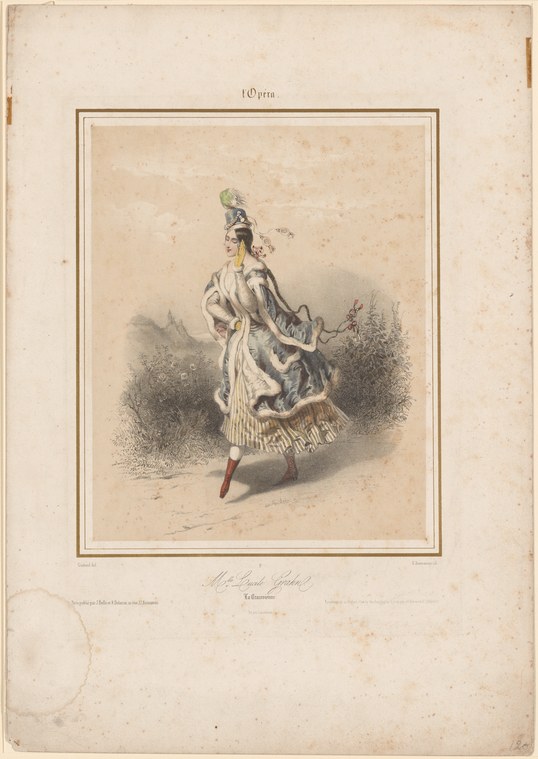
Mlle. Lucile Grahn: La cracovienne
Unknown artist
- Collection:
- Prints depicting dance
- Source:
- New York Public Library
- Rights:
- Public domain — free to use, share and adapt.
- Recorded as:
- Public Domain
Lucile Grahn was a historical figure of major importance in Romantic ballet, and this image documents both her presence and the visual conventions by which Romantic dancers presented themselves and their roles. The *Cracovienne* and similar character dances were part of the broader Romantic fascination with folk and national identity, and this image shows how that fascination was translated into stage costume and persona.
What you are looking at
A young female dancer in theatrical dress stands alone against a loosely sketched landscape background. She wears a white or cream-colored tunic with draped sleeves and a decorative belt, over which falls a patterned skirt with bold geometric or folk motifs in darker tones. A tall feathered headdress crowns her head. Her posture is upright and formal, weight settled on one leg, the other slightly bent, arms held at her sides with relaxed hands. The figure is rendered in a three-quarter view, and the artist has used light wash and line work to suggest movement in the drapery of her costume while keeping the body itself relatively still and posed. The background is minimal—distant trees or landscape elements sketched faintly—which isolates the dancer as the sole subject of attention. The overall effect is that of a theatrical costume study or portrait of a performer in character.
The dancing
A single dancer, weight distributed in a standing pose with one leg slightly bent and forward, suggesting a moment of rest or transition rather than active movement. The arms hang naturally at the sides, hands open and relaxed. The head is held upright beneath the headdress. The body shows no extreme extension or contraction; the posture is upright and dignified. The silhouette is created primarily by the costume's volume and drape rather than by active body articulation.
The dance depicted
The title names this as *La Cracovienne*, a Polish courtship dance in moderately quick triple time that was fashionable in European ballrooms and theatrical performances in the 19th century. The cracovienne was often danced by couples and was characterized by rhythmic footwork and turning movements. The costume—the feathered headdress, the patterned skirt, and the draped tunic—follows the Romantic-era convention of theatrical dress that suggested national or folk identity without strict historical accuracy. The pose is static and presentational rather than kinetic, typical of 19th-century dance portraiture, which froze a single moment or attitude rather than capturing movement mid-phrase.
How it was made
This is a hand-colored lithograph or engraving, executed in outline with watercolor wash. The technique allows for subtle gradation in the fabrics and skin tones while maintaining sharp definition of the costume details and headdress. The border and typography indicate a commercial print, likely one of a series of theatrical performers or dances, produced for distribution and collection. The combination of tonal wash with fine line work was standard for mid-19th-century dance imagery and theater ephemera.
About this work
This is a portrait of the dancer Lucile Grahn, a celebrated performer of the Romantic ballet era, shown in the costume of the *Cracovienne*, a popular character dance of the period. The print preserves both the dancer's likeness and the theatrical dress that defined her performance in this work. Grahn was one of the most prominent ballerinas of her time, and images such as this circulated widely in theaters and among enthusiasts of dance and theater. The work sits at the intersection of portraiture, theatrical documentation, and dance promotion—it is both a record of how the dance was dressed and performed and a marketable image of a celebrated artist.
How to look at it
Note the stillness of the body: this is not a captured mid-movement moment but a posed presentation of the dancer as a character. The artist has devoted most of the visual attention to the costume—the patterning of the skirt, the volume and drape of the tunic, the elaborate headdress—which tells us that the visual spectacle of the dress was central to the performance. The minimal background keeps all focus on the figure itself. This is a work designed to be viewed closely, to read the details of costume, and to recognize the dancer's face and bearing.
The artist
The artist is not recorded in the catalogue. The print bears no visible signature or attribution. It is likely the work of a commercial lithographer or engraver associated with a theater or print publisher in Paris or London, where such dance and theatrical imagery was produced in significant quantity during the 1830s–1850s. The style is consistent with the work of theater illustrators of the period.
The period
This image dates to the height of Romantic ballet, when European audiences were captivated by narrative ballets featuring supernatural or exotic subjects. The 1830s–1850s saw a proliferation of character dances—stylized versions of folk, national, and historical dances performed in theatrical contexts as divertissements within longer works. The *Cracovienne* was one of many such dances that allowed star performers like Grahn to display technical skill while also offering audiences a sense of cultural tourism. Simultaneously, the commercial circulation of dance prints and lithographs created a new market for theatrical imagery, making dancers' faces and costumes recognizable to audiences far beyond those who could attend live performances.
Where it lives
The print is held in the New York Public Library's collection of prints depicting dance, a collection formed to document the history of dance performance and its representation in visual media. It is a commercial theatrical print, likely issued singly or as part of a series of performer portraits.
Dance in this work
Questions about this work
Who was Lucile Grahn?
Lucile Grahn (1819–1907) was a Danish-Swedish ballerina and one of the most celebrated performers of the Romantic era. She danced with major European companies including the Paris Opera and created roles in important ballets of her time. She was known for her technical virtuosity and her ability to perform both classical and character roles.
What is the Cracovienne?
The Cracovienne is a stylized ballroom and theatrical dance based on Polish folk traditions, performed in triple meter. In the 19th century, it was incorporated into ballets and ballroom repertoires as a character or national dance. Performers such as Grahn danced it as a solo or in ensemble, often as a featured moment within a longer work.
Why do 19th-century dance prints show dancers posing rather than moving?
Lithographic and engraving techniques were slow and labor-intensive, making it impractical to capture true movement. Theatrical prints instead showed a characteristic pose or 'attitude'—a single moment that conveyed the dancer's identity, the dance, and the costume without requiring motion. These posed portraits also served as recognizable likenesses for marketing and fan circulation.
How accurate is the costume to actual Polish dress?
The costume is theatrical, not ethnographic. Romantic-era designers drew inspiration from folk traditions but adapted them for the stage—brightening colors, exaggerating silhouettes, and adding theatrical elements like the feathered headdress. The goal was visual impact and audience pleasure rather than historical fidelity.
More dance artwork





