49 works in this view — arrow keys or swipe to move between them.
Dance in Art
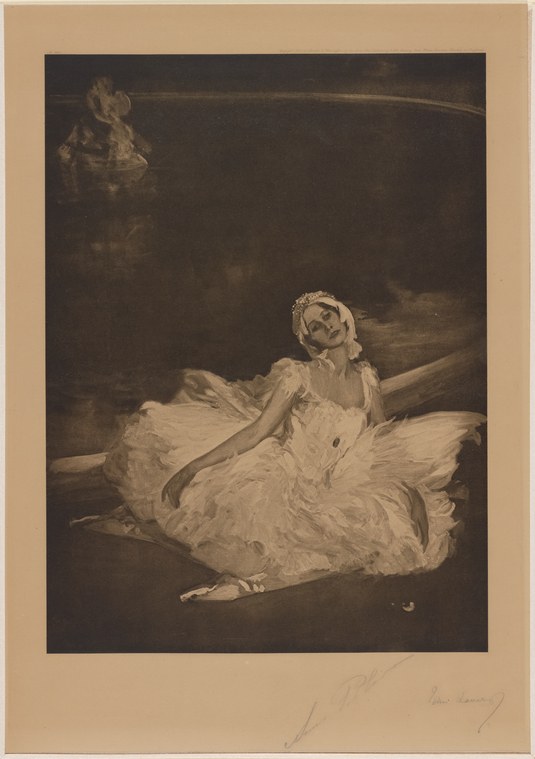
The dying swan
Unknown artist
- Collection:
- Prints depicting dance
- Source:
- New York Public Library
- Rights:
- Public domain — free to use, share and adapt.
- Recorded as:
- Public Domain
The image documents and aestheticizes the moment when Romantic ballet, in the person of Anna Pavlova and the innovative choreography of Michel Fokine, discovered that a single gesture—not a sequence, not a narrative arc, but a single arrested pose of surrender—could contain the full emotional and philosophical weight of a work. For students of ballet and dance history, this print is evidence of how the swan became the supreme emblem of the art form itself, and how a dancer's body at rest could become more expressive than in motion.
What you are looking at
A solitary female dancer reclines across the composition in an attitude of expiration or final collapse, her body fully extended and supported by one arm. She wears a light, voluminous tulle skirt and fitted bodice with decorative detail at the neckline—the costume of classical ballet. Her head is turned slightly upward and back, her face marked by shadow, her body inclined at an acute angle to the ground plane, one leg extended fully behind. The setting is a dark, indeterminate space rendered in rich brown and black tones; a faint curved arc or stage border appears in the upper portion of the composition. The light source, warm and directional, falls across the dancer's torso and face, creating sharp contrasts of shadow and highlight that emphasize the fragility and stillness of the pose. This is the final moment of a dying figure—the moment of surrender or death itself.
The dancing
A single dancer, alone in the frame. Her weight rests primarily on her upstage arm, which is bent at the elbow and planted to support her torso; her downstage arm lies across her body. One leg extends fully behind her, en relevé or en pointe—the supporting leg of the pose; the other appears to extend or lie forward, completing the extreme arching line from head to toe. The head is tilted back, the face expressionless or anguished. There is no dynamism here: every muscle appears to be giving way. The posture is neither the controlled artificiality of a classical position nor the balletic line of an active movement, but rather the grammar of collapse—a body at the threshold between life and stillness.
The dance depicted
This is almost certainly Giselle's death scene or, more likely, the death of the swan—possibly the Russian Imperial version of 'La Mort du Cygne' made famous by Pavlova, or the Danish Romantic ballet tradition of swan imagery. The title 'The dying swan' points to Pavlova's signature role, created by Fokine in 1905; this print may document or be inspired by that work or the broader late-Romantic fascination with the swan as symbol of beauty, grace, and mortality. The pose—the extended arabesque merged with collapse—is neither pure classical ballet nor narrative mime, but rather the liminal gesture invented by early 20th-century theatrical dance to collapse beauty and death into a single, unforgettable image. The artist captures not a step or sequence but an arrested moment of dramatic meaning.
How it was made
This is a monochromatic print, most likely an etching or engraving, distinguished by the fine tonal gradations and selective use of lighter grounds to render form. The technique allows for the sensitive modeling of fabric—the tulle catches light in feathery, diffuse strokes—and the dramatic chiaroscuro that concentrates emotion in shadow and highlight. The signature or mark visible in the lower right suggests a single artist's hand. The print appears to have been made for circulation among educated patrons familiar with ballet and theatrical arts; its size and finish suggest it was a standalone image rather than book illustration, likely intended as a collectible artwork for a drawing room or gallery.
About this work
This print preserves a single, supreme moment from early 20th-century Romantic ballet theater: a dancer portrayed at the instant of expiration, her body still arranged in the grammar of classical dance even as it surrenders to stillness. The image belongs to a tradition of theatrical documentation—etchings and engravings that captured the great roles and signature moments of the Imperial stage—yet transcends mere record to become itself a meditation on beauty and mortality. The work sits at the threshold between dance documentation and fine art, where the precision of the printmaker's hand and the dancer's bodily discipline merge to create a single, permanent image of beauty seized at its moment of ultimate fragility.
How to look at it
Attend first to the extreme fragility of the pose: the way the supporting arm bends under the weight of the body creates a sense of imminent collapse rather than sustainable balance. Notice how the printmaker has used shadow to render the vulnerability of the exposed torso and throat, and how light catches the tulle in a way that suggests lightness and immateriality even at the moment of heaviest weight. The turned-away face and closed or barely open eyes invite the viewer into a private moment of dying, a convention inherited from 19th-century Romantic painting but here made specific to dance through the precision of the ballet costume and the articulation of the body's line.
The period
This print was almost certainly made in the early 20th century, during or shortly after the height of the Russian Imperial Ballet's influence on European and American theatrical taste. Anna Pavlova's 'The Dying Swan' (1905) became the most iconic solo in ballet history, performed thousands of times and earning such renown that obituaries identified her by reference to the role. The image reflects the broader Romantic fascination with death, nature symbolism, and the female body in states of vulnerability—themes central to the symbolist and decadent movements in visual art and literature of the period. Theatrical prints of this kind were a major form of celebrity culture and artistic circulation before cinema; they documented and popularized the great dancers and performances of the day.
Where it lives
Held in the New York Public Library's collection of prints depicting dance. The print appears to be a separate artwork circulated independently, likely acquired as a fine art object or celebrity keepsake rather than as part of a larger series or publication.
Dance in this work
Questions about this work
Is this Pavlova's 'Dying Swan'?
The title and the pose point unmistakably toward that work or works in its tradition. However, without a signature or publication mark, we cannot confirm that this print documents Pavlova specifically or was made from life. It may instead be inspired by or created in homage to that iconic role, or part of the broader theatrical tradition of swan imagery in ballet.
Why did the dying swan become so famous?
The role combined technical balletic mastery with emotional directness and symbolic power: the swan became an emblem of beauty, grace, and tragic mortality all at once. Pavlova danced it thousands of times and made it her signature, cementing it as perhaps the most recognizable image in ballet history. For audiences, the four-minute solo offered a complete emotional and philosophical statement: life, struggle, and peaceful surrender, all in a single gesture.
What printmaking technique is this?
From the fine tonal gradations and the way line and shadow work together, this appears to be an etching or engraving—likely the former, given the subtlety of the tonal effects. Both techniques allowed for sensitive rendering of fine details like the tulle skirt while building dramatic chiaroscuro through selective inking and wiping.
Was this made from a photograph?
That is possible but cannot be determined from the image alone. The printmaker may have worked from a photograph, from life study, or from memory and artistic imagination. The extreme clarity of certain details (the tulle, the facial features) suggests close observation, but the selective focus and heightened emotional intensity suggest artistic interpretation rather than literal transcription.
More dance artwork





