49 works in this view — arrow keys or swipe to move between them.
Dance in Art
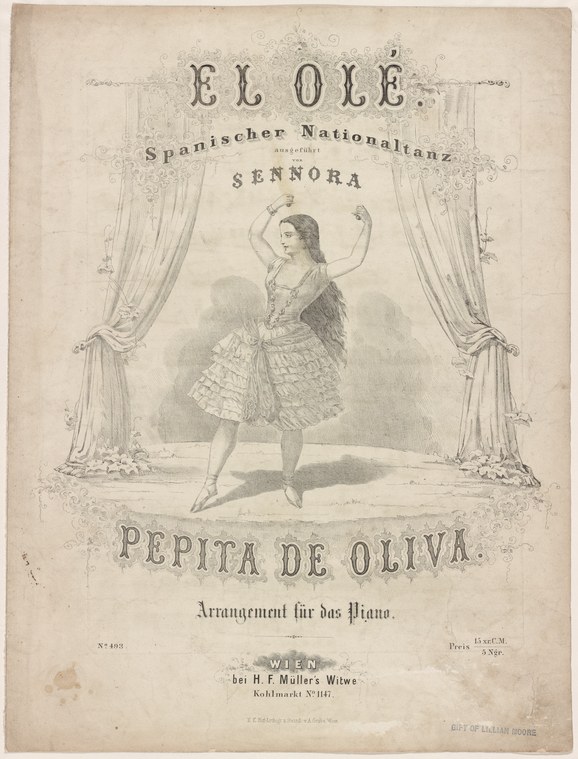
El olé: Spanischer Nationaltanz ausgeführt von Sennora Pepita de Oliva. Arrangement für das Piano
Unknown artist
- Collection:
- Prints depicting dance
- Source:
- New York Public Library
- Rights:
- Public domain — free to use, share and adapt.
- Recorded as:
- Public Domain
This image is one of the few named records of a professional Spanish dancer's performance in nineteenth-century Vienna, capturing both the visual and commercial dimensions of how flamenco traveled and was adapted for Central European audiences. For historians of flamenco, women performers, and theatrical dance, Pepita de Oliva is nearly invisible except in such ephemeral commercial prints—making this sheet-music cover a rare primary document of her labor and visibility.
What you are looking at
A woman in mid-nineteenth-century theatrical costume performs a Spanish national dance on a stage framed by ornate proscenium curtains. She wears a short, tiered skirt with decorative trim characteristic of Spanish flamenco dress, a fitted bodice, and her hair is styled in a long arrangement down her back. Her pose is a moment of dynamic movement: her body is angled to the left, both arms raised and bent at the elbow in expressive gestures, her right leg appears to be engaged in footwork while her weight shifts. The setting is decidedly theatrical—the curtains are drawn back to reveal the performer alone against a neutral background, lit to emphasize her figure and costume. This is a sheet-music cover, indicating the piece was composed for piano arrangement and was commercially distributed across the German-speaking world.
The dancing
A single female dancer occupies center stage, her posture energetic and assertive. Both arms are raised to approximately shoulder height, with elbows bent and hands extended in an open, animated gesture. Her torso twists slightly, and her legs are in motion—the stance is neither fully grounded nor balletic, but rather caught mid-turn or mid-step with the weight shifting forward. The positioning suggests rapid footwork and hip movement, with the lower body engaged while the upper body remains expressive and articulate. Her gaze is directed toward the audience, acknowledging the performer's awareness of spectators.
The dance depicted
This is a theatrical representation of the Spanish national dance called el olé, an early commercial Europeanization of flamenco idiom performed in concert and ballroom contexts during the nineteenth century. The title identifies the performer as Señora Pepita de Oliva, a professional dancer active in Vienna and Central Europe in the mid-1800s. The painting captures the standardized theatrical version of Spanish dance as performed for German and Austrian audiences: more controlled and costumed than folkloric flamenco, but retaining the expressive arm and hand movements, the rapid footwork suggested by stance, and the costume markers. The arrangement "für das Piano" (for piano) indicates this was part of a broader commercial circuit of Spanish-themed concert music and theatrical spectacle.
How it was made
This is a lithographic print, recognizable from the tonal gradations, the fine linear work in the curtain draping, and the way the figure is rendered in gray washes against the light background. Lithography allowed for rapid commercial production and distribution of theatrical images—this work was published by H. F. Müller's Witwe (widow) in Vienna, suggesting it was marketed as a souvenir or promotional item tied to live performance. The technique enabled both the fine detail in costume and facial features and the broader compositional framing that emphasizes the stage architecture.
About this work
This is a mid-nineteenth-century lithographic sheet-music cover documenting a professional performance of Spanish national dance in Vienna. It records both the costume and bodily style of theatrical flamenco as it circulated through Central European concert halls and ballrooms, and names the performer—Pepita de Oliva—whose career in Vienna is otherwise sparsely documented. The work sits at the intersection of theatrical spectacle, commercial music publishing, and the early European fascination with Spanish dance as exotic entertainment. It belongs in the study of how flamenco became internationalized and refashioned for non-Spanish audiences, and how women performers like Oliva navigated the circuits of European concert and ballroom culture.
How to look at it
Attend to the moment the artist chose to freeze: this is not a static pose but a frame from continuous rapid movement, with the arms in mid-gesture and the body clearly in transition. Notice how the costume—the short, tiered skirt and fitted bodice—emphasizes the lower body and allows visibility of the legs and footwork. The raised, expressive arms and open hand position were markers of Spanish theatrical dance, distinct from the ballroom closed holds of Central European dances. The staging within the ornate proscenium frames this as professional concert performance, not social dancing.
The period
The 1840s-1860s saw the emergence of Spanish dance—especially the generalized theatrical version known as cachucha, bolero, and el olé—as fashionable concert entertainment across Western Europe. Professional female performers brought Spanish movement vocabulary to Vienna, Paris, London, and other major cities, where they were integrated into the broader culture of ballroom music, concert spectacle, and musical theater. Spanish themes were part of the broader Romantic-era appetite for exoticism and "national" character dances. In Vienna especially, the waltz and new quadrille forms coexisted with fascination for Spanish, Hungarian, Polish, and other regional dances—all refashioned for concert and ballroom consumption. Publishing houses capitalized on this demand by producing sheet music and promotional imagery tied to popular performers.
Where it lives
The print is held by the New York Public Library as part of the Prints depicting dance collection. It is a commercial theatrical souvenir and sheet-music cover, one of many such items produced by Viennese and German music publishers in this era.
Dance in this work
Questions about this work
Who was Pepita de Oliva?
She was a professional Spanish dancer active in Vienna in the mid-nineteenth century. Beyond this sheet-music cover and related promotional materials, documentary evidence of her career is sparse. She performed theatrical versions of Spanish national dances—el olé, cachucha, bolero—in concert halls and ballrooms. Her prominence enough to be named on commercially published sheet music indicates she had achieved some fame in Viennese entertainment circles, but she remains a largely undocumented figure.
What is the difference between el olé and flamenco?
El olé was a theatrical and concert-hall adaptation of Spanish dance movement and music, created for European audiences who had not experienced Spanish folkloric forms firsthand. It retained the rapid footwork, expressive arm gestures, and emotional intensity of flamenco but was performed on concert stages in costume, accompanied by piano or small orchestras, and refined for non-Spanish spectators. It was part of a broader European fantasy of Spain as exotic and passionate, rather than a transmission of flamenco as it was practiced in Spain.
Why was this sheet music published in Vienna?
Vienna in the mid-nineteenth century was a major center of musical publishing and ballroom culture. Spanish dance was fashionable among Vienna's concert-going and dancing public. Publishing the arrangement of the music allowed both the general public and music students to access and perform arrangements of the popular numbers, extending the performer's reach beyond those who could attend live performances. The sheet-music cover served as both a commercial product and a promotional image for the performer.
How does the costume indicate the style of dance?
The short, tiered skirt allows visibility and movement of the legs—essential for showing rapid footwork. The fitted bodice and long hair create an expressive upper body and a visual line from shoulders to hips. These elements differ markedly from the full-length skirts and tighter constraint of contemporary ballroom and theatrical-ballet costume, signaling to the viewer that this is a different movement vocabulary. The tiered, frilled construction itself became a visual marker of Spanish national dance in nineteenth-century European imagery.
More dance artwork





