49 works in this view — arrow keys or swipe to move between them.
Dance in Art
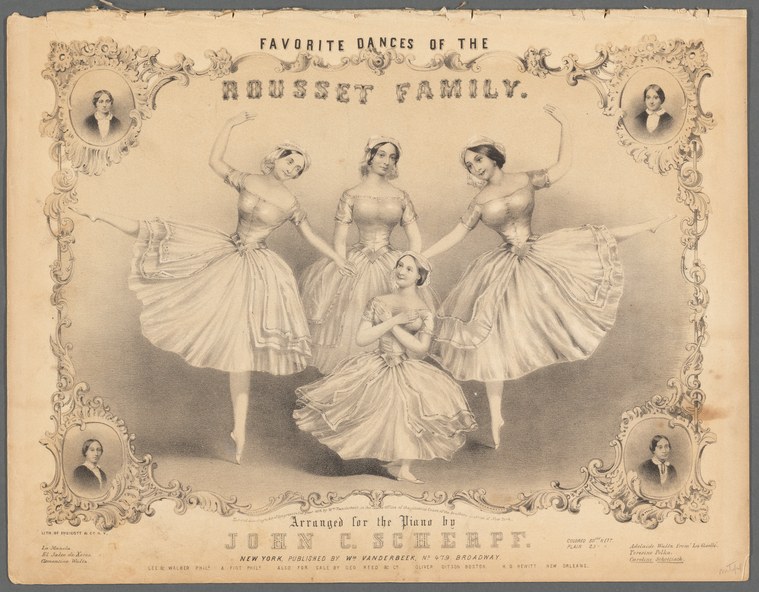
Favorite dances of the Rousset family, arranged for the piano by John C. Scherpf
Unknown artist
- Collection:
- Prints depicting dance
- Source:
- New York Public Library
- Rights:
- Public domain — free to use, share and adapt.
- Recorded as:
- Public Domain
This reveals how ballet style was domesticated and made available to middle-class households through published music and imagery. The association of the Rousset name with these dances, and their publication as a named collection, shows how family reputation and dance repertory were commercially bound together in 19th-century America.
What you are looking at
This is a lithographed title page for a published collection of piano arrangements. Four female dancers in mid-19th-century costume dominate the composition: three stand upright in classical ballet poses wearing voluminous tulle skirts, while a fourth sits or reclines in the foreground, also in tulle. All wear the fitted bodices and hair styles typical of 1850s theatrical dress. The figures are arranged in a pyramidal composition against a plain background, framed by an ornate rococo border of scrolls and flourishes. In the upper corners are two portrait medallions of what are likely the arrangers or composers; similar portraits appear in the lower corners. The overall effect is of a theatrical souvenir or published score cover, announcing itself as a record of the Rousset family's favorite dances transcribed for domestic piano performance.
The dancing
The three standing figures adopt classical ballet attitudes: they stand en face or in three-quarter view, arms raised or positioned with the restraint of mid-19th-century technique, legs extended in pointe or near-pointe positions. The seated or reclining figure in the foreground maintains the same erect posture and arm carriage despite her lowered position. The poses are static and symmetrical rather than dynamic—the dancers are posed for display rather than captured mid-movement. All four wear the ankle-length tulle skirts, fitted bodices with off-shoulder necklines, and centered hair styles of Romantic-era ballet.
The dance depicted
The work is a score cover or title page for piano arrangements of favorite dances. The catalogue title does not specify which dances are included, only that they belonged to or were favored by the Rousset family and were arranged for piano by John C. Scherpf. The image shows Romantic ballet aesthetics—the tutus, pointe work, and classical poses—suggesting the collection likely contained ballet excerpts or popular dances in the ballet idiom rather than folk or ballroom forms. The framing as 'favorite dances' and the emphasis on the Rousset family name suggest these were either dances performed by family members or dances popular in their social circle, published here as a record of their repertory.
How it was made
This is a lithograph, identifiable by the soft tonal modulation, the way the figures emerge from the background without hard outlines, and the characteristic gray-brown paper stock. The ornamental border and the delicate handling of the tulle suggest a commercial press, likely New York based on the imprint information visible at the bottom. Lithography allowed for wide distribution of such images—they served as both musical scores and theatrical souvenirs, advertising the dances and the family's association with them to a middle-class domestic audience who might purchase the piano arrangements.
About this work
This is a published piano score cover from mid-19th-century America, announcing a collection of ballet-style dances arranged for home performance. The Rousset family were likely theatrical dancers or came from a theatrical background; this publication commemorates their repertory. The image is valuable as evidence of how Romantic ballet aesthetics circulated in domestic culture—not just in theaters but in drawing rooms where amateur pianists would perform arrangements of fashionable dances. The work sits at the intersection of theatrical dance history, publishing history, and the social history of music-making in the American home.
How to look at it
Observe how the dancers are posed rather than captured in action. Their postures are formal and symmetrical, designed to display the Romantic ballet silhouette—the long leg line, the slight turnout, the upright carriage, the delicate arm positioning. Note the careful attention to the tulle: each skirt is rendered with fine parallel lines suggesting its volume and translucency, a key marker of ballet costume. The rococo border frame treats the dancers as precious objects worthy of ornamentation, elevating domestic music-making to an art-form status.
The artist
John C. Scherpf is credited as the arranger (not the composer or choreographer). His role was to transcribe existing dances—likely ballet excerpts or popular social dances—for piano solo or piano and voice, making them playable in the home. Such arrangers were crucial figures in 19th-century musical culture, serving as intermediaries between the concert hall and the parlor. No artist/illustrator is credited for the lithograph itself.
The period
This work dates to the height of American Romantic ballet enthusiasm, roughly 1850–1870. The Rousset family were performing during the era when ballet was becoming increasingly professionalized and commercialized in the United States, with European dancers touring and American companies forming. Simultaneously, middle-class domestic music-making was booming—pianos were becoming affordable and fashionable, and published arrangements of popular theatrical music were a major commercial category. The lithographic process made such marketing materials cheap and accessible, allowing theatrical enterprises to reach far beyond the audience that could attend live performances.
Where it lives
Held in the New York Public Library's prints collection, this is catalogued as a lithograph but classified broadly as a print depicting dance. It is one of many 19th-century musical score covers and theatrical souvenirs in American archives, valuable for what they reveal about commercial dance culture and home entertainment.
Dance in this work
Questions about this work
Who were the Rousset family?
The catalogue record does not specify. They were likely professional dancers or came from a theatrical family, and this publication was made to commemorate and commercially capitalize on their reputation and repertory. Their dances were popular enough to merit publication and wide distribution through lithographic printing.
What dances are actually in the collection?
The title page does not list them. You would need to consult the full printed score, which would show the individual pieces with their own titles. The lithographed cover is advertising and decoration; the content is in the musical pages that followed.
How was this image made?
Lithography. An image was drawn on a stone with a greasy crayon, the stone was treated with chemicals, and ink adhered only to the greasy marks. Paper was then pressed onto the stone, capturing the image. This allowed for multiple copies and fine detail at relatively low cost, making it perfect for theatrical marketing and music covers.
What does this tell us about 19th-century dance?
It shows that ballet style dominated middle-class taste, that family names were marketable assets in the dance world, and that the business of dance extended into the home through arrangements and publications. It also shows that lithography and publishing made choreography and dancers' reputations legible to audiences far beyond the theater.
More dance artwork





